February 2, 2026
.webp)

12 Essential Types of Shots in Film to Master in 2026
Explore the 12 key types of shots in film, from wide establishing shots to intimate close-ups. Learn how to master them for your NZ-based projects.
Practical Skills
minutes
The difference between an amateur video and a compelling visual story often comes down to one thing: shot selection. Understanding the various types of shots in film is like learning a new language. Each shot conveys a specific emotion, piece of information, or perspective, allowing you to guide your audience's experience deliberately.
Whether you're creating marketing content for a farming business in Canterbury, a pet grooming service in Auckland, or aiming to go pro with your photography, mastering these fundamental techniques will elevate your work. This comprehensive guide breaks down 12 essential shot types, from the intimate close-up to the expansive wide shot, explaining their purpose, emotional impact, and practical application for Kiwi creators and small business owners.
We'll provide clear definitions, concrete examples from films (including some local gems), and actionable tips to help you move beyond simple recording. You will learn to start communicating visually with intent and precision, without needing to enrol in a formal training course. Think of this as your practical toolkit for turning ideas into impactful visual narratives. For those looking to explore how these shots come together in short-form content, you might find valuable resources on the shortgenius platform. Let's dive into the foundational building blocks of visual storytelling.
1. Wide Shot (WS) / Establishing Shot
A Wide Shot (WS), often used as an Establishing Shot, is one of the most fundamental types of shots in film. It captures the subject from head to toe, along with a significant portion of their surrounding environment. The primary purpose is to establish the scene, providing the audience with crucial context about where and when the action is taking place. It answers the immediate questions of setting and scale, grounding the viewer in the story's world.

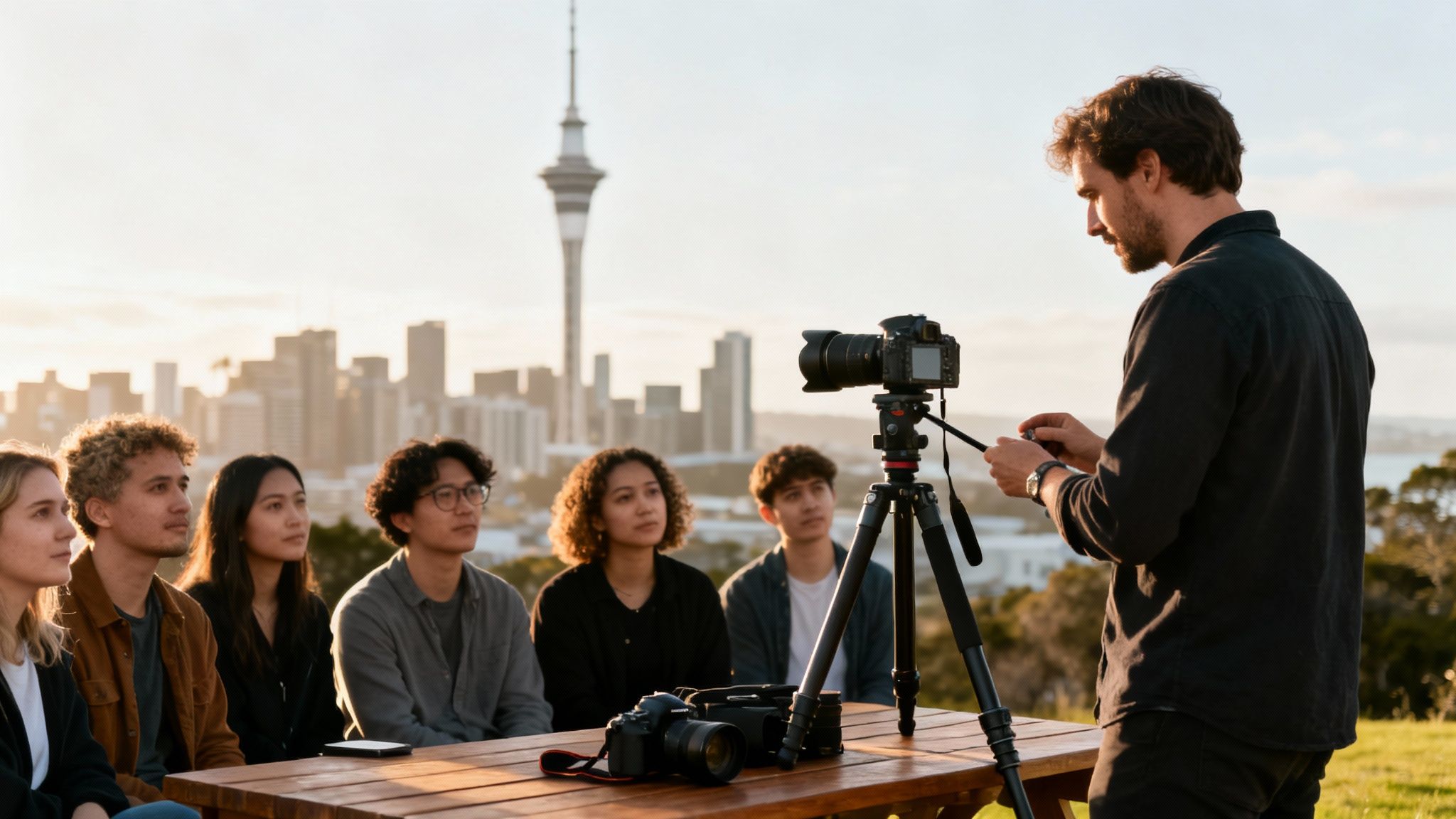
This shot is a cornerstone of visual storytelling. For instance, a sprawling aerial shot of a dairy farm in the Waikato, like in a farm-to-table documentary, immediately communicates the scale of the operation. Similarly, the opening shot of a film might be a wide view of Auckland’s skyline, instantly placing the narrative in a bustling, urban environment.
When to Use a Wide Shot
- To open a scene: Use it to orient your viewers and set the stage before moving to closer shots.
- To show scale: It’s perfect for emphasising the vastness of a landscape or the isolation of a character within it.
- To reveal relationships: By showing characters in relation to their environment, you can infer their status or emotional state.
Practical Tips for Nailing the Shot
To get the most out of your wide shots, focus on strong composition. Use natural framing elements like trees or gateways to guide the viewer’s eye toward the main subject. Think of the wide shot as more than just a setup; it's an opportunity to build atmosphere and visual interest. A well-composed wide shot can be as powerful as a dramatic close-up. For a deeper understanding of how this shot works with others, you can learn more about camera angles and shots.
2. Medium Shot (MS)
The Medium Shot (MS) is a true workhorse in filmmaking and video production, framing the subject from roughly the waist or chest up. This shot offers a perfect balance: it’s intimate enough to capture facial expressions and body language, yet wide enough to include some environmental context. This makes it one of the most versatile and frequently used types of shots in film, allowing the audience to feel connected to the subject without losing a sense of their surroundings.
Often called the "waist shot," this perspective feels natural and conversational, mirroring how we typically see people in real life. It’s the default for most dialogue scenes in narrative films and the primary shot for instructional content. For instance, a video demonstrating livestock handling or a pet grooming tutorial would heavily rely on medium shots to show both the demonstrator and the animal clearly, providing essential context while keeping the focus on the action.
When to Use a Medium Shot
- For dialogue and interviews: It’s the standard for capturing conversations, as it shows both body language and facial expressions.
- To demonstrate a process: Ideal for instructional videos where you need to see the presenter and what they are doing.
- To bridge wide and close shots: It serves as a natural transition, moving the viewer’s focus from the setting to the subject.
Practical Tips for Nailing the Shot
To create a compelling medium shot, focus on clean composition. Ensure the background is uncluttered and relevant to your subject, supporting the story rather than distracting from it. Positioning your subject slightly off-centre using the rule of thirds can add visual interest. For instructional content, combine your medium shots with closer angles to highlight specific details, like the correct technique for a task. This combination keeps viewers engaged and informed.
3. Wide Shot (WS) / Establishing Shot
A Wide Shot (WS), often used as an Establishing Shot, is one of the most fundamental types of shots in film. It captures the subject from head to toe, along with a significant portion of their surrounding environment. The primary purpose is to establish the scene, providing the audience with crucial context about where and when the action is taking place. It answers the immediate questions of setting and scale, grounding the viewer in the story's world.
This shot is a cornerstone of visual storytelling. For instance, a sprawling aerial shot of a dairy farm in the Waikato, like in a farm-to-table documentary, immediately communicates the scale of the operation. Similarly, the opening shot of a film might be a wide view of Auckland’s skyline, instantly placing the narrative in a bustling, urban environment.
When to Use a Wide Shot
- To open a scene: Use it to orient your viewers and set the stage before moving to closer shots.
- To show scale: It’s perfect for emphasising the vastness of a landscape or the isolation of a character within it.
- To reveal relationships: By showing characters in relation to their environment, you can infer their status or emotional state.
Practical Tips for Nailing the Shot
To get the most out of your wide shots, focus on strong composition. Use natural framing elements like trees or gateways to guide the viewer’s eye toward the main subject. Think of the wide shot as more than just a setup; it's an opportunity to build atmosphere and visual interest. A well-composed wide shot can be as powerful as a dramatic close-up. For a deeper understanding of how this shot works with others, you can learn more about camera angles and shots.
4. Extreme Close-Up (ECU) / Detail Shot
An Extreme Close-Up (ECU), also known as a Detail Shot, is a powerful framing technique that magnifies a specific, often minute, detail of a subject. This shot goes beyond the human face to focus on things like the texture of a fabric, the subtle twitch of an eye, or the intricate mechanics of a device. Its purpose is to direct the audience's full attention to a critical piece of information, create intense emotion, or clarify a technical process with absolute precision.

For instructional or documentary-style content, this shot is invaluable. In a video demonstrating pet grooming techniques, an ECU of a clipper trimming a dog's nails provides unmatched clarity. Likewise, a tutorial on photography might use an ECU to show the turning of an aperture dial, making the learning process clear and tangible. It's one of the most effective types of shots in film for showing, not just telling.
When to Use an Extreme Close-Up
- To demonstrate technical skills: Use it to show precise, fine motor actions, like in veterinary procedures or equipment maintenance.
- To heighten drama or emotion: An ECU of a tear rolling down a cheek or a trembling hand can convey powerful feelings without a word.
- To reveal critical details: It’s perfect for highlighting a clue in a mystery or a key feature in a product showcase.
Practical Tips for Nailing the Shot
To create an effective ECU, crystal-clear focus and stable camera work are essential. Even a slight movement can ruin the shot. Use a tripod and ensure your lighting is perfect to highlight the specific texture or detail you want to capture. This shot can feel jarring if used too often, so reserve it for moments of high impact and always follow it with a wider shot, like a medium or wide, to re-establish context for your viewer.
5. Over-the-Shoulder Shot (OTS)
The Over-the-Shoulder Shot (OTS) is a classic technique used to create a dynamic perspective in conversations and interactions. This shot frames a subject by looking over the shoulder of another person, whose back and shoulder are visible in the foreground. It immediately puts the viewer into the scene, creating a sense of participation and intimacy that is crucial for engaging dialogue. It’s one of the most effective types of shots in film for building a connection between characters and the audience.
This shot is a staple in interview content, documentaries, and instructional videos. For example, in a video demonstrating sheepdog training on a Canterbury farm, an OTS shot from the farmer's perspective looking at the dog instantly clarifies their commands and the dog's reaction. Likewise, a business mentorship video might use this shot to show a supportive conversation between a mentor and a small business owner, making the advice feel more personal and direct.
When to Use an Over-the-Shoulder Shot
- To film conversations: It’s ideal for dialogue-heavy scenes, making them feel natural and engaging.
- For instructional content: Use it to show a demonstration from a learner's point of view, such as a chef explaining a recipe to a guest.
- To build connection: It helps establish the relationship between two characters, whether it's collaborative, confrontational, or intimate.
Practical Tips for Nailing the Shot
For a polished OTS shot, ensure the foreground shoulder doesn't obscure too much of the main subject. Use a shallow depth of field to keep the main subject sharp while slightly softening the foreground element, guiding the viewer's focus. It's also crucial to pair this shot with its reverse-shot counterpart to provide balanced coverage of the conversation, creating a seamless and professional sequence.
6. Dutch Angle Shot
A Dutch Angle Shot, also known as a Dutch Tilt or Canted Angle, is a deliberate tilt of the camera so the horizon line is not parallel to the bottom of the frame. This technique creates a psychological sense of unease, tension, disorientation, or dynamic energy. Popularised by German Expressionist cinema, this is one of the more stylised types of shots in film used to disrupt the viewer's sense of stability and normalcy.
While common in thrillers to create anxiety, it can be a powerful creative tool in other contexts. Imagine filming a dynamic sequence of a shearer at work in a Wairarapa woolshed; a subtle Dutch angle could enhance the scene's energy and intensity. Likewise, a business origin story could use this shot to visually represent a moment of crisis or a pivotal, game-changing decision, adding a layer of dramatic flair to the narrative.
When to Use a Dutch Angle Shot
- To create psychological unease: It’s highly effective for conveying a character’s confusion, madness, or a perilous situation.
- To add energy and dynamism: Use it in action sequences or music videos to make the visuals feel more exciting and kinetic.
- To signal a shift: A tilt can visually signify that something is "off" or that the story is taking a turn.
Practical Tips for Nailing the Shot
The key to a successful Dutch angle is intention. Use it sparingly to maximise its impact; overuse can make your footage look amateurish. For creative storytelling, like a brand video, try combining it with stable, conventional shots for balance. This contrast will make the tilted frame more powerful when it appears, effectively signalling a moment of transition or heightened importance to your audience.
7. Pan (Camera Movement)
A Pan is a fundamental camera movement where the camera pivots horizontally, either from left to right or right to left, while its base remains stationary. It is one of the most common types of shots in film used to follow a moving subject, reveal new information, or visually connect different elements within a scene. A pan mimics the natural way we turn our heads to survey our surroundings, making it an intuitive and powerful storytelling tool.
This movement is essential for establishing a sense of space and context. For instance, a slow pan across a line of modern milking equipment in a Waikato dairy shed can showcase the scale and efficiency of the operation. Similarly, in a nature documentary, a sweeping pan across the Southern Alps can reveal the breathtaking expanse of the landscape, immersing the viewer in the environment.
When to Use a Pan
- To follow action: Keep a moving subject, like a quad bike crossing a paddock, within the frame.
- To reveal information: Start on one detail and pan to reveal a larger scene or a surprise element.
- To show relationships: Visually connect two subjects or a character and their objective within the same shot.
- To survey a location: Use it to guide the audience’s eye across a landscape or property, such as a farm or vineyard.
Practical Tips for Nailing the Shot
For a smooth, professional-looking pan, using a tripod with a fluid head is highly recommended. This prevents shaky, amateurish footage. Plan your start and end points before you begin recording, and maintain a consistent, moderate speed throughout the movement. Remember that the pan should be motivated by the story; use it to guide the viewer’s attention purposefully rather than just scanning a scene without reason.
8. Tilt (Camera Movement)
A Tilt is a vertical camera movement where the camera pivots up or down on a fixed axis, similar to nodding your head. This type of shot directs the viewer's attention along a vertical plane, making it a powerful tool for revealing information gradually, emphasising height, or showcasing the scale of a subject from bottom to top or vice versa. It’s a deliberate movement that builds anticipation and guides the audience’s gaze.
This movement is essential in various storytelling contexts. In an architectural video, a slow tilt up the side of a newly built commercial building in Christchurch can convey its impressive height and modern design. In agricultural content, a tilt shot is perfect for documenting the full stature of a prized dairy cow, starting from its hooves and moving up to its head to showcase its size and conformation. It’s one of the most effective types of shots in film for establishing vertical dominance.
When to Use a Tilt
- To reveal a subject: Slowly tilting up to reveal a character's face or an object of significance can create a dramatic or surprising effect.
- To emphasise scale: Use it to show the height of a towering tree, a tall silo on a farm, or a steep mountain range.
- To create a sense of awe: A tilt up towards the sky or a majestic structure can inspire feelings of wonder and grandeur.
Practical Tips for Nailing the Shot
For a smooth and professional tilt, a fluid head tripod is crucial. Start and end the movement with a static, well-composed shot to give the viewer an anchor point. Keep the movement slow and steady, lasting at least two to three seconds to avoid a jarring effect. This intentional pace allows the audience to absorb the visual information being presented and fully appreciate the scale you're trying to communicate.
9. Zoom (Camera Movement/Lens Technique)
A zoom is a powerful lens technique that changes the focal length during a shot, making the subject appear closer or further away without physically moving the camera. Unlike a dolly shot where the camera moves through space, a zoom magnifies or de-magnifies a portion of the frame, which can create a distinct, sometimes stylised, effect. It’s a versatile tool for directing the viewer’s attention or creating dramatic emphasis.
While sometimes associated with the action films of the 1970s, the zoom is widely used in modern filmmaking, especially in documentaries and online content. For example, a nature documentary might slowly zoom in on a tūī to reveal the intricate details of its feathers. Similarly, a product demonstration video for a piece of farm tech might use a quick zoom to highlight a specific feature or control button, making it a key technique in many types of shots in film.
When to Use a Zoom
- To direct attention: Use a slow zoom to guide the audience’s focus towards a crucial detail in the frame.
- To create intensity: A rapid "crash zoom" can heighten a moment of surprise, shock, or dramatic realisation.
- For practical constraints: It’s useful when you cannot physically move the camera closer to the subject, such as during a live event.
Practical Tips for Nailing the Shot
For a zoom to be effective, it must be motivated and deliberate. Use it sparingly to avoid distracting the viewer. A subtle, slow zoom can build tension or curiosity, whereas a fast one should be reserved for high-impact moments. Ensure your lens is capable of smooth zooming; a quality lens can make all the difference. Mastering such techniques starts with having the right equipment, so it helps to understand the best camera for photography and film work.
10. Dolly Shot / Tracking Shot (Camera Movement)
A Dolly Shot, also known as a Tracking Shot, involves physically moving the entire camera forward, backward, or alongside a subject while filming. Unlike a zoom, which magnifies the image optically, a dolly shot changes the spatial relationship between the subject and its background, creating a powerful sense of depth, motion, and immersion. This technique pulls the viewer directly into the scene, making them feel like an active participant rather than a passive observer.
This movement is fundamental to modern filmmaking and is incredibly versatile. For example, a slow dolly-in on a character’s face can heighten emotional tension, while tracking alongside a farmer walking through their paddocks can create a dynamic and engaging tour of their property. In real estate videos, a smooth dolly shot through a home’s interior provides a fluid, professional showcase that makes potential buyers feel as if they are walking through the space themselves.
When to Use a Dolly Shot
- To create immersion: Use it to guide your audience through a space, such as a workshop, studio, or farm facility.
- To build emotion: A slow push-in can intensify a moment, while a pull-out can create a sense of isolation or reveal a larger context.
- To follow action: Track alongside a moving subject, like a veterinarian doing their rounds or a dog playing at a kennel, to keep the shot dynamic.
Practical Tips for Nailing the Shot
For a smooth dolly shot, careful planning is key. Mark out the camera’s start and end points before you begin filming. Using a dedicated dolly, a slider, or a wheeled tripod will produce the most professional results, although a gimbal can also work well. Combine the movement with a voiceover to create compelling facility tours or product demonstrations. Start and end with a static frame to anchor the shot and give it a clean, polished feel.
11. High Angle Shot
A High Angle Shot is a cinematic technique where the camera is positioned above the subject, looking down on them. This perspective is a powerful tool for visual storytelling, often used to make the subject appear vulnerable, small, or insignificant within their environment. It gives the audience a sense of power or a god-like view of the action, altering the psychological dynamics of a scene.
This shot is incredibly versatile and is seen everywhere from dramatic films to practical online content. For instance, a high angle shot looking down on a farmer inspecting a vast field can emphasise the scale of their land and their solitary role within it. Similarly, many Kiwi cooking tutorials on social media use a bird's-eye view to clearly demonstrate the process of preparing a pavlova, making the steps easy to follow.
When to Use a High Angle Shot
- To create vulnerability: Position the camera high to make a character seem powerless or threatened.
- For technical demonstrations: It’s perfect for overhead craft, cooking, or product demonstration videos.
- To show location and layout: Use it to give a clear view of a space, like the layout of a farm or a room's interior.
- To observe behaviour: It is excellent for capturing the movement patterns of animals or people from an objective viewpoint.
Practical Tips for Nailing the Shot
To execute an effective high angle shot, ensure your camera is securely mounted, especially if using a tripod or overhead rig. This angle can sometimes distort features, so be mindful of how close you are to the subject. For instructional content, combining a high angle with eye-level shots provides variety and a more comprehensive view. This shot is more than just a camera position; it’s a narrative choice that shapes the audience's perception. To explore how this fits with other camera placements, you can learn more about the different angles of camera shots.
12. Low Angle Shot
A Low Angle Shot is a powerful cinematic technique where the camera is positioned below the subject's eye line and tilted upward. This perspective makes the subject appear larger, more powerful, and dominant within the frame. It’s a fundamental choice among the various types of shots in film used to manipulate audience perception and confer a sense of authority, intimidation, or grandeur upon a character or object.
This shot is a staple for creating psychological impact. Think of a promotional video for a high-tech agricultural business in Canterbury; a low angle shot of a massive new harvester makes the machinery seem impressive and cutting-edge. Similarly, in a documentary, an interview with a respected iwi leader filmed from a subtle low angle can visually reinforce their mana and authority. The technique was notably popularised by Orson Welles in Citizen Kane to emphasise the protagonist's immense power.
When to Use a Low Angle Shot
- To establish power: Use it to make a character or subject appear dominant, confident, and in control.
- To showcase scale: It's perfect for emphasising the impressive size of buildings, equipment, or natural features.
- To create intimidation: A low angle can make a villain seem more threatening or a situation feel more daunting.
Practical Tips for Nailing the Shot
To effectively use a low angle, be mindful of subtlety. An extreme angle can distort a person's features, creating an unflattering or cartoonish effect. Instead, position the camera just slightly below the subject’s eye level to create a sense of confidence without a-lienating the viewer. Combining low angle shots with eye-level or high angle shots provides balance, preventing your visual narrative from feeling one-dimensional and helping you build a more complex character or story.
12 Film Shot Types Comparison
Putting Theory into Practice: Your Next Shot
We've journeyed through the fundamental building blocks of visual storytelling, exploring the diverse and powerful types of shots in film. From the epic scale of the Wide Shot that can capture the grandeur of a South Island landscape to the intimate detail of an Extreme Close-Up revealing the texture of a handmade product, each shot is a deliberate choice. It's a tool for communication, a way to guide your audience's eye, and a method for injecting emotion and meaning into every frame.
The true power of this knowledge doesn't come from memorising definitions. It comes from understanding the why behind each choice. A Low Angle Shot isn't just about placing the camera on the ground; it's about making your subject feel powerful, imposing, or heroic. A simple Pan isn't just a horizontal movement; it's a way to reveal new information, follow a character's gaze, or connect two distinct elements within a scene.
Key Takeaways: From Knowledge to Action
Mastering these techniques transforms you from someone who simply records what’s in front of them into a conscious storyteller. You are now equipped to make strategic decisions that serve your narrative, whether you're creating a promotional video for your Kiwi business, documenting a process on the farm, or elevating your creative photography portfolio.
Remember these core principles:
- Purpose Over Preference: The most technically impressive shot is useless if it doesn't serve the story. Always ask yourself, "What am I trying to make the audience feel or understand with this shot?"
- Variety Creates Rhythm: A sequence composed entirely of Medium Shots will feel monotonous. By mixing Wide Shots for context, Close-Ups for emotion, and dynamic movements like a Dolly Shot for energy, you create a visual rhythm that keeps your audience engaged.
- Composition is King: A shot is more than just its distance from the subject. Pay attention to the rule of thirds, leading lines, and the balance of elements within your frame. These compositional rules apply to all the different types of shots in film we've discussed.
Your Actionable Next Steps
Theory is valuable, but practice is where skill is forged. Don't feel pressured to use all twelve shots at once. Instead, set yourself a small, achievable project.
- The Three-Shot Challenge: Choose a simple subject, a person making a cup of tea, a pet playing, or a piece of machinery in operation. Your goal is to tell a micro-story using only three different shots from this list. For example, use a Wide Shot to establish the kitchen, a Medium Shot of the person pouring water, and an Extreme Close-Up of the steam rising from the cup.
- Analyse, Don't Just Watch: The next time you watch a film or a high-quality advertisement, actively identify the shots being used. Pause and ask why the director chose that specific shot. Was the Over-the-Shoulder Shot used to build tension in a conversation? Did the High Angle Shot make a character seem vulnerable? This reverse-engineering process is an incredibly powerful learning tool. To see how these theoretical concepts are applied in real-world productions, you can Explore examples in a video gallery demonstrating various film techniques.
- Experiment with Movement: Dedicate a practice session solely to camera movement. Practice a smooth Pan across a landscape. Try a slow Tilt up a tall tree or building. Even if you're just using your smartphone, focusing on deliberate, stable movement will dramatically improve the professional quality of your videos.
The language of film is universal. By understanding and applying these fundamental types of shots in film, you gain fluency in that language. You unlock the ability to tell more compelling stories, create more engaging content, and connect with your audience on a deeper, more emotional level. Your camera is no longer just a recording device; it's your pen, your paintbrush, and your voice. Now, go and create your next shot.
Ready to turn your creative passion into professional-level skill? Prac Skills NZ offers hands-on, practical online courses designed for Kiwis looking to build real-world abilities in areas like photography and digital media. We provide structured, actionable learning to help you create with confidence. Please note that we are not an NZQA registered college, but an online learning platform providing career-focused skills. Prac Skills NZ