
February 2, 2026
.webp)
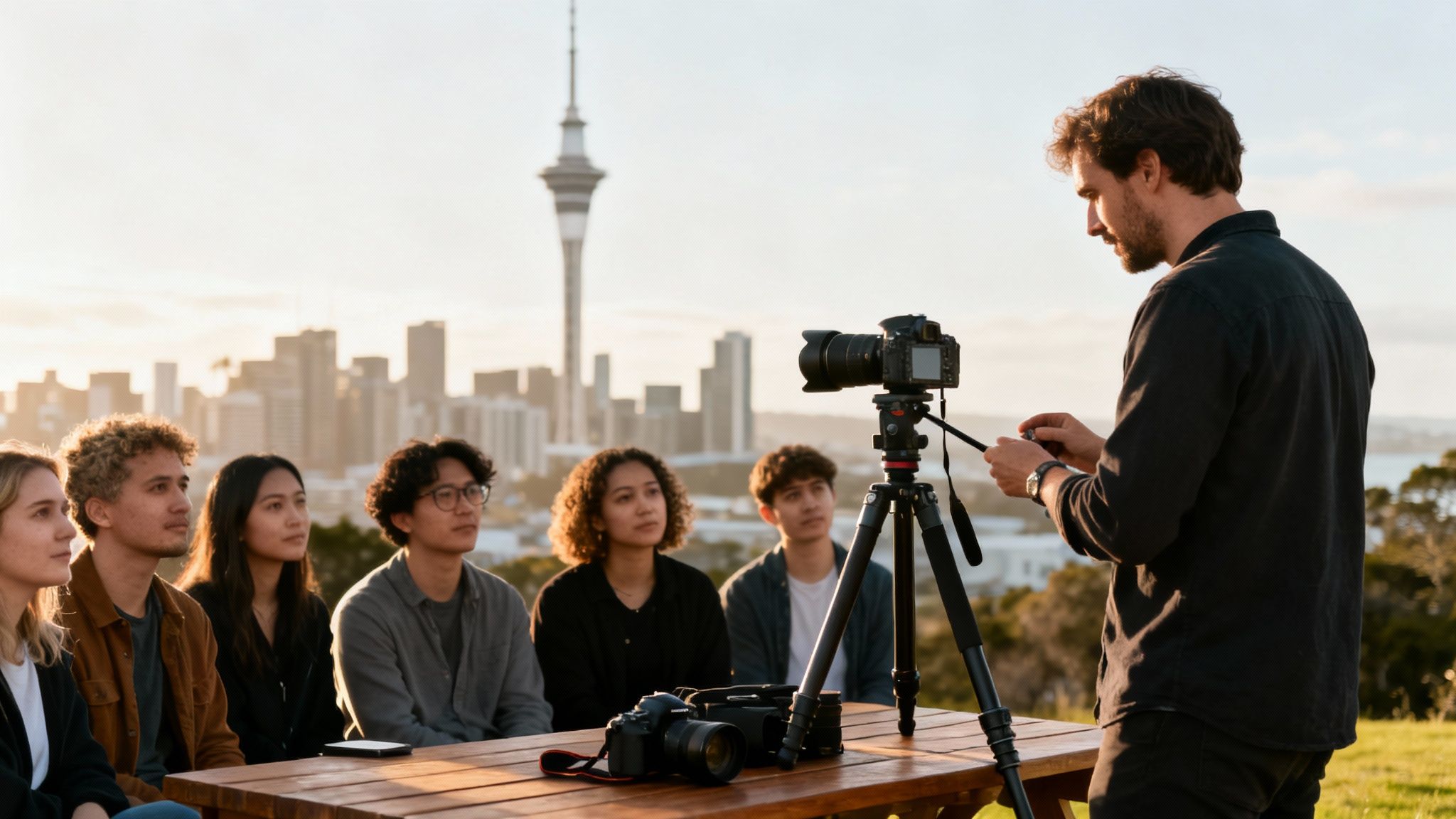
Find the Best Photography Course Auckland Has to Offer
Explore every photography course Auckland offers. Compare workshops, online courses, and certificates to find the perfect fit for your goals and budget.
Practical Skills
minutes
So, you're looking for a photography course in Auckland? Smart move. The right course is all about matching your personal goals with a learning style that actually works for you. Whether you're just wanting to take better photos of the kids or you're a budding entrepreneur who needs slick product shots, the best option will be one that slots into your life and gives you skills you can use straight away.
Your Guide to Auckland Photography Courses

It’s hard not to be inspired in Auckland. From the rugged beauty of the west coast beaches to the buzz of the city centre, there's a photo opportunity around every corner. But turning that spark of inspiration into a genuinely incredible image? That takes a bit of skill.
Choosing a photography course can feel like a huge decision, especially with so many different formats and styles popping up all over the city.
Think of this guide as your map. We'll cut through the noise and help you find a path that lines up with your creative vision, your schedule, and your budget. It’s not about finding the one "best" course in Auckland, but about finding the one that’s the perfect fit for you.
Finding Your Perfect Fit
The ideal course really depends on where you're at in life. Are you a busy parent who needs total flexibility, or a creative professional ready to go deep on a new skill?
Let’s break down some common goals:
- Capturing Memories: You just want to take beautiful photos of your family, your travels, and daily life without getting bogged down in confusing technical stuff.
- Boosting Your Business: You're a small business owner who knows that high-quality images for your website and social media are non-negotiable.
- Starting a Side Hustle: You dream of making some extra cash from your passion, whether that’s shooting weekend events, portraits, or selling prints online.
- Becoming a Professional: You're all in. You want to build a full-time career and need a rock-solid foundation in both the technical craft and the art of photography.
The key is to find a programme that gives you practical, real-world skills. Heaps of modern courses are designed for the busy Kiwi lifestyle, offering flexible learning that lets you gain new abilities without having to put your life on hold.
Once you’re clear on your own goals, you can confidently pick a photography course in Auckland that will get you where you want to go. If you're keen to explore practical, career-focused options, you can learn more about our range of photography courses and find a programme that just works.
Comparing Different Photography Learning Paths
Choosing the right photography course in Auckland is a bit like picking the right lens for a shot. You wouldn't use a wide-angle for a detailed portrait, and you wouldn't use a macro lens for a sweeping landscape. Each learning path is built for a different purpose, a different timeline, and a different level of ambition.
Let's break down the most common formats you'll come across in the city, so you can figure out which one feels like the perfect fit for your creative journey.
Weekend Workshops
Think of a weekend workshop as a creative shot in the arm. It’s an intense, short-burst learning experience that zeroes in on a single, specific topic, like mastering astrophotography or finally getting your head around studio lighting.
- Who it’s for: Hobbyists looking to quickly pick up a new skill or photographers wanting to iron out a specific weakness without a long-term commitment.
- Time Commitment: Usually just one or two full days.
- Outcome: You’ll walk away with a specific, practical skill you can use straight away. It's a fantastic way to score a quick win and get a real boost of confidence.
For instance, a weekend landscape workshop might spend a full day out at Piha Beach, teaching you how to use filters to manage that harsh coastal light, followed by a session on editing those exact shots. To get a better feel for these, check out our guide on New Zealand photography workshops.
Part-Time Certificate Courses
Part-time certificate courses are the perfect middle ground between a quick workshop and a full-on diploma. They offer structured, meaningful learning that you can actually fit around a 9-to-5 job or family life.
These courses are all about steady, consistent progress. They cover a much broader range of fundamental skills than a one-off workshop, building your knowledge week by week. It’s the ideal format for anyone wanting to build a solid foundation without hitting pause on the rest of their life.
This path is about building momentum. Each week, you add another layer of skill and understanding, moving from basic camera settings to more complex creative concepts at a manageable pace.
Diplomas and Formal Qualifications
If you're aiming to make photography your career, a formal diploma offers a deep, structured educational path. These are comprehensive programmes that cover both the technical craft and the artistic side of photography in serious detail.
It's worth noting that many fantastic practical courses are run by private training providers, and their focus is on industry-ready skills rather than formal qualifications. For a nationally recognised qualification, you'll need to look for an NZQA-approved provider.
Auckland's photography scene includes programmes like the New Zealand Diploma in Photography (Level 5). This can be done full-time in a year or part-time over four years, and entry often just requires a small portfolio. You can explore the specifics of this NZQA-approved diploma to see if that formal pathway feels right.
Specialised Advanced Courses
Once you've nailed the basics, you might want to find your niche. Specialised advanced courses are for photographers who know where they want to focus—or are determined to figure it out.
These programmes are laser-focused on a particular genre, such as:
- Commercial Photography: Mastering product shots, food styling, and the art of advertising imagery.
- Portrait Photography: Learning sophisticated lighting, posing, and how to connect with clients for family, corporate, or artistic portraits.
- Wedding Photography: Covering the entire process, from client consultations and shot lists to capturing candid moments and mastering post-processing workflows.
This is where you make the leap from being a generalist to becoming an expert. A specialised course helps you develop a unique style and gives you the business smarts needed to attract clients in that specific market, turning your passion into a proper, profitable venture.
Auckland Photography Course Formats Compared
With so many options, it can be tough to see the wood for the trees. Here’s a quick comparison to help you match a course type to your own goals, time, and budget.
Ultimately, the best path is the one that gets you closer to your personal photography goals, whether that’s taking better family photos or launching a full-time business.
In-Person Workshops vs Online Learning
Choosing between an in-person workshop and an online photography course in Auckland is a major fork in the road. It’s a bit like learning to cook a complex dish. Some people thrive by being right there in the kitchen with a chef, getting instant feedback and feeling the heat. Others prefer to master the recipe at their own pace at home, pausing and replaying a detailed video until they get it just right.
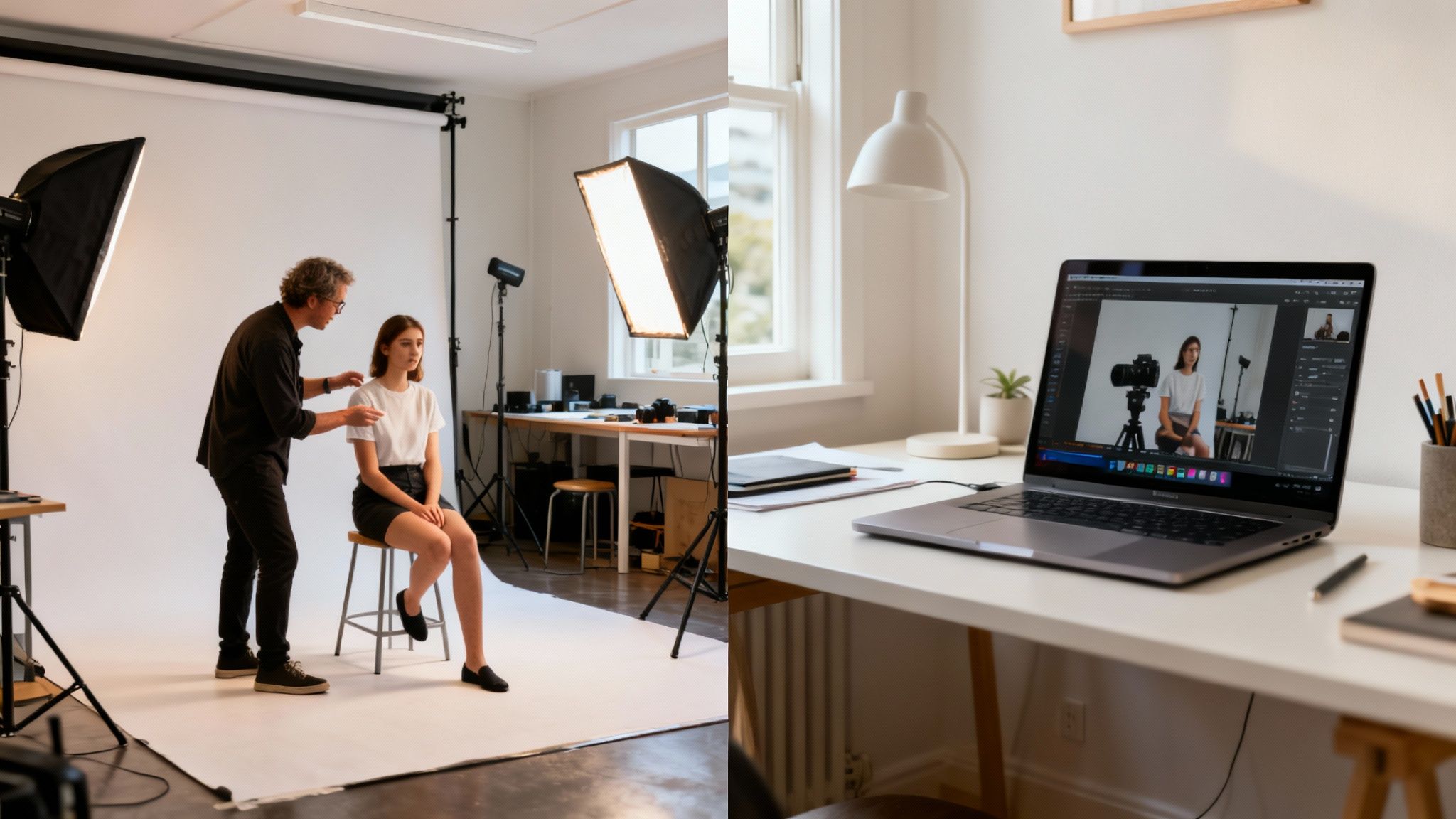
Honestly, neither approach is better than the other. The right choice is the one that clicks with your learning style, your lifestyle, and your budget. Let’s break down the pros of each to help you figure out where you'll really shine.
The Case for In-Person Learning
There’s a unique, hands-on energy in a traditional classroom that you just can't replicate online. For many Aucklanders, it’s the direct interaction and immediate guidance that make all the difference.
There are some real advantages to learning face-to-face:
- Instant Feedback: An instructor can spot right away if you’re holding the camera awkwardly or if your lighting setup needs a tiny tweak. They can correct those small mistakes before they turn into bad habits.
- Access to Professional Gear: Many in-person courses let you get your hands on high-end cameras, lenses, and studio lighting you might not own. It’s a fantastic chance to experiment without the hefty investment.
- Valuable Networking: You're in a room full of other aspiring photographers. This is a golden opportunity to build connections, find people to collaborate with, and grow your local creative network.
This direct, collaborative environment is perfect if you’re energised by group dynamics and need a structured class schedule to keep you on track.
The Power of Online Flexibility
While in-person courses have their perks, the flexibility of online learning is a game-changer for many busy Kiwis. A modern online photography course in Auckland is designed to fit into your life, not the other way around.
Online courses really excel here:
- Learn on Your Schedule: You can fit lessons in whenever it suits you—during your lunch break, after the kids are in bed, or on a quiet weekend. No need to battle Auckland traffic to get to a class on time.
- Mastery at Your Own Pace: Still wrestling with the exposure triangle? No problem. You can re-watch that lesson as many times as you need. On the flip side, if you've already got a topic down, you can jump ahead without waiting for everyone else.
- Greater Affordability: Without the overheads of a physical campus, online courses are often much more budget-friendly, making top-notch education more accessible to everyone.
This self-directed approach puts you squarely in control of your own education. You decide when, where, and how you learn, making sure your new skills slot seamlessly into your life.
Ultimately, the decision boils down to one question: Do you learn best with direct, hands-on guidance in a group, or do you prefer the freedom to learn independently and revisit material whenever you need? Your answer will point you straight to the photography course Auckland locals like you will find the most rewarding.
Understanding Photography Qualifications and Career Paths
Trying to figure out photography credentials in New Zealand can be a bit of a maze at first. You've got your formal, academic qualifications on one side and your practical, industry-focused certificates on the other. Getting your head around the difference is the key to picking a photography course in Auckland that actually lines up with what you want to achieve.
Think of it like learning to build furniture. You could spend years in a formal apprenticeship, learning everything from timber science to the history of design. Or, you could do an intensive workshop that teaches you how to build a beautiful, sellable dining table in a matter of weeks. Both routes have merit, but they're built for very different outcomes.
The Formal Academic Route
Here in New Zealand, the most structured path is an NZQA-accredited diploma. These are comprehensive programmes run by registered tertiary institutions. They offer a deep dive into the theory and practice of photography, often covering art history, fine art concepts, and advanced technical principles over a year or more.
This pathway is usually a great fit if you:
- Are aiming for a career in academia or an institutional role, like in a museum or gallery.
- Want a nationally recognised formal qualification to put on your CV.
- Do best in a structured, traditional learning environment with set timetables.
For someone wanting to get into the industry via a traditional full-time studio job or an institutional position, a formal diploma can be the perfect ticket.
The Practical Skills Pathway
Then you've got the skills-based pathway, which is all about getting you job-ready. This is where industry-recognised certificates shine. These courses are designed for efficiency, arming you with the practical skills you need to start earning money or producing top-notch work, fast.
Often, these certificates are accredited by international bodies like ICOES or CPD, which are all about recognising excellence in professional development. It's important to know that the providers offering these hands-on courses are not NZQA-registered. Their value isn't in formal academic standing, but in their direct, real-world application.
A practical certificate is designed for action. It’s for the entrepreneur needing to lift their e-commerce brand, the creative who wants to launch a pet photography side-hustle, or anyone looking to add a credible, in-demand skill to their resume without the long-term commitment of a diploma.
Connecting Skills to Career Outcomes
The path you take has a direct impact on your career and what you can earn. The photography market in Auckland is buzzing with diverse opportunities for skilled shooters. For instance, data shows that photographers in New Zealand pull in a solid average annual salary of $60,795, and Auckland is a major hub for the best-paying gigs. As you can learn from detailed photography salary guides, this number really depends on your specialty and whether you're freelancing or on staff.
A formal diploma might set you up for a stable studio salary. A practical certificate, on the other hand, gives you the specific skills to chase high-value freelance work in niches like weddings, events, or commercial photography, where established pros can earn well over $100,000. At the end of the day, the "best" qualification is simply the one that gives you the exact skills you need to hit your personal and professional goals in Auckland’s vibrant creative scene.
How Practical Online Courses Fit a Modern Kiwi Lifestyle
Let’s be honest, for many of us juggling work, family, and everything in between, the thought of adding a fixed study schedule to the mix feels impossible. The daily commute, rigid class times, and strict deadlines of traditional education just don't mesh with a modern, busy Kiwi lifestyle. This is precisely where practical online courses are changing the game for learners across Auckland.

Picture this: you're on the train from Henderson into the city, finally using that travel time to stream a lesson on mastering manual mode. Or maybe you're unwinding after a long day by listening to an audio lesson on Spotify, absorbing key concepts about composition without ever cracking a textbook. This is the flexibility at the heart of a modern photography course in Auckland designed for real life.
These programmes are built around a simple idea: learning should fit into your life, not the other way around. The focus is squarely on practical application over abstract theory, giving you skills you can put to use straight away.
A Real-World Auckland Example
Let’s take Sarah, a small business owner in Ponsonby who runs a boutique online store. Her products are amazing, but her DIY photos look flat and unprofessional, and she knows it's hurting sales. She simply doesn't have time for a full-time diploma, and weekend workshops always seem to clash with market days.
For Sarah, a practical online course is the perfect fit. She can dive into product lighting and editing in the evenings after her kids are asleep. In just a few weeks, she's producing images that look crisp, professional, and appealing, giving her the confidence to elevate her brand's entire online presence.
This is the power of practical learning. It delivers specific, market-ready skills that give you a direct return on your investment, whether that's more sales for your business or the ability to kick off a new side hustle.
Built for Flexibility and Confidence
Modern online learning platforms get it. They understand the need to remove the barriers that so often stop people from upskilling in the first place.
Key features that support a busy Kiwi lifestyle include:
- Frictionless Enrolment: Sign up in minutes online without wading through lengthy applications or sitting through sales calls.
- Learn Anywhere: With content available as video, audio, and slides, you can learn while commuting, exercising, or just chilling at home.
- Money-Back Guarantees: Enrol with peace of mind, knowing you can get a refund if the course isn't quite right for you.
- Stackable Certificates: Earn credentials quickly to build your credibility and showcase your new skills without a long-term commitment.
This model puts you firmly in control of your learning journey. In New Zealand's creative economy, photography is a major player, with creative industries contributing over $11 billion annually to our national economy. For Aucklanders wanting to tap into this market, practical online courses offer a direct and efficient path.
The ultimate goal is to arm you with the skills you need to succeed in the real world. That could mean mastering advanced techniques to capture stunning landscapes or understanding the business side of photography to launch your own venture. If you're ready to explore a programme that offers this blend of in-depth skill and practical application, check out our Advanced Photography Course Bundle designed for aspiring Kiwi photographers.
Your Next Steps to Becoming a Better Photographer
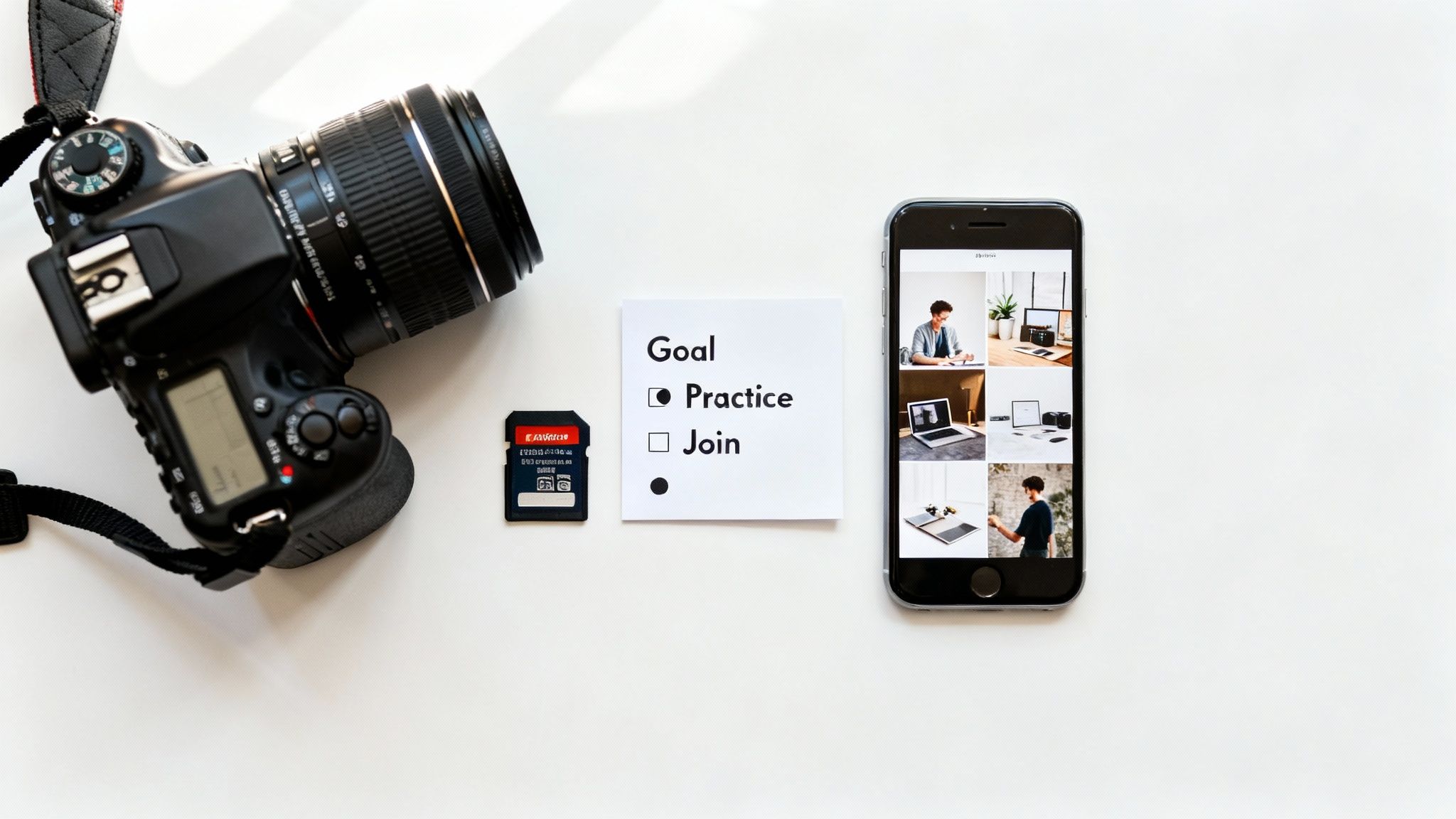
Alright, you’ve explored the different ways to learn and weighed up the pros and cons of studying online versus in a classroom. Now for the exciting part: turning that inspiration into action. This is where you map out a clear path from where you are today to where you want to be with your camera.
The best place to start is with a simple checklist. Answering these questions honestly will help you pick the right photography course in Auckland with confidence, making sure it’s a perfect match for your goals.
Your Personal Photography Checklist
Before you sign up for anything, take a moment for a quick gut check. Getting clear on what you really need is the most valuable thing you can do right now.
- Define Your Goal: What’s the dream? Are you hoping to capture priceless family moments, start a side hustle shooting events, or build a professional portfolio that lands you clients? Get specific.
- Assess Your Time: Take a realistic look at your weekly schedule. Do you have chunky blocks of time for classes, or do you need to learn in short bursts, maybe on your commute or after the kids are in bed?
- Set Your Budget: Figure out what you can comfortably invest in your learning. Don't forget that online courses are often a more affordable way to get your hands on genuinely practical skills.
- Identify Your Learning Style: Do you learn best with the immediate, hands-on feedback you get in a classroom? Or do you prefer the self-paced, rewind-and-repeat nature of an online course?
Think of your answers here as your personal compass. They’ll point you straight to the kind of course that feels less like a chore and more like the next exciting step in your creative journey.
Putting Your Skills into Practice in Auckland
Theory is great, but photography only truly comes to life when you’re out there shooting. Auckland is a fantastic playground for practising your new skills, with everything from dramatic landscapes to slick urban scenes.
Once you get started, try these local tips:
- Hire Gear to Experiment: There’s no need to drop thousands on expensive gear right away. Places around Auckland offer camera and lens hire, which is a brilliant way to try before you buy.
- Explore Prime Shooting Spots: Put your new knowledge to the test. Head out and capture the moody, dramatic coastline at Piha, the gentle, rolling hills of Cornwall Park, or the sharp architectural lines of Wynyard Quarter.
- Connect with the Community: Jump on Facebook and join a few local photography groups or find a meetup. Sharing your work and seeing what others are creating is one of the fastest ways to get better.
A huge part of growing as a photographer is getting to know your gear, and that includes figuring out things like the best camera for wildlife photography if that’s your passion. The most important thing is to just start. Explore your options, check out a few free lessons, and take that first step with confidence today.
Frequently Asked Questions
Jumping into the world of photography courses can bring up a few questions. To help you feel confident about your next move, we’ve put together some straight answers to the things we get asked most about photography courses in Auckland.
Do I Need a Super Expensive Camera to Get Started?
Honestly? Not at all. A great beginner course won’t be about the gear; it'll be about teaching you the bones of photography—composition, light, and how to tell a story with your images. These are skills that work whether you're using a top-of-the-line DSLR or the phone in your pocket.
Plenty of students start out with a decent smartphone or an entry-level camera and get absolutely stunning results. The goal is to master the craft first, not to collect expensive equipment. Good courses, especially the flexible online ones, are built so you can learn the theory and put it straight into practice with whatever camera you already have.
How Much Do Photography Courses Cost in Auckland?
The costs really do vary quite a bit, depending on what you're after. A short weekend workshop might set you back a few hundred dollars, while more in-depth, part-time certificate courses can range from $1,000 to $4,000. If you're looking at formal diploma programmes at a big institution, that’s a much larger financial commitment.
Online courses often end up being a more affordable route. Because they don't have the overheads of a physical campus, they can offer fantastic value and focus purely on getting practical, career-ready skills directly to you. It always pays to check with the provider for the most up-to-date fees.
The real key is finding a course that gives you genuine value for your money and fits your budget. An affordable, skills-focused online course can often provide a much better return on investment by getting you ready for real-world work, faster.
Can I Actually Make a Living from Photography in Auckland?
You absolutely can. Auckland has a really healthy and diverse market for talented photographers. There's strong demand for everything from weddings and commercial product shoots to real estate and corporate events. It's a competitive field, no doubt, but there's always room for high-quality, professional work.
Many of the city's successful photographers got their start by building up a portfolio and client base as a side hustle before making the leap to a full-time career. Taking a course that gives you practical, market-ready skills puts you at a huge advantage for turning that creative passion into a profitable business.
What’s the Difference Between a Diploma and a Certificate?
Think of it like this: a diploma is usually a formal, NZQA-accredited qualification you get from a traditional institution. It's a deep, structured education that takes a fair bit of time. A practical skills certificate, on the other hand, is generally shorter and laser-focused on teaching you specific, job-ready skills you can use straight away.
Which one is right for you really comes down to your goals. If you're after a formal academic qualification to follow a traditional career path, a diploma could be a good fit. But if your main goal is to quickly pick up practical skills to start a business or a side hustle, a skills-based certificate is often the most direct and efficient way to get there.
Ready to build practical, real-world photography skills that fit your lifestyle? At Prac Skills NZ, we offer career-focused courses designed for busy Kiwis. Explore our programmes and start your creative journey today at https://www.pracskills.co.nz.