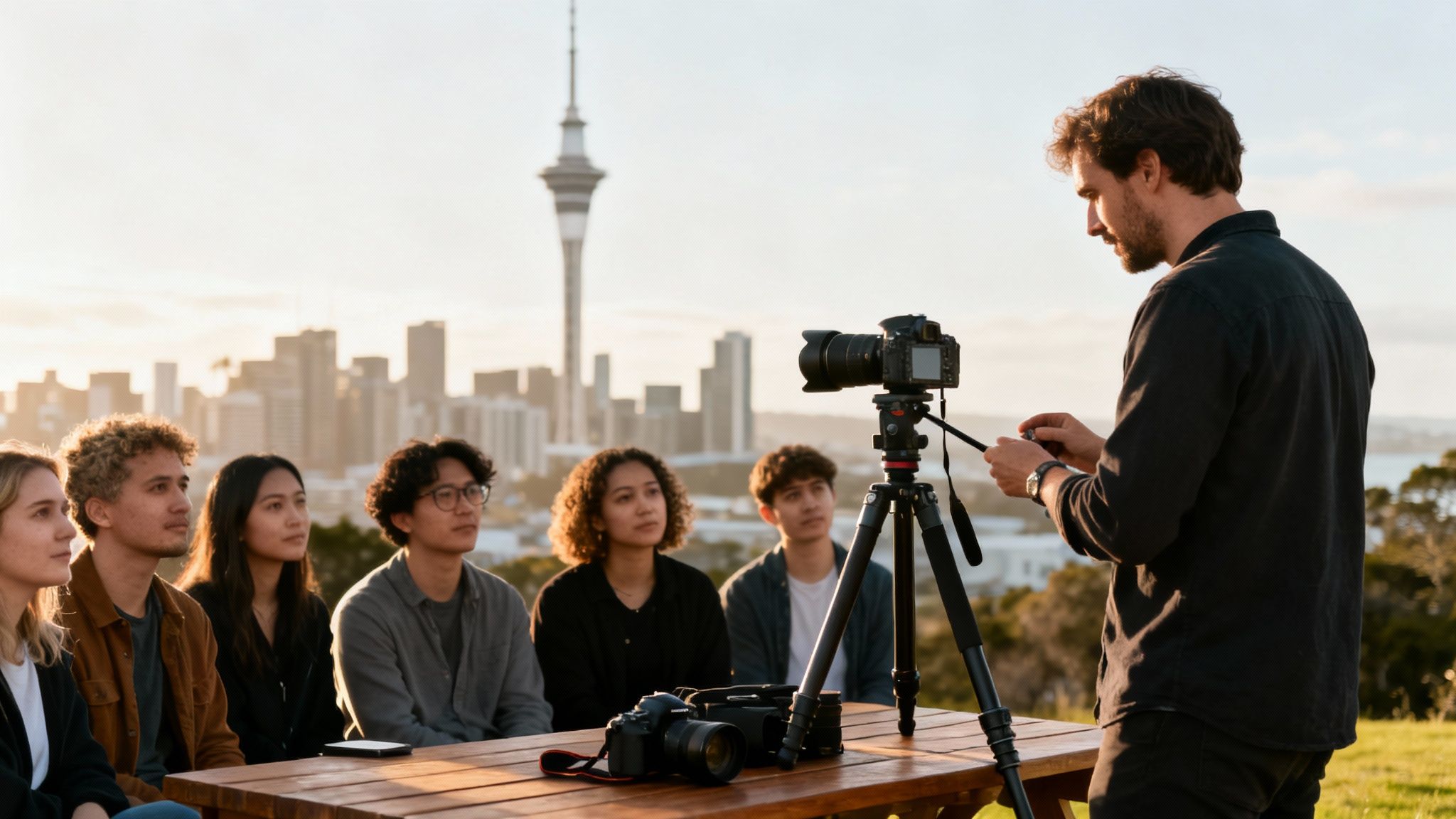
February 2, 2026
.webp)
Mastering Angles of Camera Shots for Powerful Storytelling
Unlock cinematic storytelling with our guide to angles of camera shots. Learn how camera placement shapes emotion, drama, and audience perception in your films.
Practical Skills
minutes
Camera shot angles are so much more than just a technical setting on your camera. Think of them as the emotional grammar of visual storytelling. The way you position your camera has a direct line to how your audience feels about a character or a scene, creating a sense of power, vulnerability, or connection with a simple shift in perspective.
How Camera Angles Shape Your Story
Imagine your camera is your audience's eyes. Where you place it doesn't just determine their physical viewpoint, but their emotional one, too. This is the real magic behind using different camera shot angles. It’s less about memorising complex rules and more about understanding the "why" before you even think about the "how."
A simple change in your camera's height can completely flip the meaning of an image. Are you looking down on your subject, making them seem small and helpless? Or are you looking up, transforming them into a heroic, larger-than-life figure? These choices are the building blocks for guiding how your viewer feels.
The Power of Perspective
This guide isn't about giving you a formal, academic lecture. It’s designed to give you practical, real-world insights into this visual language. We'll explore how each angle works to tell a better story, helping you make deliberate, powerful decisions behind the lens. The goal is to build your confidence so that every shot you take has a clear purpose.
Getting your head around this concept is a game-changer for anyone creating visual content. In New Zealand's booming screen industry, camera angles have been absolutely vital in crafting iconic productions. For instance, to really make our country's majestic landscapes feel immense, film crews often use wide-angle lenses at 15-30 degree elevations. It’s a technique that helps drive the industry's projected $1.55 billion revenue. You can discover more about NZ's motion picture industry trends to see the bigger picture.
Your camera angle is your tone of voice. It can whisper, shout, or just state a neutral fact. Picking the right one makes sure your visual message is heard exactly the way you mean it to be.
By mastering just a few key perspectives, you can add incredible depth and emotion to anything you shoot. It doesn't matter if it's a short video for your small business or capturing the beautiful, rolling hills of a local farm. This foundation will set you up perfectly to explore the specific types of angles we'll dive into next.
The Three Foundational Camera Angles
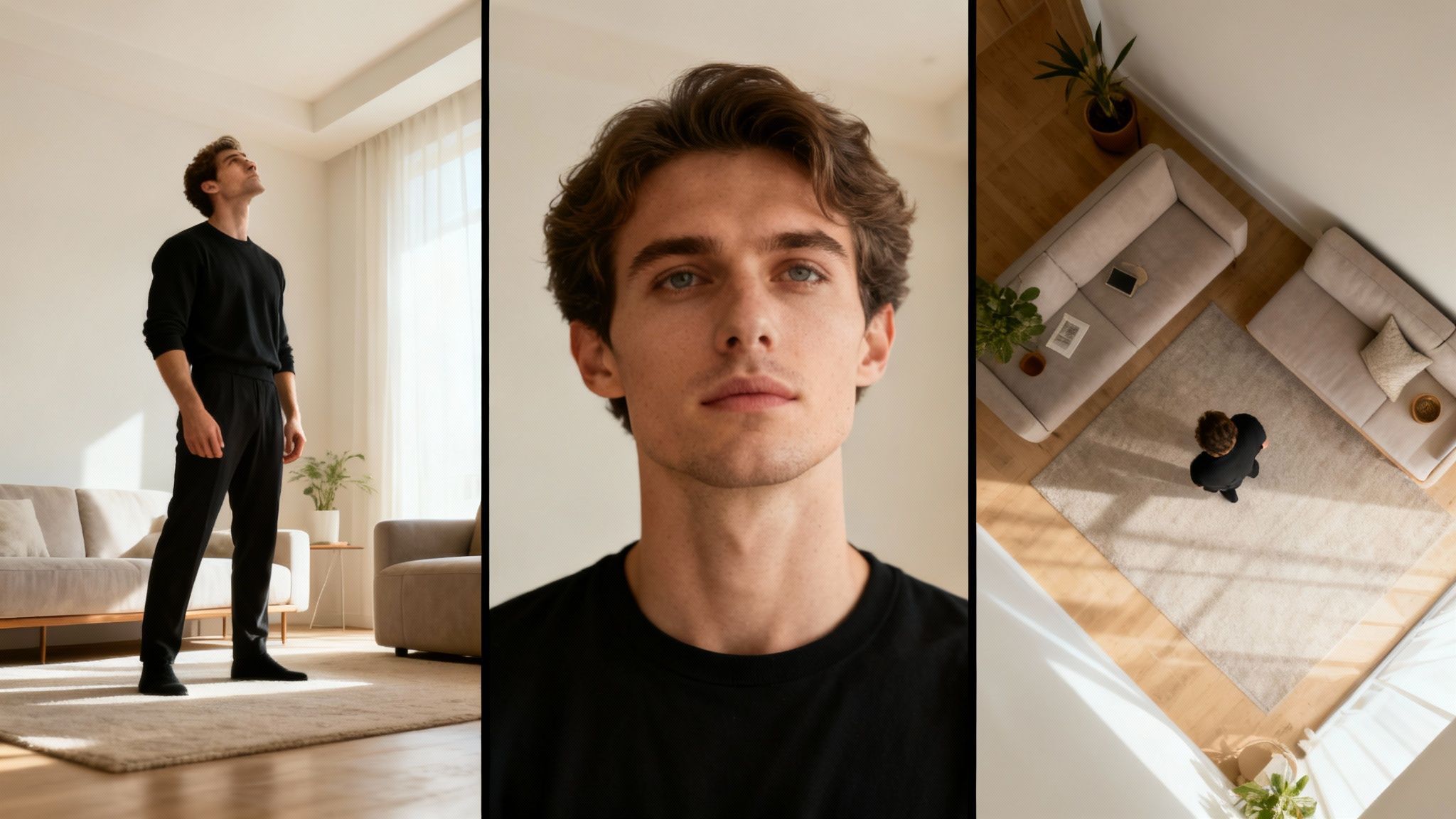
Before you can start telling truly compelling visual stories, you need to get your head around the three foundational angles. Think of them as the primary colours of your visual palette; almost every other fancy or complex shot is just a variation or combination of these basics.
This essential trio—the Eye-Level, High-Angle, and Low-Angle shot—is your direct line to your audience's emotions. Once you understand what each one does, you gain incredible control over the power dynamics and emotional feel of every scene you shoot.
To help you get started, here's a quick look at how these angles shape the way your audience feels.
Common Camera Angles and Their Emotional Impact
This table is your cheat sheet for understanding the psychological effect each of the three foundational camera angles has on the viewer.
Now you've got the overview, let's break down exactly how and when to use each of these powerful tools.
The Eye-Level Shot: Your Neutral Ground
The eye-level shot is your bread and butter. It’s the angle we see the world from every day, positioning the camera at the same height as your subject’s eyes. This immediately creates a sense of familiarity and realism.
Because it mimics natural human interaction, this angle feels neutral and direct. There's no hidden power play here; the viewer feels like they're right there in the room, having a straight-up conversation with the person on screen. It’s the perfect choice when you want your audience to feel empathy or a sense of equality.
Say you're filming a profile on a local Kiwi business owner. An eye-level shot makes them feel approachable and trustworthy, like a peer you could have a yarn with, not an intimidating CEO or someone to feel sorry for.
The High-Angle Shot: A View from Above
Right, now let's change things up. The high-angle shot places the camera above your subject, pointing down at them. This one simple move completely flips the emotional script of the scene.
Looking down on someone instantly makes them seem smaller, weaker, and more vulnerable. This is your go-to angle for showing a character being overwhelmed by their situation—whether it’s a lone tramper dwarfed by the massive Southern Alps or an employee getting a dressing-down from their boss. It immediately puts your audience in a position of dominance.
A high-angle shot is a powerful tool for visual subtext. It tells the audience that the person on screen is in a position of weakness or danger, often without a single word of dialogue being spoken.
The Low-Angle Shot: Looking Up to Power
Finally, we have the low-angle shot, which does the complete opposite. By getting the camera down low and pointing it upwards, you instantly make your subject seem powerful, dominant, and much more significant.
This is the classic "hero shot." It’s used to make people look larger-than-life—whether that's heroic or even a bit threatening. Picture a farmer standing proudly over their paddocks or a rugby player psyching themselves up before a big match; a low-angle shot elevates their entire presence in the frame. You're literally forcing the audience to "look up" to them, reinforcing their authority or importance in the story.
Getting comfortable with these three camera angles gives you a solid toolkit to intentionally guide how your audience feels. Each one offers a different psychological viewpoint, and learning when to use them is the first big step toward becoming a much more effective visual storyteller.
Using Advanced Angles for Dramatic Effect
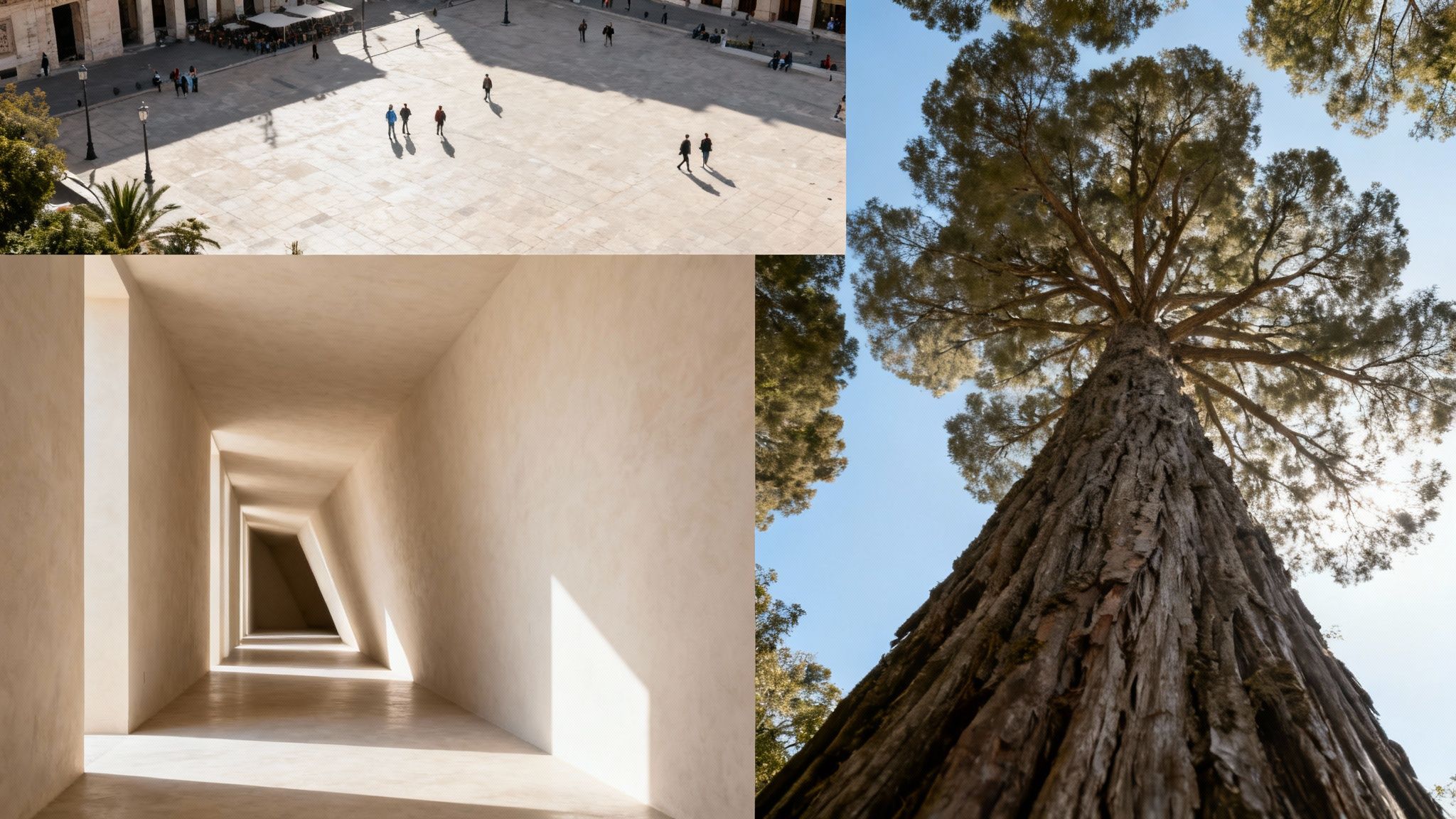
Once you’ve got a handle on the basic camera angles, it’s time to play with the more specialised shots that really inject some punch and emotion into your work. Think of these advanced camera angles as your secret weapons for creating unforgettable, high-impact moments.
Moving beyond standard eye-level perspectives lets you guide the viewer's experience in more subtle, surprising ways. These aren’t your everyday shots; they’re deliberate choices made to set a specific mood, reveal a crucial piece of the puzzle, or build serious psychological tension. Let's break down three of the most effective ones.
The Bird's-Eye View: An Overhead Perspective
The bird's-eye view, often called an overhead shot, is exactly what it sounds like. You place the camera directly above the action and point it straight down. It’s the ultimate "god-like" perspective, giving the audience an all-seeing view that no single character in the scene could ever have.
This angle is brilliant for two main things. First, it’s fantastic for establishing geography. A bird's-eye shot of a sprawling Canterbury farm can instantly communicate the scale of the operation, while an overhead view of a bustling market can reveal patterns and pathways the audience would otherwise miss.
Secondly, it can create a powerful sense of emotional detachment or fate. By looking down from such a distance, your subjects can seem small, almost like chess pieces being moved by an unseen force. This makes it an incredibly powerful tool for showing characters who are trapped or completely overwhelmed by their surroundings.
The Worm's-Eye View: An Extreme Low Angle
Now, let's flip the perspective entirely and get down to the worm's-eye view. This is just an extreme version of the low-angle shot where the camera is practically on the ground, looking straight up. It forces your audience to see the world from the perspective of something very, very small.
This angle is all about exaggeration and scale. It makes the world feel absolutely colossal and intimidating. A simple stand of native punga trees can suddenly transform into a towering, prehistoric forest, and a regular building can look like an unconquerable skyscraper.
When you use the worm's-eye view on a person, it creates an immense feeling of power and dominance—even more so than a standard low-angle shot. It’s the perfect choice for making a character seem monumentally important or terrifyingly imposing, as it distorts their features and makes them completely own the frame.
A great way to think about these extreme angles is to ask: "What new information or feeling does this impossible perspective give the audience?" A bird's-eye view offers clarity and scope, while a worm's-eye view creates awe and intimidation.
The Dutch Angle: For Psychological Tension
Finally, we have the Dutch angle, sometimes called a Dutch tilt or canted angle. This technique involves tilting the camera on its roll axis, knocking the horizon off-kilter. The result is a shot where all the vertical and horizontal lines are skewed, creating a deeply unsettling and disorienting effect.
Unlike the other angles that play with height, the Dutch angle messes with our sense of balance. Our brains are hardwired to see the world on a level plane, so when that’s disrupted, it immediately signals that something is wrong.
This shot is a filmmaker’s shorthand for psychological unease, tension, or even madness. It’s a great way to show a character’s confused mental state or create a feeling of instability in an otherwise normal scene. Just be sure to use it sparingly; its jarring nature can easily pull your audience out of the story if it isn't motivated.
Right, so we’ve covered the theory. We know what a bird's-eye view is, and we understand the feeling a low-angle shot can create. But knowing the theory is one thing; putting it into practice in your own work is where the magic really happens.
Let's move from the 'what' to the 'how' and look at some real-world situations where choosing the right camera angle can completely transform your project.
Whether you're down at the local rugby pitch, filming a promo video for a mate's new café, or just capturing the incredible beauty of our Kiwi landscapes, these techniques are for everyone. The aim is to be deliberate with your shots, making conscious choices that add a layer of depth and emotion to your work.
Ideas for Real-World Scenarios
Ready to get your hands dirty? Here are a few concrete examples of how you can use different camera shot angles to bring your projects to life, with a bit of a local flavour.
For the Local Sports Club: Get right down on the ground with a low-angle shot to capture an athlete in action. This perspective instantly makes them look powerful and heroic, turning a standard action shot into something truly epic.
For a Small Business Video: Trying to show off the vibe of a local café or shop? Use a high-angle shot. It gives viewers a great overview of the space, making it feel open, welcoming, and easy to navigate.
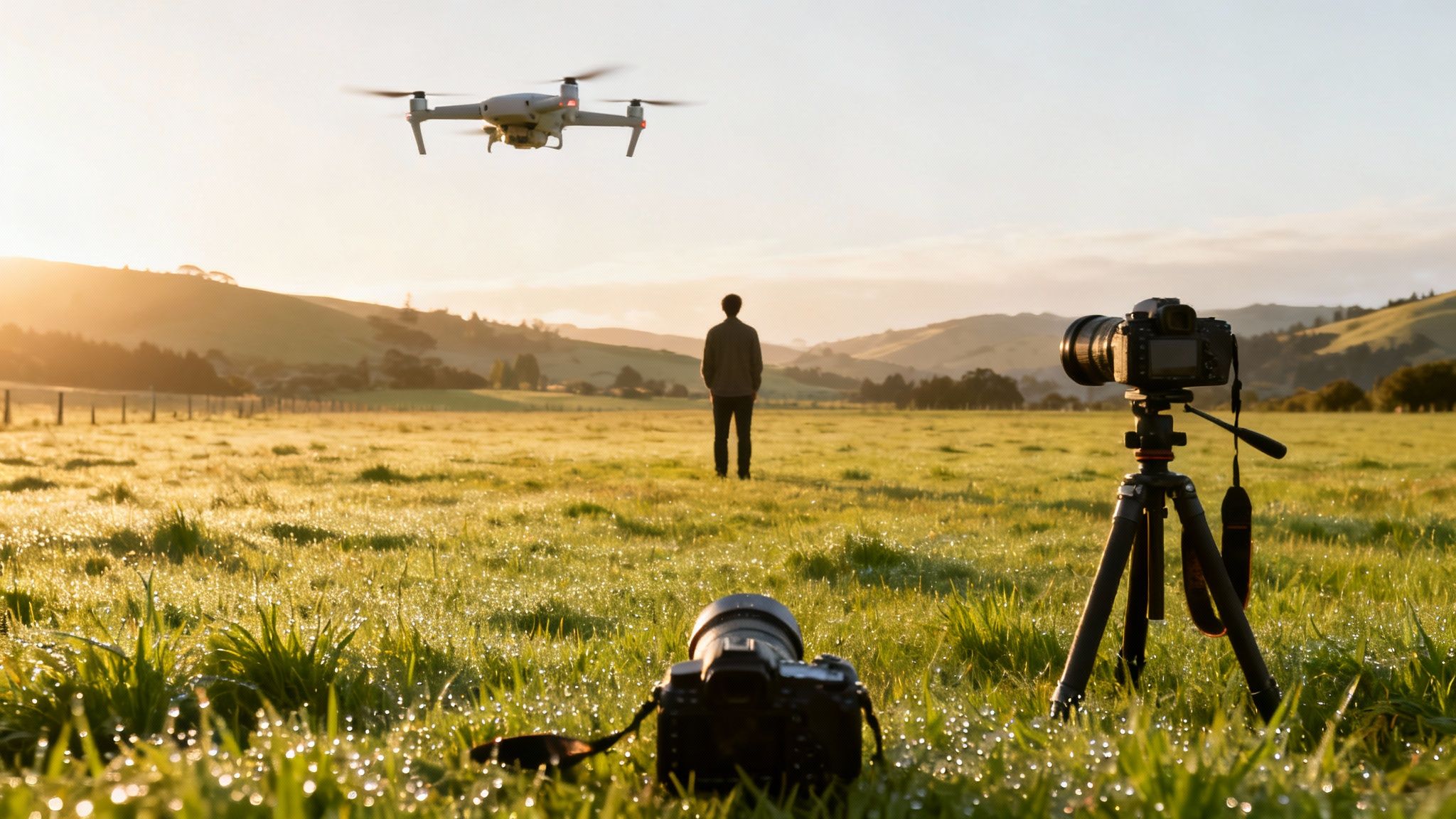
For Capturing Landscapes: A drone’s bird's-eye view is unbeatable for showing the sheer scale of a Central Otago vineyard or a sprawling Waikato farm. This angle reveals patterns you just can't see from the ground, giving a sense of grandeur and place.
These aren't complicated tricks; they're simple adjustments that can radically change the story you’re telling. The power of camera angles isn't just for Hollywood blockbusters. If you want to see how these individual shots fit into the bigger picture, it’s always helpful to follow a comprehensive video production workflow guide to keep your project on track.
The Economic Impact of Angles
Believe it or not, strategic camera work can have an impact that goes far beyond the screen. Just look at how camera shot angles in New Zealand cinema have directly boosted our tourism industry.
After The Lord of the Rings, the use of sweeping low-angle and worm's-eye views to capture the landscapes of Middle-earth sparked a massive wave of film tourism. This powerful visual storytelling helped visitor spending in the Matamata-Piako District jump from $9 million in 2010 to a staggering $45 million by 2015. It's a clear example of how compelling visuals can drive real-world results.
Think of camera angles as your visual vocabulary. A low angle says 'power,' a high angle says 'vulnerability,' and a bird's-eye view says 'scale.' Choosing the right 'word' ensures your message is clear and effective.
By starting to apply these ideas, you'll find yourself creating more thoughtful and impactful visual content. For those who are keen to dive deeper and truly master these skills, an Advanced Photography Course Bundle can provide the structured learning you need to really elevate your work.
Choosing the Right Gear and Composition
A great shot is about more than just picking a cool angle. It’s about bringing your entire vision to life, and that means choosing the right tools and composing your frame with purpose. The gear you use and how you frame your shot work hand-in-hand with camera angles to create something that really connects with people.
Think of it this way: your camera angle sets the emotional tone, but your lens choice adds the flavour. A wide-angle lens paired with a low angle can totally exaggerate perspective, making a Kiwi farmer's boots look massive against the backdrop of a sprawling paddock. Swap to a telephoto lens, and you suddenly compress that distance, making the background feel closer and creating a much more intimate scene.
Essential Gear for Creative Angles
You don't need to break the bank, but a few key pieces of equipment will open up a whole new world of creative possibilities for exploring different camera shot angles. Sometimes, even the simplest tools can make a night-and-day difference in the quality and stability of your work.
Here’s a look at some gear worth considering:
Tripods: This is your best mate for stability. A decent tripod lets you lock in those super-precise low or high-angle shots without a hint of camera shake, keeping your images sharp and professional.
Gimbals: For that smooth, flowing movement, nothing beats a gimbal. It lets you move the camera around freely while keeping the shot incredibly stable. It’s perfect for tracking a moving subject or creating those dynamic, cinematic sequences.
Drones: Once a luxury, drones are now more accessible than ever. They are the ultimate tool for capturing those breathtaking bird's-eye views that show off the sheer scale of a landscape or an event in a way no other piece of gear can.
Composition Rules That Enhance Your Angles
Once you've got your gear sorted, composition is the final piece of the puzzle. Timeless principles like the 'Rule of Thirds' or 'Leading Lines' aren't just standalone rules; they work in harmony with your camera angle to guide the viewer’s eye and create a balanced, engaging image.
Imagine you're using a low angle to make someone look heroic. If you just stick them in the centre of the frame, it's okay. But if you place them along one of the intersecting points of the Rule of Thirds, the shot instantly becomes more dynamic and visually interesting. It’s a simple trick that adds a professional polish. For more practical advice, you can explore our guide on finding the best camera for photography to match your creative style.
Composition and camera angles are like a dance partnership. One can work alone, but when they move together, they create something far more powerful and graceful.
The expertise to handle specific gear for complex shots is a highly valued skill right here in New Zealand's motion picture industry. With 2,690 production businesses nationwide, cinematographers who can nail a precise 45-degree oblique angle in an Auckland studio are always in demand. As you can learn more from the Screen Guild's technician rates, Rate Cards help ensure they're paid fairly for their craft, showing just how much technical skill is a respected part of the creative process.
Frequently Asked Questions About Camera Angles
Getting the hang of camera angles is a journey of trial and error. To help you on your way, we’ve put together answers to some of the most common questions that pop up when you’re learning to tell powerful visual stories.
Think of this section as your go-to guide for quick, practical insights to solve common challenges and really start nailing your camera work.
What Is the Biggest Mistake Beginners Make with Camera Angles?
The most common trap is shooting everything from eye-level. It’s a reliable, necessary angle, for sure, but relying on it too much can make your visuals feel flat and lifeless, stripping your scenes of any real emotional punch.
Another classic error is throwing in a dramatic angle, like a Dutch tilt, without a good reason. When an angle doesn't serve the story, it just feels gimmicky and pulls the viewer out of the moment. The key is intentionality—always have a solid reason for choosing the angle you’re using.
How Do I Choose the Right Angle to Create a Specific Emotion?
It all starts with the feeling you want to get across. Before you even touch the camera, think about the emotion you want your audience to feel, and then match the camera’s perspective to that feeling.
For connection and empathy: An eye-level shot is your best friend. It creates a sense of being on the same level.
To show power or intimidation: Get down low. A low angle forces the viewer to literally look up at your subject.
To convey vulnerability or weakness: A high angle is perfect for this, making the subject seem smaller and less powerful.
For tension or disorientation: A Dutch angle immediately signals to the audience that something just isn’t right.
Think about the power dynamics in your scene. Choosing an angle that reflects those dynamics is a simple but incredibly effective way to guide how your audience feels.
Do I Need Expensive Gear to Use Different Camera Angles?
Absolutely not. While professional gear gives you more stability and control, your most valuable tool will always be your creativity. You don’t need a massive budget to start exploring the impact of different angles of camera shots.
A basic tripod can help you get steady low and high angles. A compelling worm’s-eye view can be as simple as placing your camera safely on the ground. You can even create a bird’s-eye shot by finding a higher vantage point, like standing on a ute tray, a balcony, or the top of a staircase. Being resourceful will always get you further than having an expensive kit, especially when you're just starting out.
Your ability to see a scene from a unique perspective is far more important than the gear you own. The best camera angle is the one that tells the story most effectively, regardless of the equipment used to capture it.
How Does My Lens Choice Impact the Camera Angle?
Your lens and your camera angle work as a team to shape the final image. They have a huge influence on each other. A wide-angle lens combined with a low angle will exaggerate everything, making subjects in the foreground look massive and dramatic.
On the other hand, a telephoto lens can compress the background, creating a feeling of intimacy or even surveillance, even from a standard eye-level position. The best way to learn is to play around with different lens and angle combinations until you find what works for you and develop your own visual style. For those keen to build on these fundamentals, you can find a wealth of practical information within our photography course category.
At Prac Skills, we provide practical, career-focused courses designed to help Kiwis turn their creative passions into real-world success. Explore our range of photography courses today and start telling more powerful stories. Learn more at https://www.pracskills.co.nz.