
February 2, 2026
.webp)

A Practical Guide to Strategic Planning and Strategy for NZ Businesses
A practical guide to strategic planning and strategy for your NZ business. Learn to use proven frameworks and create a roadmap for real growth and success.
Practical Skills
minutes
Staring at the future of your business can feel a bit daunting, but sorting out strategy versus strategic planning is actually quite simple. Think of it this way: your strategy is the destination—that big, exciting goal you're aiming for. Strategic planning? That’s the detailed road map that gets you there. It's the nuts and bolts of turning a vision into reality.
Your Blueprint for Business Success

Let’s break this down with a classic Kiwi road trip analogy. Imagine you want to launch the top-rated local café in your town. That big ambition is your strategy. It’s your 'what' and 'why'—what you want to become, and why it's going to matter to you and your customers.
But you can't just wish yourself at the destination. You need a plan. Strategic planning is your step-by-step map for the journey. It lays out every turn, every stop for supplies, and every kilometre you need to cover.
From Big Idea to Daily Action
This detailed map—your strategic plan—answers the crucial 'how' questions. It breaks your huge goal into smaller, manageable chunks so you don’t get lost along the way. For that top-rated café, your plan would need to get specific on things like:
- The Route You'll Take: Which marketing channels will you actually use to get the word out? Will you pour your energy into social media, take out an ad in the local paper, or sponsor community events?
- The Supplies You'll Need: What gear do you need to buy? How many staff will you need on day one, and what kind of skills should they have?
- The Stops Along the Way: What are your key milestones? This could be launching your winter menu in three months or hitting 50 five-star online reviews within six.
A great strategy points you in the right direction, but a solid strategic plan ensures you have enough fuel, the right vehicle, and a clear map to actually complete the journey.
More Than Just Corporate Buzzwords
Look, strategy and strategic planning aren't just for the big corporates in the city. They’re essential, practical tools for every New Zealand business. Whether you're a side-hustle photographer in Auckland, running a farm in the Waikato, or just figuring out how to start a small business, a clear plan is your ticket to success.
It’s what transforms a vague dream into a concrete set of actions. For anyone putting their blueprint together, a complete digital marketing playbook for local businesses can provide some real-world guidance on the marketing front. This structured approach helps you make smarter decisions, put your precious resources in the right places, and turn that vision into a real, thriving business.
Why a Strategic Plan Is Non-Negotiable in the NZ Market
In New Zealand's ever-shifting economy, a strategic plan is so much more than a document gathering dust on a shelf—it’s your business's anchor in unpredictable waters. Without one, even the most promising venture can get tossed about by market shifts, new regulations, or sudden swings in customer behaviour. It’s the difference between navigating with a compass and just drifting with the current.
This kind of forward-thinking is what separates businesses that survive from those that truly grow. A well-thought-out plan gives you the resilience to pivot when challenges pop up, turning what could be a crisis into a genuine opportunity. This became painfully clear for many in sectors like tourism when they were hit with unexpected strategic shocks.
Put simply, businesses with a clear strategy were far better equipped to adapt. Those without a plan were left scrambling to find their footing. It’s not just about planning for growth; it’s about building a sustainable and adaptable business that can thrive no matter what the local market throws at it.
Stability Breeds Confidence and Investment
For any small business, side hustle, or farm enterprise, a stable and predictable policy environment is a massive advantage. When you can reasonably trust that the rules of the game won't change overnight, you can make long-term investments in your business with a whole lot more confidence.
This is where national-level strategic planning directly impacts your day-to-day operations. For instance, strategic planning is now a defining feature of how New Zealand organisations—both public and private—make decisions, and this shapes the entire environment you operate in. Take Stats NZ’s Statement of Strategic Intentions 2025–2029; it sets out clear, long-term outcomes for things like better use of data and improved productivity. This matters because Kiwis have relatively high trust in government—46% in 2023, well above the OECD average of 39%. This trust creates a predictable setting for planning multi-year investments in new gear, marketing campaigns, or training.
When a government department commits to a four-year cycle, a farmer can plan for advanced livestock training with more confidence, knowing the regulatory landscape is likely to remain stable. You can learn more about how national strategy shapes the business environment on stats.govt.nz.
Building Resilience Against Market Shocks
On the flip side, a lack of strategic planning leaves a business dangerously exposed. Think of it as building a house without checking the weather forecast. It might stand perfectly fine on a calm day, but the first big storm will expose every single weakness.
A strategic plan acts as your operational shock absorber. It forces you to identify potential threats and create contingency plans before they happen, giving you a crucial head start when things go sideways.
This proactive approach is what separates businesses that just scrape by from those that truly flourish. By stress-testing your ideas and assumptions ahead of time, you build a much more robust and resilient operation.
- Financial Resilience: Your plan helps you allocate resources smartly, making sure you have cash reserves tucked away for unexpected downturns.
- Operational Agility: It encourages you to diversify your suppliers or customer bases, reducing your dependence on a single source of income or materials.
- Market Awareness: Continuous strategic thinking keeps you tuned into market trends, allowing you to adapt your offerings before they become obsolete.
Ultimately, a strategic plan is your commitment to being proactive rather than reactive. It provides the clarity and direction needed to build a business that not only weathers the storms but also knows how to harness the winds to its advantage. It transforms your business from a passive participant into an active shaper of its own future.
Building Your Strategic Plan Step by Step
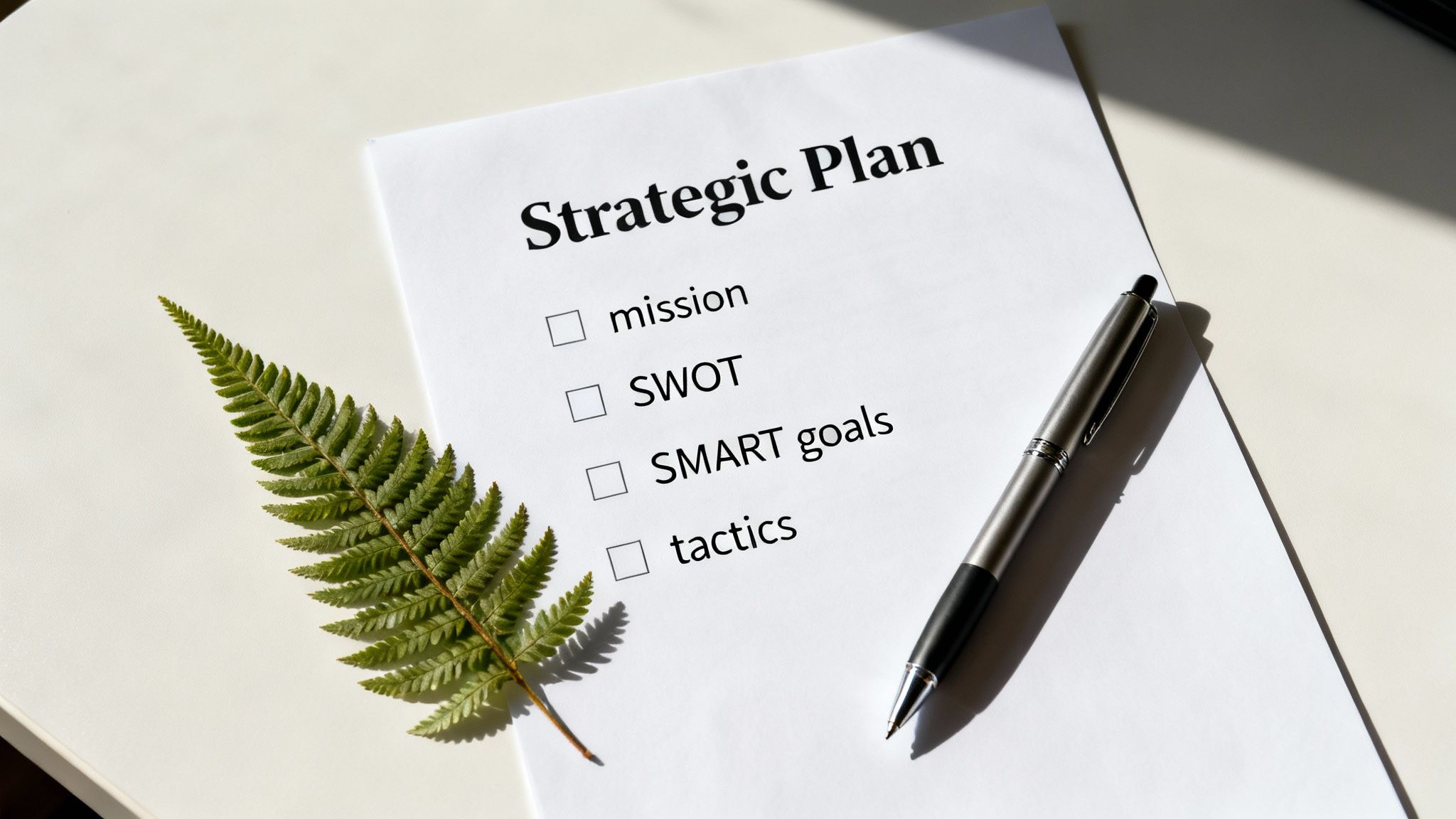
Alright, we’ve covered why strategic planning is so important. Now it's time to get our hands dirty and move from theory to action. This is where you roll up your sleeves and actually build the roadmap that will guide your business.
Don't be put off by the thought of a complicated process. A simple, clear plan that you actually use is worth far more than a perfect one gathering dust in a drawer. We'll break it down into four straightforward steps, each one a building block for your business's future. It's an approach designed for busy Kiwi business owners, giving you a practical tool for making smarter decisions every single day.
Step 1: Define Your Core Identity
Before you can map out where you’re going, you need to be crystal clear on who you are. Your core identity is the bedrock of your business. It shapes your culture, your brand, and every single decision you make. This comes down to three key things.
- Mission Statement: This is your why. It’s a short, sharp statement explaining why your business exists, beyond just turning a profit. For a local café, it might be: "To be the community's favourite spot for great coffee and connection."
- Vision Statement: This is your where. It paints a picture of the future you're working towards. That same café’s vision could be: "To become the most recognised and loved café in the Waikato region, known for our quality and community spirit."
- Core Values: These are your how. They are the non-negotiable principles that guide how you and your team behave. Think 'Community Focus,' 'Exceptional Quality,' or 'Sustainable Practices.'
These aren't just fluffy words for your website. They're practical filters. When you're faced with a tough choice, you can ask, "Does this decision line up with our mission, vision, and values?"
Step 2: Conduct an Honest SWOT Analysis
A SWOT analysis is a dead-simple but incredibly powerful tool for figuring out where you stand right now. It gets you to look at your internal Strengths and Weaknesses, alongside the external Opportunities and Threats you're facing. Being brutally honest here is the key to making it useful.
Let’s take a classic Kiwi example. Imagine you run a small pet-sitting business in a new, growing suburb. Your SWOT might look something like this:
This simple exercise gives you a clear snapshot of what you've got to work with and what you need to keep an eye on. It’s the perfect foundation for setting your goals.
Step 3: Set SMART Goals
With your identity defined and your SWOT complete, you're ready to set some meaningful goals. Vague ideas like "grow the business" just won't cut it. Instead, use the SMART framework to create goals that are Specific, Measurable, Achievable, Relevant, and Time-bound.
This simple structure turns a fuzzy wish into a concrete objective. It gives you absolute clarity and a clear benchmark for what success looks like.
A SMART goal isn't just a target; it's a commitment with a deadline. It forces you to think through the specifics of what success actually looks like and how you'll know when you've hit it.
For instance, instead of "get more online sales," a SMART goal would sound like this: "Increase online sales to Australian customers by 15% within the next six months by running targeted social media ads and offering a flat-rate shipping promotion." See the difference? It's specific, measurable, achievable, relevant to growth, and has a firm deadline.
Step 4: Develop Your Tactics
Finally, you need to pin down the specific actions—your tactics—that will bring your goals to life. This is the most detailed part of your plan, where you map out the day-to-day tasks needed to get the job done.
For that SMART goal we just set, your tactics might include:
- Month 1: Research and select the best social media advertising platform for our target audience.
- Month 2: Design and launch three different ad campaigns aimed at Australian users interested in NZ products.
- Ongoing: Check ad performance every week and tweak the budget based on what's working.
- Ongoing: Keep a close eye on website analytics to measure the conversion rate from our Aussie visitors.
By following these four steps, you create a strategic plan that’s deeply connected to your business's purpose and firmly grounded in reality. It becomes a living document—your guide for navigating challenges and seizing opportunities with real confidence.
Choosing the Right Strategy Framework for Your Business
Once you have a solid handle on your business's core purpose and goals, it’s time to pick a framework to guide your thinking. You don't need a business degree for this; these are just structured ways of looking at your business and the market you're in.
Think of them like different camera lenses—each one brings a different part of the picture into sharp focus, helping you see things you might otherwise miss. Picking the right one helps you organise your thoughts, challenge your assumptions, and ultimately, make smarter decisions. Let's look at a couple of proven models and see how they apply to a typical New Zealand business.
Understand Your Competitive Landscape with Porter's Five Forces
Developed by a clever chap named Michael Porter, this framework is fantastic for sizing up the competitive pressures in your industry. It forces you to look beyond your direct rivals and see the bigger picture of where the power—and the profit—really lies. It’s perfect for checking out a market before you dive in or for figuring out why your current market feels like such a tough slog.
Imagine you run a local landscaping business in a growing Kiwi suburb. Here’s how you’d use the Five Forces to get your bearings:
- Threat of New Entrants: How easy is it for someone else to start up? Pretty easy, right? Someone with a ute, a mower, and a bit of grit could be in business tomorrow. This puts constant pressure on your prices.
- Bargaining Power of Buyers: How much clout do your customers have? Because there are plenty of landscapers to choose from, their power is relatively high. They can shop around, which means you have to stand out on something other than price, like quality or service.
- Bargaining Power of Suppliers: What about the folks you buy from, like plant nurseries or tool suppliers? If there are only one or two specialist nurseries in your area, their power is high, and they can pretty much set the prices.
- Threat of Substitute Products: Could your customers just do something else entirely? Absolutely. They might decide to tackle a bit of DIY, lay down some artificial turf, or pour a concrete patio instead of hiring you.
- Rivalry Among Existing Competitors: How fierce is the local competition? With several other landscapers chasing the same customers, the rivalry is likely to be intense.
This quick analysis shows that the landscaping game is a competitive one. Your strategy, then, can’t just be about mowing lawns. It has to be about creating a unique advantage—maybe you specialise in native plant gardens, or you build a reputation for being unbelievably reliable.
Measure What Matters with the Balanced Scorecard
Money is important, but it only tells part of the story. The Balanced Scorecard is a framework that helps you track performance across four key areas, giving you a much healthier, more complete view of your business. It makes sure you’re not just chasing today's profits at the expense of tomorrow's success.
The Balanced Scorecard encourages you to ask a broader set of questions: Are our customers happy? Are our internal processes efficient? Are we learning and growing as a team?
It zooms in on four different perspectives:
- Financial: Are we making money and growing? (e.g., profit, revenue).
- Customer: How do our customers see us? (e.g., satisfaction ratings, repeat business).
- Internal Processes: What do we need to be brilliant at? (e.g., job completion time, minimising waste).
- Learning and Growth: How can we keep getting better? (e.g., team skills, developing new services).
By keeping an eye on metrics in all four areas, you ensure your strategic planning and strategy are well-rounded. For instance, investing in your team’s skills (Learning and Growth) leads to more efficient work (Internal Processes), which results in happier clients (Customer) and, you guessed it, a healthier bottom line (Financial).
For a deeper dive into structuring your business for success, exploring different business management courses can provide valuable frameworks and practical skills.
Choosing the Right Strategic Framework for Your NZ Business
So, which framework should you use? It really depends on what you need to figure out right now. If you're worried about competition, Porter's Five Forces is your tool. If you want a more holistic view of your business's health, the Balanced Scorecard is a great choice.
Here’s a simple table to help you decide.
There are plenty of other frameworks out there, but these two are a brilliant starting point. They get you thinking beyond the day-to-day and looking at the bigger picture, which is exactly where strategy begins.
Putting Your Strategy Into Action: A Tourism Case Study

It’s one thing to talk about theory and frameworks, but it’s another to see them work in the real world. Let’s bring strategic planning and strategy to life with a story that shows just how a big-picture plan connects to the day-to-day decisions that make a small business tick.
Meet Alex, who runs a small, guided photography tour business along a stunning stretch of coastline. Alex’s strategy is simple but ambitious: to become the number one choice for premium, small-group photography tours that truly capture the area’s unique natural beauty.
To make that vision a reality, Alex can't just rely on passion. A solid strategic plan is needed, and the first step is to ground it in real-world data, not just a gut feeling.
Using Data To Shape Decisions
New Zealand’s tourism and visitor-driven industries are a perfect example of why this structured approach is so critical. According to Tourism New Zealand, international visitor arrivals hit 3.35 million in the year to February 2024, a recovery to 86% of 2019 levels. That’s not just a number; it’s a massive opportunity. National-level planning like this has a direct ripple effect on local operators in creative fields like photography. You can dive deeper into these tourism trends and strategic goals on tourismnewzealand.com.
Instead of guessing, Alex dug into the visitor data and found a clear pattern. International tourists flock to the region from November to March, with another little spike during the July school holidays. That single insight becomes the bedrock for several smart, tactical decisions.
A strategic plan isn’t about trying to predict the future with 100% certainty. It’s about using the best information you have to make intelligent choices that give your business a genuine competitive edge.
Armed with this knowledge, Alex crafts a multi-layered action plan. Suddenly, the data is informing everything from pricing and marketing to professional development, creating a cohesive approach where every move supports that bigger strategy.
From Insights To Action Steps
The visitor data gives Alex a clear roadmap for the entire year, moving the business from reactive scrambling to proactive planning.
Here’s a snapshot of how the plan breaks down:
- Seasonal Pricing: Alex introduces dynamic pricing. During the November-March peak, premium, all-inclusive packages are on offer. In the quieter winter months, it’s all about discounted rates and special "locals-only" workshops to keep cash flow steady.
- Targeted Marketing: The data also hints at who is travelling when. Alex now runs distinct marketing campaigns for European and North American travellers ahead of summer, while targeting Australian families for the winter school holidays.
- Strategic Upskilling: Alex knows the peak season is where the real money is made. So, the quiet shoulder season is the perfect time to invest in skills. Enrolling in an advanced photography course in September means new techniques are polished and ready to go just as demand soars.
Putting it all together, successful execution often comes down to refining your Go-To-Market strategy to ensure every action has a clear, measurable outcome. For Alex, this story-driven approach links high-level data directly to tangible business decisions, proving that strategic planning is an incredibly powerful tool for any small Kiwi enterprise.
Keeping Your Strategic Plan Alive and Relevant
Here’s the biggest mistake I see business owners make: they treat their strategic plan as a one-off task. They pour their heart and soul into creating a brilliant plan, only to let it gather dust in a forgotten folder. A plan that isn’t used is useless.
The real magic happens when your strategic plan becomes a living, breathing guide that shapes your decisions every single day. This means moving from planning to doing—and, just as importantly, to measuring. Without tracking your progress, you're just flying blind. You need clear signposts to tell you if your actions are actually getting you closer to your goals, or if you’ve wandered off course. This is where Key Performance Indicators come in.
Setting Meaningful Key Performance Indicators
Key Performance Indicators (KPIs) are the specific, measurable numbers you'll use to see how you're doing. They’re the bridge between your broad ambitions and hard data, connecting directly back to the SMART goals you set earlier. A good KPI is a number that tells a story about your performance.
Your KPIs should be cut specifically for your goals. Here are a few examples that might ring true for a Kiwi business:
- KPI Example: "Reduce material waste on the farm by 5% each quarter."
- KPI Example: "Sign up 10 new clients for our pet-sitting service each month."
- KPI Example: "Increase our repeat customer rate by 15% over the next year."
A KPI isn’t just a pat on the back. It’s a diagnostic tool. When a number is off target, it’s not a failure—it’s an invitation to ask 'why?' and learn from what the data is telling you.
Learning from a Disciplined Approach
You don't need to reinvent the wheel to see how well this works. New Zealand’s own government agencies offer a live case study of how disciplined strategic planning with clear measures improves performance.
Take the Department of Internal Affairs, for instance. They tracked 155 performance measures in 2023/24 and found that around 87–88% hit their targets. Critically, they also dug into the 12% that didn't, citing challenges like limited specialist resources and new systems—the same hurdles small NZ businesses face. It shows the goal isn't perfection; it's about continuous learning. You can explore their performance management approach on dia.govt.nz to see how they do it.
Establishing a Simple Review Cadence
To keep your strategy from going stale, you need a regular rhythm for checking in. A complicated review process is the first thing that gets dropped when you're busy, so keep it simple. The aim is to build a habit of reflection and adjustment.
Try a two-part schedule:
- Brief Monthly Check-in: A quick, informal look at your main KPIs. Are the numbers heading in the right direction? This can be as simple as a 30-minute review to spot any big issues early.
- Deeper Quarterly Review: A more formal sit-down every three months to look at the bigger picture. This is your chance to adjust tactics, move resources around, or even tweak a goal if the market has shifted.
This consistent cycle ensures your strategic plan remains a powerful, relevant tool that helps you adapt and thrive. For those wanting to develop their skills in this area, you might be interested in exploring how micro-credentials in NZ can validate your expertise.
Your Strategic Planning Questions Answered
Even after mapping everything out, it’s normal to have a few lingering questions. Diving into strategic planning for the first time can feel a bit daunting, and it's smart to iron out the practical details before you start. Let's tackle some of the most common questions we hear from Kiwi business owners, so you can move forward with real confidence.
How Often Should I Review My Strategic Plan?
Think of your plan as a living, breathing guide, not a dusty document you file away. A full-scale, deep-dive review once a year is a great rhythm for checking in on your big-picture vision and long-term goals. But for everything else? You need to check in far more often.
We recommend a lighter catch-up every quarter. This is your chance to see how you're tracking against your KPIs, react to any shifts in the market, and tweak your tactics without having to start from scratch. Of course, if something major happens—your main supplier goes under, or a new competitor sets up shop next door—don't wait. Pull out the plan and review it immediately.
Is a Strategic Plan Really Necessary for My Small Side Hustle?
Absolutely. Don't let the word 'strategic' intimidate you. At its core, strategy is just about being intentional, and that’s crucial whether you're running a multinational company or a weekend passion project.
For a side hustle, your plan might just be a single page, but that single page is incredibly powerful. It forces you to get crystal clear on what you actually want to achieve (like earning an extra $500 a month or landing your first five clients), who you're trying to reach, and where you should focus your precious time and money. It’s what turns a hobby into a proper business with a clear direction.
The most common mistake is creating a plan that is too complex and then never looking at it again. A simple plan that you actually use is infinitely better than a perfect one that collects dust.
What Is the Biggest Mistake to Avoid?
Without a doubt, it's getting bogged down trying to create a 50-page corporate manifesto. That’s not the goal here. You're aiming for a practical, usable tool that helps you make smart decisions every single day, not an academic paper.
Keep it simple. Focus on a handful of key goals, and make sure your action steps are clear, straightforward, and achievable. Your strategic planning and strategy efforts should feel empowering, not overwhelming.
Ready to build the practical skills that bring your strategic plan to life? At Prac Skills NZ, our online courses are designed for the realities of the New Zealand market. Whether you're growing a business, starting a side hustle, or deepening a passion, we provide the tools you need to succeed. Explore our career-focused courses today at https://www.pracskills.co.nz.