
February 2, 2026
.webp)

How to start a small business in NZ: A practical launch guide
how to start a small business in New Zealand: A practical guide from validating ideas to attracting your first customers and growth.
Practical Skills
minutes
So, you’ve got a brilliant idea for a business in New Zealand. That's fantastic. Every great Kiwi venture starts with that initial spark, a gut feeling that you're onto something people really need.
But here’s the thing: passion alone doesn't pay the bills. The real make-or-break moment comes when you step back from the excitement and put that idea through a serious reality check.
Turning Your Kiwi Business Idea into Reality

Before you even think about a business name or a cool logo, you need to ask some tough questions. Who is actually going to buy this? What real-world problem does it solve for them? And, crucially, are they willing to open their wallets for your solution?
This is the first, most important hurdle.
From Passion Project to Viable Business
Shifting from a hobby to a business is all about a change in mindset. A hobby is for your own enjoyment, and whether it makes money is secondary. A business, on the other hand, must be profitable to survive and grow.
This journey starts with validation. You need solid proof that a market exists for what you want to sell. The good news is, this doesn't require a huge budget. It just requires a smart, structured approach to listening to your potential customers before you build anything.
The top reason startups fail isn't because of a bad product or a lack of passion. It's a lack of customers. Validating your idea first is the single best thing you can do to lower your risk and create something people actually want.
Conducting Lean Market Research
Good market research isn't about collecting spreadsheets full of data; it's about gaining genuine insight. You want to deeply understand your future customers—their frustrations, their hopes, and how they're currently trying to solve the problem you're tackling.
Here are a few practical, low-cost ways to dive in:
- Online Surveys: Tools like Google Forms are your best friend here. Keep it simple and ask open-ended questions like, "What's your biggest challenge with X?" or "If you could wave a magic wand, what would you change about the current options available?"
- Informal Chats: Shout a coffee for a few people who fit your target demographic. Your only job is to listen. Ask them about their experiences related to your idea, and let them do most of the talking.
- Social Media Listening: Jump into relevant Kiwi Facebook groups or Reddit threads where your ideal customers are already hanging out. See what questions they're asking and what they complain about. This is raw, unfiltered gold.
Validating your idea is a crucial first step. To help you work through it methodically, here's a simple checklist to guide your thinking and actions.
Business Idea Validation Checklist
This table will help you systematically check if your brilliant idea has what it takes to become a successful business. Work through each step before you commit too much time or money.
Completing this checklist gives you more than just answers; it gives you confidence. It provides a solid foundation, showing you've done the groundwork to turn a passion into a proper, thought-out business venture.
The landscape for small businesses in New Zealand is huge—a staggering 97% of our 612,417 businesses have fewer than 20 employees. But the reality can be tough. Data shows a steady decline in survival rates over time, with only 85% making it past their first year. This really highlights why getting the fundamentals right from day one is so important.
Ultimately, getting a handle on the basics of market research, financial planning, and business strategy is what separates the dreamers from the doers. Strong business management courses and skills give you the framework to build something that not only launches but lasts.
Building Your Legal and Financial Foundation

Okay, you've got an idea that's passed the reality check. Now for the part that sounds a bit daunting but is actually quite straightforward: making it official. This is where you build the proper structure for your venture, so you can trade legally, handle taxes, and operate above board here in New Zealand. It's less about scary paperwork and more about setting up a solid base to grow from.
The first big decision you'll need to make is your business structure. This choice ripples through everything—from your personal liability and how you're taxed to the amount of admin on your plate. Getting this right from the start is a cornerstone of setting up a business properly.
Choosing Your NZ Business Structure
For most Kiwis starting out, there are three main paths to consider. Each has its own pros and cons, and the right one for you will depend on your situation, how much risk you're comfortable with, and where you see this business going.
Sole Trader: This is the go-to for many people dipping their toes in the water. It’s the simplest structure to get going. You are the business; there’s no legal separation between you and your work. Your business income is taxed as your personal income, keeping things simple. The big catch? You have unlimited liability. If the business gets into debt, your personal assets could be on the line.
Partnership: Teaming up with someone? A partnership is a simple way to structure a business with one or more other people. Like being a sole trader, it's fairly easy to set up with a good partnership agreement. The crucial thing to remember is that all partners are jointly on the hook for business debts—you're liable for your partners' actions, not just your own.
Limited Liability Company (LLC): Forming a company creates a completely separate legal entity. This is the game-changer. It shields your personal assets from business debts, a concept called limited liability. It definitely involves more admin and ongoing compliance with the Companies Office, but it's the structure of choice if you plan to scale up, bring on investors, or take on any significant financial risk.
Think of it this way: a sole trader is like using your personal car for courier deliveries—easy, but if you crash, it’s all on you. A company is like the business owning its own delivery van—more to manage, but it protects you personally if things go sideways.
Getting Registered and Compliant
Once you've picked a structure, it’s time to get registered. This is what makes your business a real, recognised entity in the eyes of the New Zealand government and the IRD.
First up, you'll need a New Zealand Business Number (NZBN). Think of it as your business's unique ID card. It makes dealing with government agencies, suppliers, and other businesses a whole lot smoother. It’s free and easy to apply for online, no matter which structure you've chosen.
Next, you'll need to sort things with Inland Revenue. If you're a sole trader, you can just use your personal IRD number. If you've formed a company, the business will need its own IRD number. This is also when you'll need to decide if you're registering for GST. It’s only compulsory if you expect your turnover to hit $60,000 or more in a 12-month period.
Getting your legal and financial basics right from day one isn't just about ticking boxes. It’s about building a stable platform for growth. A clean, organised foundation prevents massive headaches down the track and makes your business look credible and professional from the get-go.
As part of establishing your business, you need to protect your brand. This often means looking into things like trademarking your brand name to ensure your unique identity is legally yours and yours alone.
Setting Up Your Finances for Success
If I could give just one piece of financial advice, it would be this: separate your business and personal finances. Immediately. Mixing them is a recipe for chaos, making it nearly impossible to know if you're actually making money or to file your taxes without a major migraine.
As soon as you’re registered, open a dedicated business bank account. Every dollar the business earns goes in, and every business expense comes out. It’s a simple discipline that creates a crystal-clear financial record. This makes managing your cash flow—the lifeblood of your business—so much easier. Understanding the money moving in and out helps you spot potential shortfalls and decide where you can (and can't) afford to spend.
Crafting Your Offer and Setting Up Operations
Alright, with the legal and financial paperwork sorted, we get to the exciting part. This is where your idea stops being just a plan and starts becoming something real that people can see, touch, and buy. It’s time to shape what you sell and figure out exactly how you’ll get it to your customers.
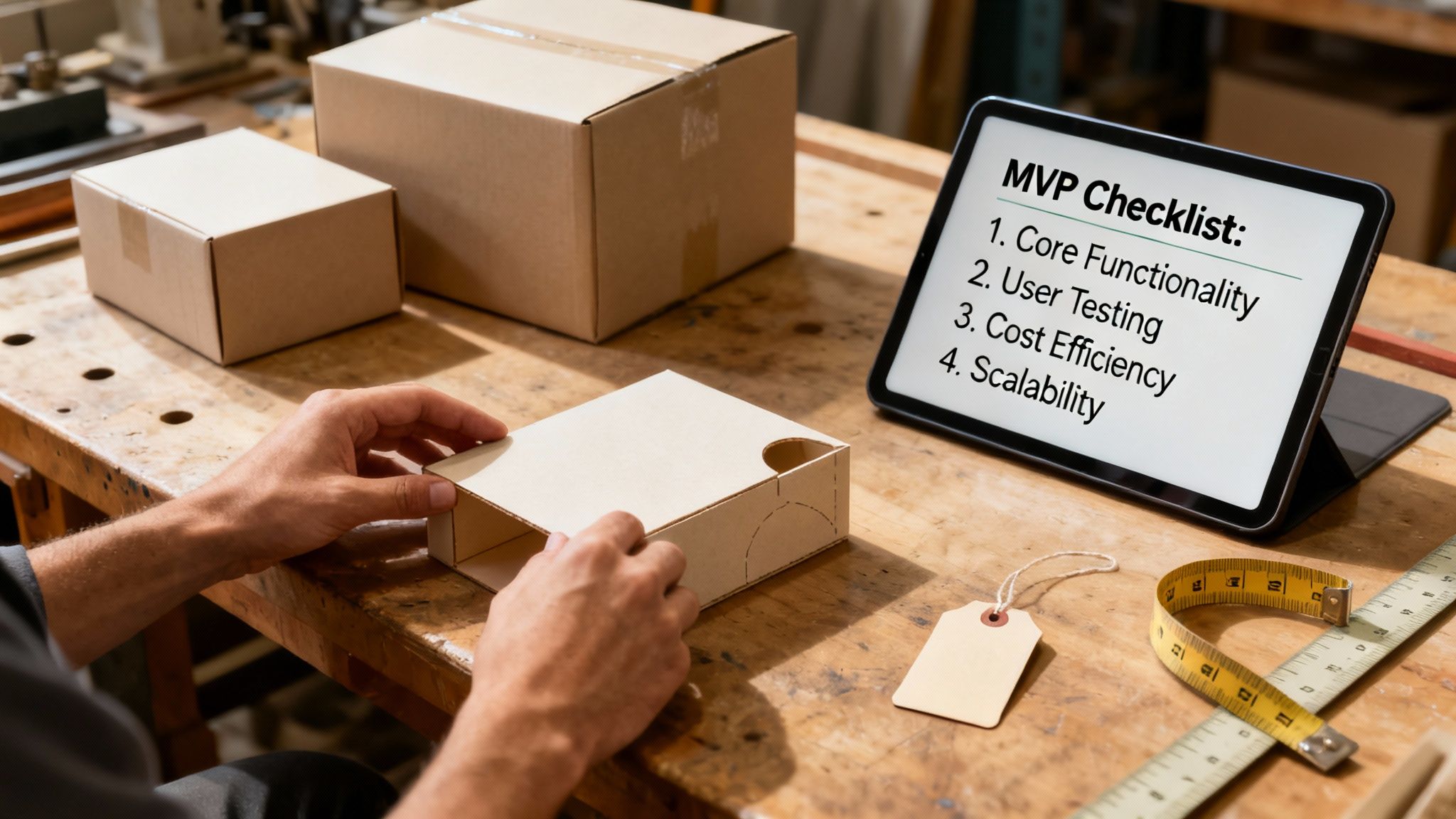
The temptation is always there to launch with the perfect, all-singing, all-dancing version of your product. But from experience, that’s rarely the smartest move. A much better approach is to start with a Minimum Viable Product (MVP). This isn't about releasing something half-baked; it’s about launching the most basic version that solves a core problem for your very first customers.
Think about a new coffee roaster. Their MVP isn't a full-blown café with branded keep-cups and a fancy loyalty app. It’s simply one or two amazing blends of perfectly roasted beans, sold at the local weekend market. It gets right to the heart of the matter—giving people access to incredible, fresh coffee—while letting you get priceless feedback before you sink more money into the venture.
Defining Your Minimum Viable Offer
The whole point of an MVP is to learn, fast. It lets you test your biggest assumptions without betting the farm. Will people actually pay for your handcrafted dog collars? Does your business coaching package genuinely help clients hit their targets? A lean launch lets the market give you the real answers.
To pin down your MVP, ask yourself these questions:
- What’s the single biggest problem I’m solving? Get laser-focused on nailing that one thing.
- What’s the absolute simplest way to deliver that solution? Cut out all the "nice-to-have" features for now and stick to the essentials.
- Who are my very first customers? Your MVP should be built to make this small group of early adopters incredibly happy.
If you’re dealing with a physical product, this is also where you need to think about production and how it looks on the shelf. For a food business, for instance, getting the presentation right is non-negotiable. Our guide on food and packaging fundamentals has some great, practical tips for making your product pop right from day one.
Nailing Your Pricing Strategy
Deciding what to charge is easily one of the trickiest calls you'll make. Go too high, and you could scare everyone off. Too low, and you devalue your work and make it almost impossible to turn a profit. While there’s no secret formula, a few solid strategies can point you in the right direction.
- Cost-Plus Pricing: This is the most straightforward method. Tally up all your costs to make the product or deliver the service, then add your desired profit margin on top. It’s safe and ensures you cover your bills, but you might be leaving money on the table if customers see more value in what you offer.
- Value-Based Pricing: This approach flips the script and focuses on what your offer is worth to the customer, not what it costs you to make. If your bookkeeping service saves a client 10 hours a month and helps them avoid costly IRD penalties, its value is far greater than the time you spend on it. It takes confidence but can be much more profitable.
- Competitive Pricing: This is all about checking out what your rivals are up to and positioning yourself accordingly. You could price a little lower to capture the budget-conscious market, a bit higher to signal premium quality, or somewhere in the middle to compete directly.
Your launch price is just a starting point, not a life sentence. Think of it as your first best guess. The feedback you get from those initial sales is pure gold—it’ll tell you exactly how you need to tweak your pricing as you grow.
Setting Up Lean Operations
You really don’t need a complex and expensive suite of software to get your business off the ground. The name of the game is staying lean. Focus only on the absolute essentials for talking to your team, managing projects, and getting your product out the door. You’d be surprised how far free and low-cost tools can take you.
A basic operational toolkit could look something like this:
By focusing on a tight MVP, pricing smartly, and keeping your operations lean, you build a much stronger foundation. This lets you launch quicker, learn from actual customers, and create a business that’s built to last.
Finding Your First Customers Through Smart Marketing

You’ve sorted the legal stuff, nailed down your offer, and got your operations humming. Now for the exciting part: getting people to actually buy what you’re selling. Marketing can feel like a massive, complex beast, but for a new Kiwi business, it’s not about flashy, expensive campaigns. It’s all about making real connections.
Your mission, should you choose to accept it, is simple: find that first handful of loyal customers. These early adopters are so much more than just sales. They are your proof of concept, your best source of honest feedback, and your future champions who will spread the word for you. The key is to focus on low-cost, high-impact activities that build real momentum without draining your bank account.
Forget trying to be everywhere at once. Just pick one or two places where your ideal customers already hang out, and go all-in there.
Building Your Digital Shopfront
Even if you’re a brick-and-mortar business, a professional online presence is completely non-negotiable in this day and age. Think of it as your digital handshake—it’s where potential customers go to size you up before they decide to trust you with their hard-earned money. The good news? It doesn’t need to be complicated or expensive.
You’ve really got two main options to get started:
- A Simple Website: Often, a basic one-to-three-page website is all you need. It should clearly explain who you are, what you do, who you help, and how people can buy from you or get in touch. Platforms like Squarespace or Shopify make this surprisingly easy, even for total beginners.
- A Polished Social Media Profile: For some businesses, like a local cake maker or a personal trainer, a well-managed Instagram or Facebook page can be more than enough to get the ball rolling. Just make sure you fill out every section professionally, use high-quality photos, and make your contact details impossible to miss.
Your goal here is to create a credible and trustworthy first impression. An unprofessional or half-finished online profile can send potential customers running straight to your competitors. For some great, practical advice, check out our guide with ten tips for a standout online presence you can put into action today.
Don’t get stuck on making it perfect. Your first website or social media profile is just a starting point. The most important thing is that it exists, looks professional, and makes it dead simple for someone to become a customer. You can always tweak and expand it as your business grows.
The latest Xero small business insights show that while Kiwi businesses are seeing modest sales growth, the number of jobs is declining. This tells us that lean, effective marketing is more critical than ever for new entrepreneurs. It really highlights the need to focus on activities that directly drive sales, allowing you to grow without taking on the cost of employees straight away.
Low-Cost Marketing Tactics for Kiwi Startups
When the budget is tight, you have to get clever. Not all marketing efforts are created equal, especially when you’re just starting out. Here’s a quick comparison of a few effective marketing channels that are perfect for new businesses in New Zealand, looking at what they’ll cost you in time and money.
Choosing the right tactic depends entirely on your business and your customers. The best approach is to pick one that feels natural to you and commit to it consistently.
From Interest to First Sale
Getting those first customers is usually a very hands-on process. It’s less about slick automation and more about genuine, personal interaction. When someone shows a flicker of interest—whether they comment on your post, send an email, or chat with you at a market—your job is to make the next step as easy and welcoming as possible.
Be ready to answer their questions with confidence and gently guide them towards a purchase without being pushy. At this stage, you’re building relationships, not just processing transactions. Every single positive interaction you have with these early clients helps lay the foundation for a stellar reputation that will help your new business truly thrive.
Managing Daily Operations and Planning for Growth
You’ve done it. You’ve launched, the first sales are trickling in, and the buzz is real. This is a huge milestone, but now the real work begins. The focus shifts from the starting line to building a business that can go the distance. This is all about getting organised with your day-to-day tasks while keeping one eye firmly on the future.
Successfully running a small business in New Zealand is a bit of a balancing act. You've got to juggle the immediate needs—getting orders out the door, answering queries, and watching the money—while also laying a solid foundation for long-term growth. It’s less about grand, sweeping gestures and more about creating solid, repeatable habits.
Simplifying Your Compliance and Accounting
Don't let the words "compliance" and "accounting" scare you off. For a new business, this really just means keeping a clean and honest record of the money coming in and going out. This isn't just for the IRD's benefit; it’s absolutely essential for you to understand the financial health of your own business.
Good bookkeeping starts the moment you make your first sale. Every single transaction needs to be tracked.
Here’s what you absolutely have to keep a record of:
- All Invoices: Both the ones you send to customers and the ones you get from suppliers.
- Bank Statements: From your dedicated business account, showing every deposit and withdrawal.
- Expense Receipts: From that software subscription to a coffee meeting with a potential client—keep everything.
- Asset Records: Details of any big purchases for the business, like a new laptop or specialised equipment.
When you're starting out, a simple spreadsheet can do the job perfectly well. But as your sales pick up, you’ll quickly find that dedicated accounting software saves you a massive amount of time. Tools like Xero or MYOB are incredibly popular with Kiwi businesses for a reason. They can automate a lot of this, connect straight to your business bank account, help categorise expenses, and create reports that give you a clear picture of your cash flow at a glance. Tax time becomes far less of a headache.
Using Customer Feedback to Fuel Growth
Your first customers aren't just revenue; they're your most valuable source of information. Their feedback is pure gold, telling you exactly what you’re doing right and where you can improve. Don't just sit back and wait for them to come to you—actively seek out their opinions.
A simple follow-up email after a purchase asking, "How did we do?" can reveal incredible insights. Was the delivery fast enough? Did the service meet their expectations? What could have made it even better? This direct line to your market helps you refine what you offer, fix problems you didn't even know existed, and sometimes even spot brand-new opportunities for products or services.
Listening to your customers is the most effective and lowest-cost market research you can do. The businesses that really thrive are the ones that adapt based on real-world feedback, not just their own assumptions.
This constant loop of feedback and refinement is the engine of sustainable growth. It makes sure your business evolves right alongside your customers' needs, keeping you relevant and a step ahead of the competition.
The Power of Continuous Upskilling
Once you settle into the rhythm of daily operations, you'll inevitably find gaps in your own skillset. Maybe you realise you need to get better at social media marketing to reach more customers. Or perhaps you spot an opportunity to offer a more advanced service that requires some new technical know-how.
This is where continuous learning becomes your secret weapon. Stagnation is a real risk for any small business owner who’s trying to do it all. Proactively upskilling isn't a luxury; it's a direct investment in your business's future.
Think about it: a freelance photographer might start with family portraits but soon realises there's a lucrative market in commercial product photography. To tap into that, they need to master advanced lighting and editing. It’s a perfect example of how targeted, practical learning can lead directly to higher-value work and more income.
The New Zealand market is always changing. Staying ahead requires more than just hard work—it demands evolving skills. Whether it’s mastering new software, getting your head around financial forecasting, or learning a specialised trade, building your own capabilities boosts your credibility and opens doors. Making time for practical, career-focused learning is one of the most powerful things you can do to ensure your small business doesn't just survive, but truly thrives.
Burning Questions About Starting a Business in NZ? We've Got Answers
Jumping into the world of business ownership is exciting, but it definitely brings up a lot of questions. To cut through the noise and give you some solid ground to stand on, we’ve tackled some of the most common queries we get from Kiwis just starting out.
How Much Money Do I Need to Start a Small Business in New Zealand?
Honestly, there’s no magic number. Your startup costs can swing wildly depending on what you’re planning to do.
A freelance copywriter or a digital marketing consultant could get off the ground with just a few hundred dollars. Think a website domain, a couple of essential software subscriptions, and your business registration fee. It's a lean way to start earning without taking on massive financial risk.
On the flip side, if your dream is to open a small café or an e-commerce store with physical stock, you could be looking at tens of thousands of dollars before you even make your first sale. There are costs for things like a commercial lease, specialised equipment, and that all-important initial inventory.
The smartest move? Start as lean as you possibly can. Map out a detailed budget and list every single cost you can think of:
- Legal and registration fees with the Companies Office.
- The right insurance, like professional indemnity or public liability.
- Website development and ongoing hosting costs.
- Simple marketing materials – even just a run of business cards.
- Your first batch of inventory or raw materials.
Plenty of successful Kiwi businesses started out as a side hustle. The owners funnelled the profits from their first few sales right back into the business, funding growth organically. This approach takes the pressure off and helps you avoid starting day one with a mountain of debt.
Do I Need to Register for GST Straight Away?
Good news – probably not. GST registration isn't something you need to worry about from the get-go.
It only becomes mandatory once your annual turnover hits (or you expect it to hit) NZ$60,000 in any 12-month period. If you're earning less than that, registering for Goods and Services Tax is completely your call.
So, why would you register early? The main perk is that you can claim back the GST you pay on your business expenses, which can give your cash flow a nice little boost. But there’s a catch. Once you're registered, you have to charge GST on everything you sell and file regular GST returns with the IRD. That’s another admin task on your already-full plate.
For this reason, most startups hold off until they're getting close to that $60,000 threshold. It just keeps the accounting simpler in those critical early days when your energy is better spent finding customers and perfecting what you offer.
What Is the Biggest Mistake New Business Owners Make?
If there's one pitfall we see time and time again, it's failing to separate personal and business finances from day one. It’s so easy to just use your personal bank account when you’re starting out, but trust us, it’s a recipe for chaos.
When your finances are all mixed up, it’s almost impossible to get a clear picture of your business's health. You won't know your true profitability or be able to manage your cash flow effectively. And when tax time rolls around? It's an absolute nightmare trying to untangle every transaction. The fix is simple: open a dedicated business bank account the moment you start trading and put every single cent of business income and expenses through it.
Another common stumble is trying to do everything yourself. While the DIY spirit is essential for any startup, thinking you can be the expert in every single area is a false economy. Know when you’re out of your depth. That might mean investing in simple accounting software to get your books in order or signing up for some practical training to fill a crucial skills gap.
For a broader perspective on the entrepreneurial climate and other helpful information, it's worth checking out resources that offer more about small businesses in New Zealand. Having that wider context can be invaluable as you start to build your own venture.
Ready to turn your business idea into a reality with practical, market-ready skills? At Prac Skills NZ, we offer career-focused online courses designed for busy Kiwis. Gain the confidence and credibility you need to thrive by exploring our course bundles today at https://www.pracskills.co.nz.