February 2, 2026
.webp)
.jpg)
A Guide to Food and Packaging for NZ Businesses
Your essential guide to food and packaging in NZ. Learn about materials, safety regulations, branding, and sustainable choices to bring your product to market.
Practical Skills
minutes
So, you’ve got a killer recipe and you’re ready to share it with the world. But getting your food product from your kitchen bench to a supermarket shelf involves a lot more than just the ingredients.
Welcome to the world of food and packaging – it’s where safety, branding, and legal rules all collide. Think of your packaging as the silent salesperson for your product. It’s the first thing a Kiwi shopper sees, and it’s responsible for protecting your creation and communicating what your brand is all about.
Getting Your Food Product Ready for New Zealand Shelves
Taking a food product to market here in New Zealand is an incredible journey, but let's be honest, the packaging part can feel a bit daunting. It’s so much more than just picking a nice-looking box. You need to make smart choices about materials, design, and the mountain of regulations to make sure your product is safe, appealing, and totally above board.
This guide is your practical roadmap. We're going to walk through the essential decisions you'll be facing, from picking sustainable and budget-friendly materials that Kiwi shoppers love, to getting your head around the rules set by the Ministry for Primary Industries (MPI) and Food Standards Australia New Zealand (FSANZ). This is all about sharing helpful industry knowledge, not providing formal training. Our goal is simple: to give you the confidence to make great decisions for your business.
Of course, packaging is just one piece of the puzzle. If you're just starting out, getting the business basics right is crucial. We’ve got more advice on that in our guide on how to start a small business in NZ. Nailing both the business side and the packaging will set you up for a much smoother launch.
A great package does three things well: it protects what it sells, sells what it protects, and helps the customer use the product easily.
When you get it right, your packaging becomes one of your most powerful tools. It makes sure all your hard work gets to your customers safely, tells your unique story on a crowded shelf, and builds the kind of trust that keeps people coming back for more.
Understanding Core Food and Packaging Concepts
At its most basic, food packaging is about creating the perfect environment for your product. It’s less like a simple container and more like a tiny, specialised house built to protect what’s inside. Think of it as a silent guardian, a miniature billboard, and a helpful tool all rolled into one.
The most obvious job is containment. Your packaging physically holds your product, whether it’s a liquid, a solid, or something in between. But beyond just holding it, packaging must provide protection. It shields your food from being squashed during shipping, but also from invisible enemies like moisture, oxygen, and light that cause spoilage.
Then there's convenience. Good packaging makes the product easier for everyone to handle—from the distributor stacking it in a warehouse to the customer opening it in their kitchen. Finally, and crucially, it serves as a communication tool. The package is your first, and often only, chance to tell your story, display nutritional information, and meet legal labelling requirements.
This diagram shows how these core pillars—safety, branding, and compliance—all revolve around protecting and presenting your central product.
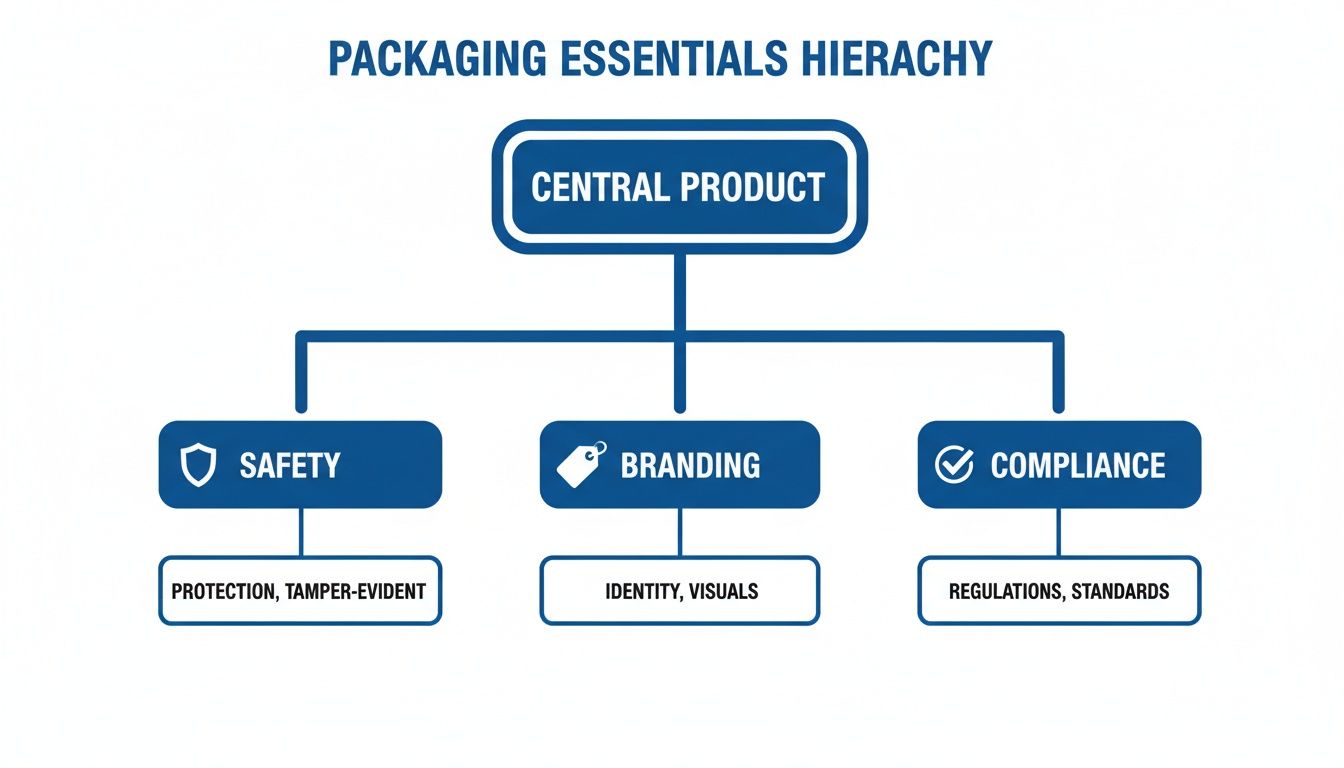
It really highlights that a successful packaging strategy has to balance all these elements. If you neglect one, the others can quickly fall apart.
The Three Layers of Packaging
To see how this works in the real world, it helps to think about packaging in three distinct layers. Each layer has a different job, but they all work together to get your product safely from your facility to the customer’s pantry.
Primary Packaging: This is the layer that’s in direct contact with the food itself. It's the glass bottle holding your tomato sauce, the plastic pouch for your muesli, or the foil wrapper on a chocolate bar. Its main job is to keep the product safe and fresh.
Secondary Packaging: This layer groups multiple individual items together. Think of the six-pack cardboard carrier for beer bottles or the printed box that holds several muesli bars. Its purpose is all about branding and making life easier for retailers and shoppers.
Tertiary Packaging: This is the big-picture, outermost layer used for bulk handling and shipping. A classic New Zealand example is the shrink-wrapped pallet of cardboard boxes you see being moved by a forklift. Its sole focus is protecting everything during transit.
Finding the Right Balance
For small producers, the real challenge is finding the sweet spot between all these functions. You need a package that offers fantastic protection, looks great on the shelf, and ticks all the legal boxes—without blowing your budget. A beautiful glass jar might give your artisanal jam amazing shelf appeal and protection, but it’s heavier and more expensive to ship than a plastic pouch.
The most successful packaging is a careful compromise between product protection, logistical cost, and market appeal. It’s not about finding a perfect solution, but the most effective one for your specific product and customer.
This balancing act is right at the heart of a smart food and packaging strategy. Getting your head around these core concepts—the four functions and three layers—gives you the foundation you need to make great decisions as you move forward.
Getting Your Head Around NZ Food Safety and Labelling Rules
Once you've got the basics of what packaging does, it's time to tackle the rules. In New Zealand, getting your food safety and labelling right isn’t just good business sense—it's the law. Think of the regulations as a safety net, protecting your customers, your brand, and your peace of mind.
The two main players you need to know are the Ministry for Primary Industries (MPI) and Food Standards Australia New Zealand (FSANZ). It’s pretty simple: FSANZ sets the standards (the Food Standards Code), and MPI makes sure everyone in New Zealand follows them. It might sound like a bit of a bureaucratic maze, but their goal is clear: make sure all food sold here is safe to eat.
This isn't a set-and-forget area, either. The rules are always evolving. For instance, in New Zealand's packaging services industry—a sector with 119 businesses pulling in around $1.5 billion in revenue—recent government moves have shaken things up. Bans on certain plastics and changing timelines for phase-outs mean you have to keep your ear to the ground. If you want a deeper dive into the industry's state of play, IBISWorld.com is a great resource.
Why Food-Grade Materials Are Non-Negotiable
One of the first and most critical rules is about what your packaging is made of. You absolutely must use food-grade packaging. This simply means the material has been tested and certified as safe to be in direct contact with food.
There are no shortcuts here. Using a non-certified material, like a generic plastic bag from a two-dollar shop, is a huge risk. These materials can contain chemicals that ‘migrate’ or leach into your food. This can introduce harmful substances, creating a serious health hazard for your customers and a massive legal headache for you.
Using certified food-grade materials is the absolute foundation of food safety. It ensures your packaging does its job of protecting the product without adding any new risks. This is your first and most important line of defence against contamination.
For a really solid breakdown of how different materials protect food, this guide on film packaging for food safety and freshness is a fantastic resource. It explains how different films work to keep products safe and preserve their quality.
What Absolutely Must Go on Your Label
Your label is how you talk to your customers, and the Food Standards Code has very specific rules about what you need to say. Getting this right isn’t just about ticking boxes; it’s about building trust and meeting your legal duties. A compliant label is a cornerstone of your food and packaging strategy.
Here's a quick checklist of the must-haves for most products:
- Product Name: A clear, honest name that tells people exactly what's inside.
- Nutritional Information Panel (NIP): Most packaged foods need this. It breaks down key nutrients like energy (kJ), protein, fat, carbs, and sodium per serving and per 100g.
- Ingredient List: List everything in the product, from the most prominent ingredient to the least, by weight. This includes additives, which need their name or code number.
- Allergen Declaration: This is a big one for customer safety. You must clearly state if common allergens like peanuts, milk, eggs, soy, or gluten are present, even in tiny amounts.
- Date Marking: Your product needs either a 'Use-By' date (for safety) or a 'Best-Before' date (for quality).
- Net Weight or Volume: State exactly how much product is in the package, minus the weight of the packaging itself.
- Your Business Details: The name and physical address of your NZ-based business must be on there so people can get in touch.
- Country of Origin: For some foods, like fresh produce and meat, you have to say where it came from.
Cutting corners on your label can get your product pulled from shelves and land you with some hefty fines. Taking the time to get it 100% right from the start is one of the smartest investments you can make in your business.
Choosing Sustainable and Cost-Effective Materials
For today's Kiwi shoppers, the story behind a product matters, and its environmental impact is a huge part of that story. Choosing sustainable options isn't just a feel-good move for the planet; it's a savvy business decision. While navigating the world of 'green' packaging might seem complex, it’s a brilliant opportunity to connect with your customers and, quite often, save a bit of money too.
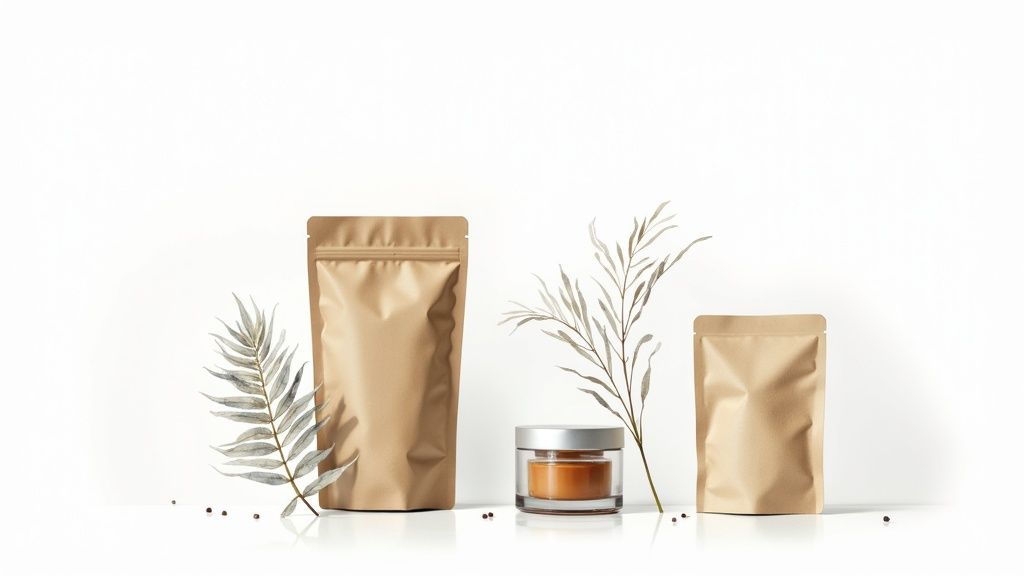
The trick is to think about the entire life of your packaging. Where do the raw materials come from? And, crucially, where will it end up within New Zealand's unique waste systems? A solution that works perfectly overseas might be a total mismatch for our local infrastructure, which makes informed, local choices absolutely vital.
Decoding Green Terminology
You’ve probably heard terms like ‘biodegradable’ and ‘compostable’ thrown around, often as if they mean the same thing. They don't. Getting your head around this difference is the first real step toward making a genuinely eco-friendly choice.
- Biodegradable: This is a broad term. It just means a material will eventually break down into natural bits and pieces. The catch? "Eventually" could mean years and years in a landfill, sometimes releasing nasty greenhouse gases in the process.
- Compostable: This is much more specific and, frankly, more useful. For something to be compostable, it has to break down into nutrient-rich soil within a set timeframe, but only under the right conditions – typically in a commercial composting facility.
For packaging to be truly compostable here in New Zealand, it needs to be accepted by our local facilities. Always hunt for official certifications to make sure the claims on the packet hold up.
Key Takeaway: If you have to choose, lean towards 'compostable' over 'biodegradable'. Compostable certification gives a clear end-of-life plan, whereas 'biodegradable' can be a vague claim that sometimes does more harm than good.
This clarity helps you be honest with your customers and stops your well-intentioned packaging from becoming another problem.
Comparing Popular Sustainable Materials
Picking the right material is always a balancing act between its green credentials, how well it protects your product, and what it costs. There's no single 'best' option – it all comes down to your specific product, brand, and budget.
One area seeing massive growth is moulded fibre pulp, made from recycled paper products. The Australia and New Zealand molded fiber pulp packaging market has already hit USD 346.10 million and is set to keep growing, largely because everyone's so concerned about plastic. It's quickly becoming the go-to for things like fresh produce, eggs, and bakery items as Kiwis demand smarter packaging.
Here are a few common materials you'll come across:
- Recycled Cardboard and Paper: A classic for a reason. It’s perfect for dry goods, widely recyclable in NZ, cost-effective, and has that natural, earthy vibe many customers love.
- Glass: It's infinitely recyclable and fantastic for preserving flavour, which makes it a winner for liquids, preserves, and other premium products. The main downsides? It’s heavy, which bumps up shipping costs, and it can break.
- Bioplastics (like PLA): These are clever plastics made from renewable stuff like corn starch. The big "but" is that they usually need a commercial composting facility to break down properly. You absolutely must check if your local facilities can handle them before you commit.
To keep up with what customers want and what the planet needs, it pays to dive deeper into the world of eco-friendly packaging materials and see what feels right for your product.
Cost-Effectiveness and Sustainability Go Hand-in-Hand
Thinking green doesn’t have to mean spending more. In fact, some of the smartest sustainable strategies are also the most economical. It often comes down to clever design and smart sourcing.
A simple but effective approach is 'lightweighting' – just using the absolute minimum amount of material you need to keep your product safe. Less material means lower costs and less waste. Simple. Buying your packaging from local New Zealand suppliers can also slash shipping costs and emissions, giving both your green credentials and your bottom line a healthy boost.
Designing Packaging That Sells Your Product
On a crowded supermarket shelf, your packaging isn't just a container; it's your most important salesperson. Think about it – it's the first handshake, the quick chat, and the final pitch all rolled into one. A great design does far more than just look pretty. It tells your brand’s story, connects with your ideal customer, and convinces them to take your product home.
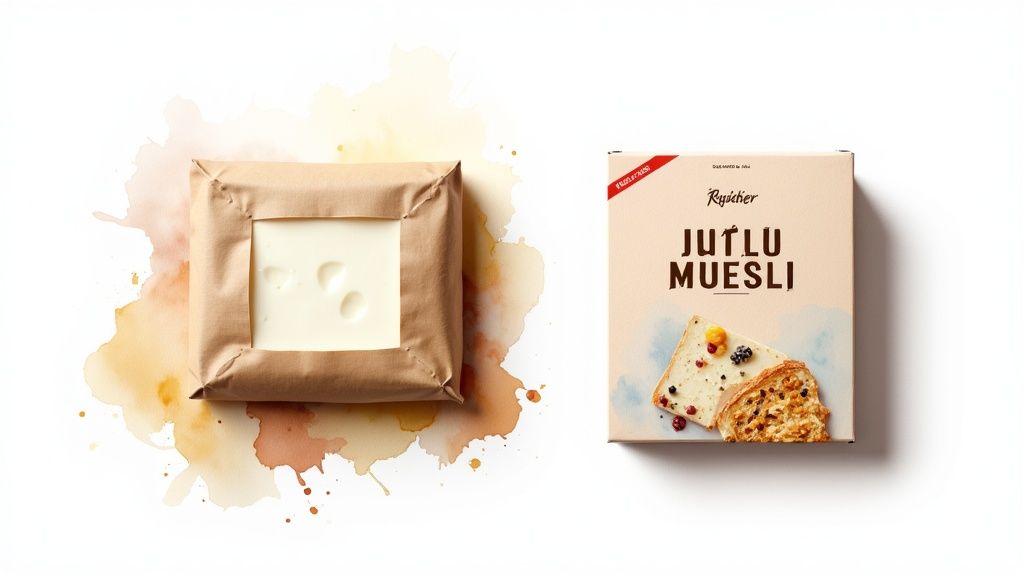
This is where the practical side of food and packaging collides with the creative world of branding. Every element you choose—your colours, fonts, and images—works together to spark an immediate emotional connection and set expectations for what’s waiting inside.
Building a Visual Story
Let's picture two different Kiwi products. One is an artisanal cheese from a small family farm in the Waikato. The other? A high-energy muesli blend made for adventurers down in Central Otago. Their packaging has to tell completely different stories to attract the right people.
For the Waikato cheese, the design might use earthy tones, elegant, classic typography, and maybe a charming illustration of the farmhouse. This instantly says heritage, quality, and tradition. The Central Otago muesli, on the other hand, would likely go for bold, vibrant colours, modern, clean fonts, and striking photos of mountains and trails, screaming energy, health, and adventure.
Your visual choices have to be deliberate and rooted in your brand's identity. Getting this foundation right is a crucial first step, long before you start thinking about the box it comes in. To get a better handle on this, you can explore more about the essentials of naming and branding your business in our dedicated guide.
Great packaging design is the silent storyteller for your brand. It should instantly communicate your product's personality, purpose, and promise without a single word being read.
By aligning your design with your brand's unique story, you’re creating a powerful, coherent message that really clicks with the people you want to reach.
The Balance of Beauty and Function
While a beautiful design is what grabs the eye, it’s completely useless if the package doesn't actually work. Real success in food packaging is found in that perfect marriage of aesthetics and practicality. Your design has to be both appealing and functional to create a positive experience from the supermarket shelf all the way to the pantry.
Ask yourself these practical questions during the design phase:
- Is it easy to open? A package that causes "wrap rage" will leave a lasting negative impression, no matter how amazing the product inside is.
- Does it protect the product? The design must work hand-in-glove with your chosen material to keep the food safe and fresh. A flimsy box for heavy items is just a recipe for disaster.
- Does it stand out? Your design needs to be visually distinct from your competitors. Take a walk down the supermarket aisle and see what everyone else is doing—then do something different.
- Is it easy to store? Awkwardly shaped packaging might look interesting, but it can be a real headache for retailers trying to stack it and for customers trying to squeeze it into their cupboards.
Getting Your Design Print-Ready
Once you've landed on a concept you love, the last hurdle is making sure it’s ready for the printers. This technical step is critical if you want to avoid costly mistakes. A professional designer will take care of this, but it’s helpful to know the basics.
Your final files need to be in the right format (usually a high-resolution PDF), use the correct colour mode (CMYK for print, not RGB for screens), and include 'bleed' and 'trim' marks. These ensure the design prints perfectly to the very edge of the package. A well-prepared file is your guarantee that the finished product looks just as brilliant in real life as it did on your screen.
Right, you’ve settled on a design and have a good idea of the materials you want to use. Now comes the part where your vision starts to become a reality: finding the right supplier to make it all happen.
Choosing who to work with is a massive decision, just as critical as the materials themselves. A great packaging partner here in New Zealand isn’t just a printer; they’re a source of invaluable advice who will work with you to find solutions that actually fit your scale and your budget.
Think of this as kicking off a long-term business relationship, not just a one-off purchase. You need a supplier who genuinely gets the specific demands of food and packaging, has rock-solid quality control, and can actually meet your deadlines. A good place to start is by researching local NZ-based companies—they'll have a much better handle on the market and you won't be stuck waiting on international shipping.
Vetting Potential Packaging Partners
Before you sign on the dotted line, you absolutely must ask the right questions. Getting this part right will save you a world of pain later on. A good supplier will be totally upfront and happy to give you detailed answers.
Put together a list of questions you’ll ask every potential partner. It’s the only way you can compare them apples-to-apples and make a choice based on what truly matters to your business.
Here are the non-negotiables you need to cover:
- Minimum Order Quantities (MOQs): For a small producer, this is often the biggest hurdle. You need to know their MOQ and if there’s any wiggle room for new businesses. Some suppliers offer stock (off-the-shelf) options with much lower MOQs than a fully custom-printed run, which can be a great starting point.
- Lead Times: Get a clear answer on how long it takes from placing an order to having the finished packaging in your hands. Dodgy lead times can throw your entire production schedule into chaos.
- Quality Control and Food Safety Certification: Ask to see proof of their food-grade certifications. This is not negotiable. It’s also worth asking about their quality control process so you know how they’d handle things like printing mistakes or dodgy materials if they ever crop up.
The Crucial Step of Package Testing
Okay, so you've picked a supplier and your first samples have arrived. The temptation to just dive into a full production run is huge, I get it. But you have to test your packaging first. This final check is your last chance to catch any problems before they become expensive failures that could wreck your product and your reputation.
Packaging validation isn't an optional extra; it's a fundamental part of managing your risk. A simple test now that reveals a flaw can literally save you thousands of dollars and protect your relationship with both retailers and customers.
Think of it as a dress rehearsal for your product’s journey from your kitchen to the customer's pantry. You need to put it through its paces to make sure it arrives in perfect shape.
How to Run Effective Packaging Trials
You don’t need a fancy, high-tech lab to do this properly. Simple, practical trials give you incredible insight into how your packaging will hold up in the real world. Your tests should focus on the two biggest risks: getting bashed around in transit and your product going off too soon.
Run a Transit Test: This is the ultimate real-world stress test. Pack your product exactly as you would to send to a customer. Seal it up, pop it in a courier box, and actually mail it to a friend (or even back to yourself). When it arrives, open it up and scrutinise it. Are there any leaks, dents, broken seals, or scuffs on the label?
Conduct a Shelf-Life Study: Make up several finished, packaged samples of your product. Store them where a customer would—in the fridge, pantry, or freezer. Then, open one each week and check for any changes. Is the colour, flavour, texture, or aroma still what it should be? This is the best way to confirm your ‘Best-Before’ date is accurate and that your packaging is doing its job of keeping the nasties out.
Your Food and Packaging Questions Answered
When you're deep in the process of getting a new food product off the ground, a hundred different packaging questions can pop up. It’s completely normal. To help clear things up, we’ve put together answers to some of the most common queries we hear from New Zealand food producers, building on everything we've covered so far.
What Is the First Step in Choosing Food Packaging?
The very first step, before you even think about colours or logos, is to get to know your product inside and out. You need to understand its unique vulnerabilities. Is it sensitive to light? Does it go soggy with a bit of moisture? Does air spoil its freshness?
A crispy cracker, for instance, needs a solid defence against humidity to stay snappy. On the other hand, a fresh-pressed juice needs protection from light that can degrade its vitamins. This initial analysis will tell you exactly which barrier properties your packaging absolutely must have. Only then can you start weighing up other important factors like your budget, sustainability goals, and the look you’re going for on the shelf.
How Can I Reduce Packaging Costs as a Small Business?
Keeping costs down is a massive priority for any small business, and thankfully, there are clever ways to do it without compromising on quality or safety. A great place to start is simply talking to your suppliers about their standard, off-the-shelf options. Designing a completely bespoke shape or size from scratch will always be the more expensive route.
Another smart tactic is called ‘lightweighting’ – essentially, using the leanest, most minimal amount of material possible while still keeping your product perfectly safe. Sourcing from local NZ suppliers is another big one, as it can slash your freight costs. And don't forget to ask about price breaks; ordering a slightly larger quantity can often bring your per-unit cost down significantly.
The most affordable packaging is the one that prevents product damage and spoilage. Cutting costs on materials is a false economy if it results in lost stock, so always prioritise protection first.
Do I Need a Unique Barcode for My Product?
Yes, absolutely. If you have any plans to sell your product through most retailers here in New Zealand, you will need a GS1 barcode. This isn't just a friendly suggestion; it's a non-negotiable part of modern retail.
That unique number is what gets scanned at the checkout, and it’s the backbone for everything from the store’s inventory management to your own sales tracking. It’s what makes your product uniquely identifiable among thousands of others. You can license your official barcodes directly from GS1 New Zealand. Once that’s sorted, you can put your energy into building effective small business marketing strategies to get your product flying off the shelves.
What's the Difference Between Compostable and Biodegradable?
This is a big one. These terms get thrown around as if they’re interchangeable, but they mean very different things. Getting this right is critical, especially if you’re making environmental claims on your packaging.
- Biodegradable is a vague term. It just means a material will eventually break down into natural elements. The catch is that "eventually" has no defined timeline—it could sit in a landfill for hundreds of years.
- Compostable is much more specific and meaningful. It means a material will break down into nutrient-rich soil within a specific timeframe, but only under the controlled conditions of a commercial composting facility.
For your packaging to be genuinely eco-friendly here in NZ, you need to look for official compostable certifications that match up with our local waste processing capabilities.
At Prac Skills, we provide practical, career-focused online courses to help Kiwis build their passions and businesses. Learn the skills you need to succeed at your own pace. Discover your next step at https://www.pracskills.co.nz.