December 13, 2025
.webp)
How to Start a Small Business NZ Your Guide
Thinking about how to start a small business NZ? Get a clear, actionable guide on business structures, registration, funding, and marketing in New Zealand.
Career Development
minutes
How to Start a Small Business NZ Your Guide
Starting a small business in New Zealand really boils down to three core phases: checking if your idea has legs, sketching out a simple plan, and getting your head around the official stuff. It’s a practical journey that’s all about taking action, not chasing formal qualifications.
Your First Steps to a Thriving NZ Business
The dream of launching your own business can feel massive and tangled, but honestly, every successful Kiwi venture kicks off with the same basic steps. It always starts with that spark of an idea. But the crucial next step is a dose of reality-checking to see if it can actually fly in the real world.
This is where you confirm if people will genuinely open their wallets for what you're offering.
Forget splashing out thousands on professional market analysis right now. Real-world research can be as simple as just talking to the people you hope to sell to. Ask them straight up: what problems are they facing that you could solve? What are they using at the moment, and what drives them crazy about it? A few honest chats can give you more gold than weeks of staring at a computer screen.
This simple process shifts you from, "I think this is a good idea," to "I know who my customer is and what they actually need."
Assess Your Idea and Market
Before you pour any significant time or money into this, you need to be brutally honest with yourself. Is there a genuine need in the New Zealand market for what you’re planning? A brilliant idea is only brilliant if it solves a real problem for a specific group of people.
Who are they? Where do they hang out? What makes them tick? Nailing these answers builds you a rock-solid foundation.
Create a Simple Roadmap
Once you’ve confirmed you’ve got an audience, it’s time to map things out. This doesn’t need to be some stuffy, 50-page document you’ll never look at again. A one-page business plan is an incredibly powerful tool for getting your vision clear and setting some achievable goals. Think of it as your roadmap, keeping you focused on what truly matters in these early days.
If you need a hand structuring your thoughts, you can learn more about how to develop a business plan that actually works for you.
This simple visual sums up the flow perfectly: first assess, then research, and finally, plan.
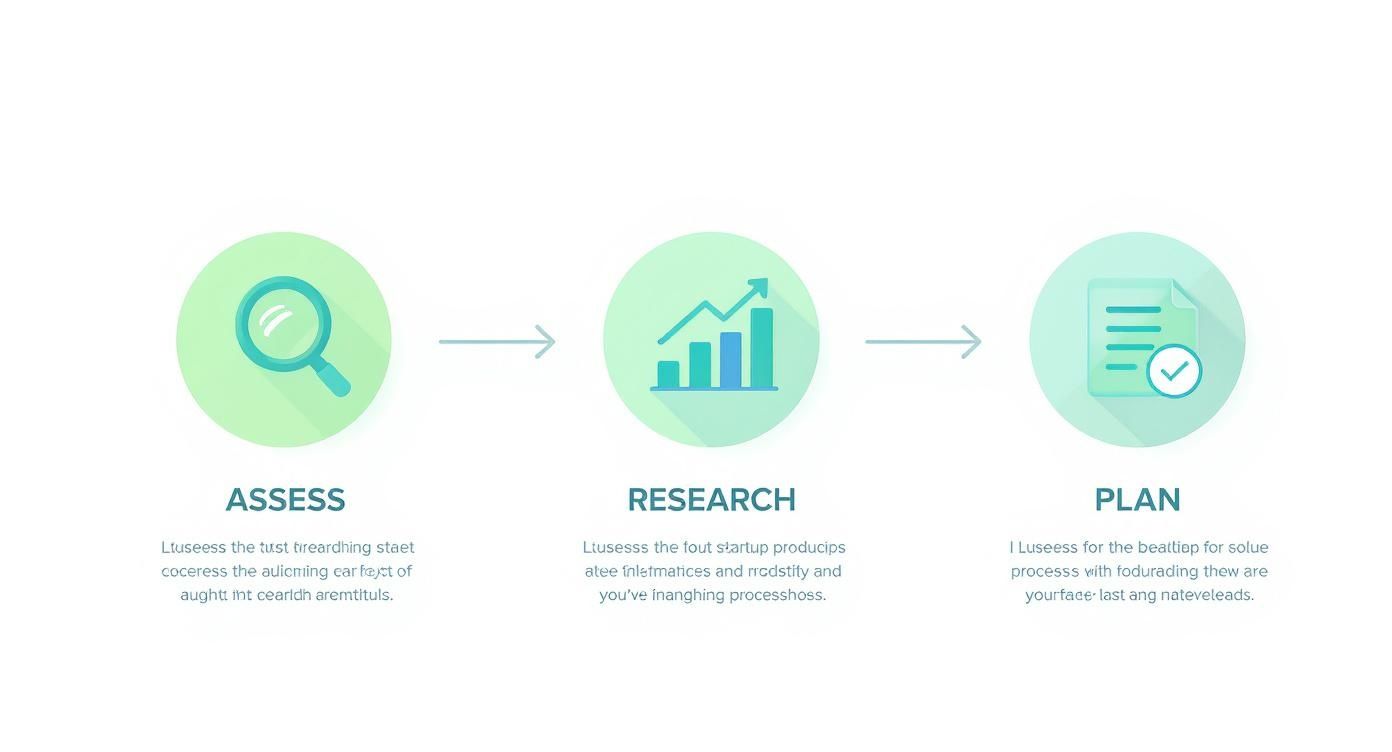
Following this process means you're building a business on solid evidence, not just a gut feeling. It’s the best way to set yourself up for success from day one.
Right, you've got a solid idea and you're ready to make it official. The next step is giving your new venture a proper legal identity. How you decide to structure your business is one of the first big calls you'll make, and it has a real impact on your personal risk, your tax bill, and how you can grow down the track.
Let's break down the main options for getting started in New Zealand.
For a lot of Kiwis dipping their toes in, becoming a sole trader is the simplest way forward. Essentially, you are the business. This means you can just use your personal IRD number to get going, which keeps the admin nice and light. It's the perfect setup for freelancers, consultants, or anyone giving a side hustle a go. The big thing to keep in mind, though, is that there's no legal wall between you and the business—if things go south, your personal assets aren't protected.
If you're teaming up with someone, you'll probably look at forming a partnership. It works a lot like being a sole trader, but all the profits, losses, and responsibilities are split between you and your partners. It's absolutely crucial to get a solid partnership agreement drawn up from the get-go to head off any arguments later on.
Deciding on Your Business Structure
Choosing the right legal setup is all about finding that sweet spot between simplicity and protection. The third, and most common, structure for anyone with plans to scale is a limited liability company.
When you register a company, you create a brand-new legal entity. This is a total game-changer because it separates your personal assets from the business's debts. If the business hits hard times, your house and car are generally safe. It does mean a bit more paperwork and some yearly compliance tasks, but for most long-term ventures, that protection is priceless.
Key Takeaway: As a sole trader, you have all the control, but you also carry all the liability. A company, on the other hand, puts a legal shield between your personal life and your business. Have a good think about your long-term goals and what level of risk you're comfortable with.
Here’s a quick rundown to help you weigh it all up:
- Sole Trader: Super simple to set up and you're the boss, but you have unlimited personal liability. All profit is treated as your personal income.
- Partnership: You can pool resources and skills, but remember you're also on the hook for your partner's business decisions.
- Company (Ltd): Your personal assets are protected, it's easier to bring in investment, but it comes with more formal admin and reporting duties.
Finding and Securing Your Business Name
Once you've landed on a structure, it's time for the fun part: picking a name. This isn't just about getting creative; your name needs to be unique, available, and easy for people to remember. It's the very foundation of your brand. A great name gives customers a clue about what you do and is simple enough that they can find you without a struggle.
Your first stop should be the government's ONECheck tool. This thing is brilliant. It lets you check if your name is free as a company name, a domain name, and on social media, all in one go. It'll save you the pain of falling in love with a name only to find out the .co.nz domain is already taken.
When you find a name that's good to go, don't hang around.
- Register the Domain: Snap up the .co.nz version straight away. If you think you might go global one day, grab the .com as well.
- Claim Social Media Handles: Even if you don't plan on using them immediately, secure your business name on platforms like Instagram, Facebook, and LinkedIn.
- Check for Trademarks: A quick search on the New Zealand Intellectual Property Office (IPONZ) website is a smart move. It can prevent some serious legal headaches later on.
For a deeper dive into the creative side of things, our guide has more detailed advice on naming and branding your new venture.
Finally, every registered business in New Zealand gets a New Zealand Business Number (NZBN). This is a unique global ID that makes dealing with government agencies, suppliers, and other businesses much easier. Think of it like an IRD number for your business—it helps streamline everything from invoicing to applications, making life a whole lot simpler.
Making it Official: NZ Business Registration and Taxes

You've landed on a business structure and a name you love. Now it's time to get into the nitty-gritty of making it all official. This part can feel a bit daunting, but it’s really just a series of logical steps. Getting these foundations right from day one will save you a world of headaches down the track.
The path you take here is directly tied to the business structure you chose earlier. For many Kiwis just starting out, the sole trader route is the simplest way to begin earning money without getting tangled in complex paperwork.
Getting Registered the Right Way
If you’re kicking off as a sole trader, you're in luck. There's no formal business registration process required. You can start trading almost immediately using your personal Inland Revenue (IRD) number. It’s the most straightforward way to get going, perfect for freelancers, contractors, or that side hustle you're finally launching.
For those who have chosen to set up a limited liability company, things are a little more formal. You’ll need to register your company with the New Zealand Companies Office. This involves officially reserving your company name (which you hopefully locked down in the previous step) and providing details about the company's directors and shareholders.
Having a broader understanding of how to register business names can be helpful, even beyond the specific NZ process, as you think about building your brand's presence.
Once your company is registered, it will be issued its own unique IRD number. This is a crucial step that creates the legal separation between you and your business.
Wrapping Your Head Around Tax
Right, let's talk about tax. It's an unavoidable—and essential—part of running a business in New Zealand. Getting a handle on your obligations to Inland Revenue (IRD) from the start is non-negotiable. The main things you’ll need to think about initially are GST and income tax.
Goods and Services Tax (GST) is a 15% tax applied to most goods and services in NZ. You only have to register for GST once your annual turnover (your total income before expenses) is likely to hit or exceed $60,000 within any 12-month period.
However, many small businesses choose to register voluntarily long before hitting that threshold. Why? Because being GST-registered allows you to claim back the GST you pay on your business expenses. This can really add up. The trade-off is more frequent paperwork with IRD, so you need to weigh up what makes sense for you.
Expert Tip: If your main clients are other GST-registered businesses, being registered yourself can make you look more established and professional. It also makes their accounting easier, which is a small but powerful way to be good to work with.
Income tax is what you pay on your business's profit. As a sole trader, your business profit is simply added to any other personal income you have and taxed at your marginal tax rate. For a company, the business pays income tax on its profits at the current company tax rate.
As you start making money, you'll also encounter provisional tax. This isn't a new tax, but a system for paying your income tax throughout the year, rather than facing one massive bill. If your tax to pay at the end of the year is more than $5,000, you'll generally be required to pay provisional tax the following year.
Don't Forget About ACC Levies
One final piece of the compliance puzzle is ACC. The Accident Compensation Corporation (ACC) provides no-fault personal injury cover for everyone in New Zealand. As a business owner or self-employed person, you’ll pay levies that fund this essential cover.
These levies mean that if you get injured and can't work, ACC can provide support, including weekly compensation for lost earnings and help with treatment costs. What you pay depends on how risky your line of work is and how much you earn.
Here’s a quick breakdown of what you'll pay:
- Work Levy: The main levy for all businesses, calculated based on your industry code and liable earnings.
- Earners' Levy: Paid by everyone who earns an income, including you as a self-employed person or a shareholder-employee.
- Working Safer Levy: A small, flat levy that helps fund WorkSafe NZ's health and safety initiatives.
After you file your first tax return, IRD passes your income details to ACC, and they'll send you an invoice. It's crucial to budget for this—it can be a nasty surprise if you're not expecting it! Getting your head around these registration and tax details is a fundamental step in learning how to start a small business in NZ the right way.
Funding Your Startup and Managing Finances
Every great business idea needs fuel to get off the ground and keep running. Figuring out how to fund your venture and manage the money wisely are two of the most critical hurdles when you're starting out in New Zealand. Let’s break down the real-world options for financing your business and the simple habits that will build a strong financial foundation from day one.
For many Kiwi entrepreneurs, the first source of cash is the one closest to home: your own savings. This is called bootstrapping, and it means you’re relying entirely on your own money to get going. It’s a powerful way to maintain complete control and avoid debt early on, but it also forces you to be incredibly resourceful and watch every dollar.
If your savings won't quite stretch far enough, the next natural step is often friends and family. This can be a fantastic way to get the capital you need, but you have to treat it with extreme care and clarity. This isn't a casual loan. Put everything in writing, outlining whether it's a loan with a clear repayment schedule or an equity investment for a stake in the business.
Exploring External Funding Options
When personal funds just aren’t enough, it’s time to look at more formal channels. Approaching a bank for a business loan is a common next step, but don’t expect to just walk in and get a cheque. You need to be well-prepared. Banks want to see a rock-solid business plan that proves you understand your market, your numbers, and exactly how you’ll generate enough revenue to make repayments.
Beyond the big banks, New Zealand has some excellent support systems designed specifically to help new ventures find their feet. The Regional Business Partner Network is a brilliant first port of call. They can connect you with expert advice, helpful resources, and even point you toward funding opportunities in your local area.
It's also worth keeping an eye out for various government grants and schemes that pop up, which are often aimed at specific industries or regions. Bookmark websites like Business.govt.nz to stay on top of the latest announcements.
For businesses with serious growth potential, angel investment might be on the cards. These are seasoned investors who provide capital in exchange for equity, and they often bring valuable expertise with them. To get a better feel for this world, check out our guide on finding angel investors in New Zealand.
Building Smart Financial Habits Early
How you manage your money is just as important as how you raise it. The single most important habit to start from day one is to open a separate business bank account. Seriously. Mixing your personal and business finances is a recipe for confusion, stress, and a massive headache come tax time.
A dedicated account gives you a crystal-clear picture of your business's cash flow—what's coming in and what's going out. It simplifies expense tracking and, just as importantly, shows the IRD that you're operating like a professional.
This leads directly to the next crucial practice: basic bookkeeping. You don’t need to be an accountant, but you absolutely need to keep accurate records. This can start with something as simple as a spreadsheet where you log every bit of income and every single expense.
Choosing the Right Accounting Tools
As your business grows, that simple spreadsheet will quickly become a liability. This is where user-friendly accounting software becomes a total game-changer. Tools like Xero or MYOB are built for small Kiwi businesses and can automate a huge amount of the financial admin.
They can help you:
- Create and send professional invoices and keep track of who has paid you.
- Connect directly to your business bank account to automatically pull in and categorise transactions.
- Manage your GST obligations and make filing returns a much less painful process.
- Generate key financial reports, like a Profit & Loss statement, giving you an instant snapshot of how your business is actually performing.
Getting your finances organised from the start is essential for stability. The recent economic climate really drives this point home. While small businesses recorded a 1.9% year-on-year increase in nominal sales in the September 2023 quarter, this growth was largely eaten up by inflation. You can dig into more insights on the current state of NZ small business sales from Xero. This data shows just how vital it is to have a tight grip on your finances to navigate any economic pressure.
Getting Your Head Around the Legal Stuff
Okay, you're registered and have your finances sorted. Now for the day-to-day rules of running a business in New Zealand. This isn't just about keeping the tax department happy—it’s about operating fairly, keeping people safe, and ultimately, protecting the business you’re working so hard to build.
It's easy to see these legal bits as restrictive red tape, but try to think of them as the framework that builds trust with your customers and protects you from some pretty serious risks.
Looking After Your Customers and Your Reputation
Two big pieces of law form the foundation of consumer rights here in NZ: the Fair Trading Act and the Consumer Guarantees Act. You don't need to become a lawyer, but you absolutely need to get the gist of what they mean for your business.
The Fair Trading Act 1986 is all about being straight up. It makes it illegal for businesses to mislead or deceive customers in any way. This applies to everything from your advertising and pricing to any claims you make about your products. If you say your product is "Kiwi-made," it had better be.
Then there's the Consumer Guarantees Act 1993 (CGA), which makes sure the things you sell are actually up to scratch. It gives customers powerful rights, guaranteeing that products are of an acceptable quality, fit for their purpose, and match how you described them. If you sell something faulty, you’re legally on the hook to sort it out with a repair, replacement, or refund.
Creating a Safe Workspace
It doesn’t matter if you have a team of ten or you're a sole trader working from your kitchen table—health and safety is your responsibility. The Health and Safety at Work Act 2015 means you have to manage risks to look after the wellbeing of your staff, customers, contractors, and even yourself.
This doesn't mean you need to generate a mountain of paperwork. It’s about taking practical, common-sense steps. Identify what could go wrong in your workplace and do what's reasonable to stop it from happening. That could be anything from teaching proper lifting techniques in a stockroom to managing digital fatigue for your remote team.
Insurance: Your Business Safety Net
Insurance is one of those expenses you hope you never have to use, but you'll be incredibly grateful for it if you do. It's the critical safety net that protects your new venture from unexpected events that could otherwise wipe you out financially.
A few types of insurance are pretty much non-negotiable for a new business:
- Public Liability Insurance: This is a must-have if customers come to your premises or if you work at their places. It covers you if someone gets injured or their property is damaged because of your business activities.
- Professional Indemnity Insurance: Absolutely essential for anyone giving advice or professional services—think consultants, designers, or IT specialists. It protects you if a client claims you've been negligent or made a mistake that cost them money.
- Statutory Liability Insurance: This one covers your legal defence costs and potential fines if you unintentionally break certain New Zealand laws, like the Health and Safety at Work Act.
Getting these legal requirements right is a huge part of building a resilient business, especially when the economy is a bit shaky. With small business confidence staying low, protecting your venture from avoidable risks has never been more important.
The latest CPA Australia survey really drove this point home, revealing that only 36% of New Zealand's small businesses grew last year—a big drop from the year before. You can read more about what Kiwi businesses are up against in the full CPA Australia small business survey.
Finding Your Industry-Specific Licences
Finally, don't forget that some industries have their own rulebook. If you're starting a café, you'll need a food licence. If you're a builder, you'll need to know the ins and outs of building consents and trade certifications.
A brilliant place to start is the Compliance Matters tool on business.govt.nz. It's designed to help you quickly pinpoint the specific regulations that apply to your line of work.
Alright, you've done the hard yards setting up the legal and financial side of things. Now for the exciting part: finding your first customers. This is where your go-to-market plan comes in, and don't worry, it doesn't need a massive budget. Early momentum is all about smart, focused actions.

First things first, you need to get crystal clear on who you're actually selling to. You simply can't be everything to everyone, especially when you're starting out. Who is your ideal customer? What specific problem are you solving for them? Once you know that, you can nail down your Unique Selling Proposition (USP)—that one special thing that makes you the obvious choice over anyone else.
Building Your Digital Footprint
In New Zealand today, a solid online presence is non-negotiable, but it doesn't have to be complicated or expensive. Your main goal is just to be findable and look professional.
Start with a clean, simple website. Platforms like Squarespace or Wix are fantastic for beginners and let you build a great-looking site without touching a line of code. It only needs to do three things well: say what you do, show people how to contact you, and make you look credible.
Next up, and this is an absolute must for any local Kiwi business, set up your Google Business Profile. It’s completely free and is hands down the most effective way to show up in local search results and on Google Maps. To really make this work for you, it's worth exploring local SEO strategies for small businesses in NZ.
Don’t spread yourself thin trying to be on every social media platform. Pick one or two where your ideal customers actually hang out. A local builder will get far more value from a professional LinkedIn profile, whereas a cake decorator will thrive on a visual platform like Instagram.
A Go-to-Market Checklist for Kiwis
Getting those first sales is about consistency, not complexity. Here’s a simple checklist to get you moving without feeling overwhelmed:
- Professional Website: Make sure it’s mobile-friendly and your USP is front and centre.
- Google Business Profile: Fill out every single section. Then, gently encourage your first happy customers to leave you a review.
- Focused Social Media: Pick one platform and consistently share useful, interesting content. Think value, not just sales pitches.
- Simple Email List: Start collecting email addresses from day one. It's a direct channel to your most loyal customers.
This focused approach helps you stand out. As of early this year, New Zealand had around 617,330 enterprises, and small businesses like yours make up about 97% of that total. You're in good company, but you need to be smart to get noticed.
The Power of Local Connections
Never, ever underestimate the power of word-of-mouth in New Zealand. Your local community can be your best marketing tool, period.
Get involved with local business groups or pop along to networking events. It's often these real-world connections that lead to your most loyal customers and valuable referrals. In a small country like ours, your reputation in your community is one of your greatest assets.
Common Questions About Starting a Business in NZ
Diving into business ownership for the first time? It's natural to have a tonne of questions swirling around. Let's tackle some of the most common queries we hear from aspiring Kiwi entrepreneurs, with clear, simple answers to get you moving forward.
How Much Does It Cost to Start a Small Business in New Zealand?
Honestly, there's no single price tag. Your costs will swing wildly depending on what kind of business you're launching. A freelance writer has vastly different startup needs than a cafe owner.
That said, there are a few common costs you can plan for. Registering your company with the Companies Office will set you back about $120. From there, you'll likely need to secure a domain name, maybe a simple website, and of course, any initial stock or equipment to get the doors open.
The good news? So many incredible Kiwi businesses started on a shoestring budget. The trick is to focus only on what's absolutely essential to make that first sale, and then reinvest your revenue from there.
Do I Need a Formal Business Plan?
Look, you don't need to lock yourself away for a week and write a fifty-page document that'll just end up gathering dust on a shelf. But a simple, one-page plan? That's an absolute game-changer.
Putting your idea down on a single page forces you to get crystal clear on what you're selling, who you're selling it to, and how the numbers will stack up. This simple roadmap is often all you need to keep yourself on track. Plus, if you ever decide to look for funding from a bank or an investor, they'll definitely want to see it.
Where Can I Find Support and Mentorship in NZ?
You’re not in this alone, and that's the best part about starting a business in New Zealand. There's a fantastic support network out there for new founders.
A brilliant first port of call is the Regional Business Partner Network. They can connect you with local advice, resources, and even funding opportunities right in your area. Don't forget about your local Chamber of Commerce or any industry-specific groups either—they're goldmines for mentorship and networking.
Ready to build the practical skills your new venture needs to thrive? At Prac Skills, we offer a range of job-focused courses designed for the realities of the New Zealand market. Explore our courses and start learning today.