
December 11, 2025
.webp)
Your Guide to Finding the Right Care Training Online in NZ
Discover how to start a rewarding healthcare career with care training online. Our guide covers choosing, funding, and succeeding in accredited NZ courses.
Career Development
minutes
Your Guide to Finding the Right Care Training Online in NZ
A career that genuinely makes a difference often begins with education that fits into your life. For anyone drawn to helping others, care training online is a flexible and direct way into New Zealand's essential healthcare sector, letting you build job-ready skills on your own schedule.
Why Online Care Training Is Your Gateway to a Meaningful Career
Let's be real for a moment: New Zealand needs more skilled carers. It's a fact.
From busy aged care facilities to families looking for reliable support at home, the demand for compassionate, well-trained professionals is growing every single day. This isn't just a number on a report; it's a real challenge felt in communities right across the country.
Teams are stretched thin, working incredibly hard to provide the quality support people deserve, but the gap is undeniable. This is exactly where you can step in and make a tangible impact. A career in care isn't just another job—it's your chance to bring comfort, dignity, and practical help to those who need it most.
Meeting a Critical National Need
The numbers don't lie. New Zealand's healthcare sector is facing a serious shortage, with a pressing need for an additional 8,232 full-time equivalent carers. That's a massive 38% increase needed just to meet safe care standards.
With enrolments in traditional, campus-based training struggling to keep up, flexible online learning pathways have become absolutely essential to filling this workforce gap. You can dig into the specifics in the full NZNO report on staffing needs in New Zealand's healthcare sector.
This reality creates incredible opportunities for people searching for truly meaningful work. By choosing to train online, you're not just starting a new career; you're stepping up to fill a crucial role that directly strengthens the well-being of your own community.
Flexibility That's Designed for Real Life
The old-school model of education simply doesn't work for everyone. Many of the best future carers are already juggling other major commitments, whether that's raising a family, working another job, or just managing the chaos of a busy life. Online learning breaks down those barriers.
It provides a practical and genuinely accessible pathway into these vital roles. The benefits are clear:
- Learn on Your Schedule: Study whenever it works for you—first thing in the morning, on your lunch break, or after the kids have finally gone to bed.
- Progress at Your Own Pace: Move through the course material at a speed that feels right, giving you the time to properly grasp each concept before tackling the next.
- Study from Anywhere: Access your entire course from anywhere in New Zealand. Forget the daily commute to a physical campus.
This flexibility is what makes it all possible. It empowers people from all walks of life to follow their passion for caring without having to hit pause on everything else. It makes a career change feel achievable, not completely overwhelming.
Ultimately, deciding to take on care training online is an investment in a future where your work has a direct, positive impact every day. It’s about getting the skills and the confidence you need to walk into a healthcare role, ready to contribute from day one.
Choosing an Online Care Course That Fits Your Goals
With so many online care training options out there, figuring out where to even begin can feel like a huge task. The best starting point? You. What’s really driving you to explore a career in care?
Maybe you feel a strong pull towards supporting the elderly in an aged care setting. Perhaps your passion is helping people with disabilities live with more independence and dignity. For others, a foundational course is the perfect stepping stone into a longer journey in health studies. Nailing down your "why" is the single most important step in finding a programme that will actually get you where you want to go.
It’s a straightforward path: understand the need, get the right training, and launch a career that truly matters.
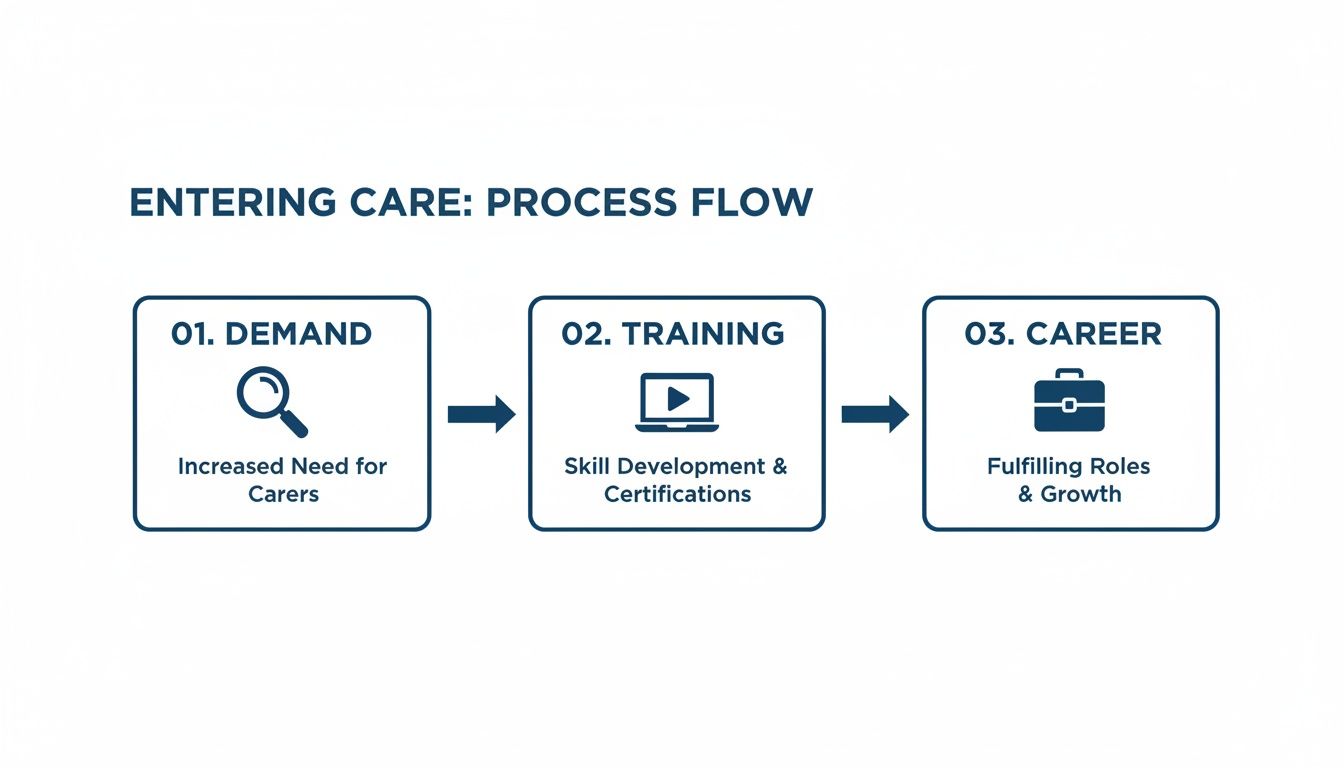
This process shows that the journey starts by seeing where you can make a difference, and then finding the specific education to make it happen.
Accreditation vs. Qualifications: What's the Difference?
One of the first things you’ll bump into is the language around course recognition. It’s absolutely vital to know the difference between industry accreditation and a formal New Zealand Qualifications Authority (NZQA) qualification. Getting this clear will make sure the course you pick matches your career goals.
Industry Accreditation (like ICOES & CPD): Think of this as a stamp of quality from the industry itself. Bodies like the International Council for Online Educational Standards (ICOES) and the CPD Certification Service check that a course meets international standards for quality content and delivery. It tells employers you’ve got a solid, practical foundation recognised by the sector.
NZQA Qualifications: These are the formal, nationally recognised qualifications that are part of the New Zealand Qualifications Framework (NZQF). They’re typically longer, more academic programmes offered by universities, polytechnics, and NZQA-registered private training establishments.
Many training providers, including us here at Prac Skills, are not NZQA-registered. Our focus is different. We specialise in providing high-quality, hands-on training that carries internationally recognised accreditation. This is all about getting you job-ready skills efficiently, without the time and cost commitment of a multi-year degree.
Think of it like this: an accredited certificate proves your commitment and gives you the core knowledge to be a fantastic candidate for entry-level roles. It’s a fast, effective way to get your foot firmly in the door.
The Must-Have Features of a Great Online Course
Okay, so you’ve got your goals sorted and you understand the accreditation landscape. Now it’s time to look at the courses themselves. Let me be frank: not all online training is created equal. You need to look for specific features that will build both your skills and your confidence.
Before you commit, it’s a great idea to explore the range of courses available for care training online and compare how they structure their modules and what they offer.
Here is a quick look at the things I always tell people to prioritise.
Comparing Key Features of Online Care Courses
When you're weighing up your options, having a clear checklist can make all the difference. This table breaks down what you should be looking for and, more importantly, why it matters for your future career in care.
Looking for these key markers will help you cut through the noise and find a programme that delivers real, practical value, not just a piece of paper.
For a great example of a course that pulls all this together, look at something like the NCFE CACHE Level 3 Diploma in Adult Care. It’s designed to prepare you for a range of roles by blending in-depth theory with practical application. Choosing a course with these kinds of features means you’ll finish not just with a certificate, but with the genuine confidence to step into a care role and start making a difference from day one.
How to Succeed in Your Online Learning Journey
Thriving as an online student is about much more than just logging into a portal. To really succeed in your online care training, you need to build a routine that actually works for you, connect the theory with what you'll be doing on the job, and actively use the resources you're given. It’s all about creating a sustainable structure from day one.
Think about someone like 'Sarah', who works part-time at a local cafe and has family commitments. A standard 9-to-5 course is out of the question, but she’s passionate about starting a career in aged care. Her success isn't going to come from generic study tips; it's going to come from smart, practical strategies that fit into her already busy life.

Building Your Personalised Study Plan
The key to staying on track is a realistic schedule that respects your other commitments. Forget trying to cram everything into one marathon session; consistency is so much more effective. For someone like Sarah, a technique called time blocking is a game-changer.
She can look at her week and carve out specific, non-negotiable slots for study. Maybe it’s an hour before her morning shift, 45 minutes on her lunch break, and a couple of solid hours on a Sunday afternoon. These aren't just vague ideas—they're appointments with her future career.
Here are a few actionable ways to make this work for you:
- Break It Down: Instead of staring at a huge module, divide it into smaller, manageable chunks. Aim to complete just one or two short lessons per session.
- Create a Dedicated Space: Find a quiet corner at home where you can focus. This simple act signals to your brain that when you're there, it's time to learn.
- Set Clear Goals: For each study block, have a specific goal in mind, like "complete the infection control quiz" or "watch the video on communication skills."
This approach turns a daunting course into a series of small wins, which is absolutely crucial for keeping your momentum going.
The most successful online learners are proactive. They don't just passively consume information; they actively schedule their learning, engage with the material, and aren't afraid to ask for help when they need it. This mindset makes all the difference.
Balancing Theory with Practical Application
Caregiving is a hands-on profession, so your training has to prepare you for what it’s really like on the floor. This means you need to actively connect the theory you're learning on screen to how you'll actually use it in a care facility or a client's home.
A great way to do this is by keeping a reflective journal. As you learn about a concept like patient dignity, jot down a few notes on what that would look like in practice. How would you demonstrate it? This simple exercise bridges the gap between knowledge and action.
Understanding how you learn best is a huge advantage. You can discover more by exploring the concepts of active versus passive learning and find your ideal method in our detailed guide.
And don't hesitate to lean on the support systems your course provides. If you're unsure how a theoretical concept applies in the real world, reach out to your tutor. That’s what they’re there for—to provide clarity and help you build the confidence you need to turn your certificate into a successful career.
From Certificate to Career: Your Next Steps
Finishing your online care training and getting that certificate in your hands is a massive win. But it's not the end of the road—it's the beginning of a new one. The real question is, what now? Let's break down how to turn that hard-earned credential into a tangible job opportunity in New Zealand's healthcare sector.
Think of your certificate, particularly one with international industry recognition from bodies like ICOES or CPD, as more than just paper. To an employer, it’s a bright, flashing sign that you're committed, proactive, and have a solid grasp of the fundamentals. It shows you’ve put in your own time to learn the essentials of quality care, from patient safety to communication.

Making Your CV Stand Out
Your CV is your first handshake with a potential employer, and that new certification needs to be front and centre. But don't just list it—frame it. You need to show off the practical skills you’ve picked up and directly answer the hiring manager’s big question: "Why should I hire you?"
Here’s a simple way to make it pop under a heading like "Education & Professional Development":
- Certification Title: The name of your course, for example, "Certificate in Aged Care & Disability Support."
- Issuing Body: The training provider you studied with.
- Accreditation: This is a key trust signal. Mention the international recognition, like, "Accredited by ICOES and the CPD Certification Service."
- Key Skills: This is your chance to shine. Use a few bullet points to list the job-ready skills you learned. Think from an employer's perspective.
For example, your skills section could look something like this:
- Proficient in modern infection control procedures and patient safety protocols.
- Skilled in compassionate communication techniques for clients with diverse needs.
- Trained in ethical responsibilities and maintaining client dignity in care settings.
This little bit of detail shows you didn't just tick a box; you've gained valuable, practical skills that you can bring to the job from day one.
Nailing the Conversation in an Interview
When you land that interview, be ready to talk about your care training online experience with genuine confidence. Employers are curious. They want to know why you chose this training and what you actually got out of it.
Instead of just saying, "I did an online course," tell them your story. Try something like, "I chose an online programme because the flexibility meant I could upskill while still managing my other commitments. The modules on dementia care were incredibly insightful, and the practical assessments gave me the confidence I needed to handle real-world situations."
Your certificate is a powerful launchpad. It is not a formal NZQA qualification, but it serves as compelling proof of your foundational knowledge and dedication. For employers filling entry-level roles, this demonstrates that you are a motivated candidate who is genuinely prepared for the responsibilities of a caregiver.
This training swings open doors to a number of crucial entry-level positions where you can start making a real difference straight away. Common career pathways include roles like Healthcare Assistant, Aged Caregiver, Disability Support Worker, or Community Carer. Each of these roles builds directly on the core skills you've just mastered, giving you a solid foundation for a long and rewarding career in the health sector.
Funding Your Training and Finding Support
Investing in your career is a big step, and let's be honest, the cost of quality online care training is a real consideration for most of us. Worried about how you'll cover the fees? Don't be. You’re definitely not alone, and there are plenty of support systems and practical options out there to make it happen.
The key is knowing where to look. When you can navigate the financial side of things with confidence, you can focus on what really matters: gaining the skills you need for a rewarding new role.
Exploring Government Support in New Zealand
For many Kiwis, the first port of call should be Work and Income. If you're currently looking for work or meet certain criteria, you might be able to get funding for training that directly boosts your chances of getting a job. Their main goal, after all, is to help people get the skills they need to join or rejoin the workforce.
Here’s what you need to know:
- Training and Study Support: Work and Income has various types of assistance that can help with course fees and other related costs for approved training programmes.
- Eligibility is Key: It’s all handled on a case-by-case basis. The best thing to do is book a chat with a case manager to discuss your career goals and the specific online care course you're interested in.
- Come Prepared: When you go to your appointment, have all the course information handy. Be ready to explain exactly how this training will equip you for an in-demand role as a carer.
This path does require you to be proactive, but it can be a massive help financially for those who are eligible. It’s a system designed to support Kiwis upskilling for essential industries, and healthcare is right at the top of that list.
Practical and Flexible Payment Options
Beyond government help, many training providers get that learners need flexibility. They often have their own payment solutions to ease the financial pressure and make education more accessible.
An investment in a training certificate is a direct investment in your future earning potential. Studies show that even short-term programmes can provide real clarity on job pathways and give graduates a clear advantage with employers.
One of the most popular options is a flexible payment plan. Instead of finding the whole course fee upfront, you can spread the cost over several weeks or months. This makes budgeting so much easier and removes a huge barrier for a lot of aspiring carers. To help ease the cost of training, you can also look into external resources for financial aid and scholarships for CNAs that might offer crucial support. Always ask a potential training provider about their payment options before you sign up.
Why Prac Skills Partners with Aspiring Carers
Starting a new career in care isn't just about ticking a box on a course. It's a massive step, and you need a partner who gets it—someone who understands your ambitions and the day-to-day realities of the job. It takes practical skills, real confidence, and training that actually fits into your life. That's exactly why we built Prac Skills: to be that partner for aspiring carers all across New Zealand.
Our whole approach is built on a pretty simple idea: give people accessible, industry-relevant training that makes them genuinely job-ready. We do this by zeroing in on what actually matters to you and your future employers. This means our course content is grounded in real-world situations you'll face on the job, not just dusty old theories.
We also know that even the most motivated person has questions along the way. That’s why we provide dedicated tutor support. Having an expert to turn to for guidance is absolutely vital for building the confidence you need to step into a new role and feel like you belong.

Commitment to Quality and Transparency
We believe in being upfront, so let’s be crystal clear: Prac Skills is not an NZQA-registered training provider. Our focus is different. Instead of offering formal qualifications from the New Zealand Qualifications Framework, we provide high-quality care training online that is respected internationally through leading accreditation bodies.
- International Council for Online Educational Standards (ICOES): This accreditation is your assurance that our courses meet global standards for quality and professionalism.
- CPD Certification Service: Our courses are also CPD-accredited, which signals a commitment to ongoing professional development that employers really value.
This specific focus allows us to offer flexible, self-paced learning that you can wrap around your existing commitments. You can learn more about our dedication to quality by reading about our accreditations and industry partnerships.
Our goal is straightforward: to equip you with the practical skills and recognised credentials you need to confidently enter the workforce, without the rigid schedules and long-term commitments of traditional education pathways.
Meeting the Needs of a Modern Workforce
Let’s face it, the demand for flexible upskilling has never been higher. New Zealand’s care sector is facing a workforce crisis, and online training platforms are booming because they offer a real solution. This shift to digital learning is helping fill thousands of vacancies by giving new people a more accessible way into the industry. The latest Medical Council of New Zealand workforce survey highlights just how critical this need is.
Our self-paced platform was built for this modern reality. We constantly hear from students who tell us our flexible approach helped them launch rewarding careers they never thought possible. By removing the usual roadblocks, we empower you to gain valuable, job-ready skills on your own terms.
Ready to take the first step towards a meaningful new career? At Prac Skills, we provide practical, accredited online courses designed for busy Kiwis like you. Explore our courses today and discover how we can help you achieve your goals. Visit us at https://www.pracskills.co.nz.
