
December 13, 2025
.webp)
Guide to starting a small business nz: Practical launch plan
Starting a small business nz? This practical guide covers planning, legal setup, funding, and attracting your first customers.
Career Development
minutes
Guide to starting a small business nz: Practical launch plan
So, you’ve got a business idea. Brilliant. But before you print business cards and quit your day job, there's a crucial first step that separates the successful ventures from the ones that fizzle out: validation.
This isn't about writing a massive, complicated business plan. It’s about doing some detective work to confirm people actually want what you’re planning to sell—and more importantly, that they’re willing to pay for it.
Getting this right from the start is about building your business on solid rock instead of sand. It saves you a world of time, money, and heartache down the track. It's about asking the tough questions before you've invested your life savings.
First Things First: Is There a Real Need?
Passion will get you started, but it won't pay the bills. The real test of any business idea is whether it solves a genuine problem for a specific group of Kiwis.
Think about it like this: are you selling a "vitamin" (something that's nice to have) or a "painkiller" (a must-have solution)? Painkillers are always an easier sell. For example, a local baker who perfects a gluten-free bread that actually tastes amazing is solving a very real problem for coeliacs in their neighbourhood. On the other hand, another generic gift shop might struggle to get noticed without a unique angle.
The goal is to move from "I think people will want this" to "I know people want this because they've told me so." This mindset shift is the most valuable asset a new business owner can have.
Practical Market Research Without the Big Budget
You don't need a corporate-sized budget to figure out what your potential customers think. In fact, some of the most effective research is just about being clever, direct, and using free tools.
Start by hanging out online where your target audience already is.
- Facebook Groups: Jump into local community or hobby-specific groups. Thinking of starting a pet-sitting service in Wellington? Join a few local dog owner groups and just listen. What are their biggest frustrations? What services do they wish existed?
- Online Forums: Websites like Reddit have communities (subreddits) for almost anything. Check out r/newzealand or other Kiwi-centric forums to see what real people are talking about.
- Simple Surveys: Tools like Google Forms are free and incredibly easy to use. Put together a short, sharp survey asking about the problems you want to solve, then share it with friends, family, and those online groups you just joined.
For more official guidance, the business.govt.nz website is an absolute goldmine. It's packed with government-backed tools and information specifically for Kiwi entrepreneurs.
This site immediately points you towards the essentials for planning, starting, and growing your business right here in New Zealand.
And make no mistake, small businesses are the absolute backbone of our economy. Enterprises with fewer than 20 employees make up an incredible 97% of all businesses in Aotearoa. These small but mighty ventures are vital, accounting for 27% of total employment and making a huge contribution to our national GDP. You can find more official stats over at the business.govt.nz website.
If you're still brainstorming, our guide to side hustle ideas in NZ has some great starting points to get the creative juices flowing.
Your Official NZ Business Checklist
Once you've got a solid idea that you're confident in, it's time to make it official. This part of starting a small business in NZ can feel a bit daunting—full of acronyms and government websites—but honestly, it’s more of a logical checklist than a mountain of red tape.
Getting these details sorted now is all about setting a strong foundation. A little bit of admin today saves you from massive headaches down the track.
Think of it this way: you're turning your concept into a real, recognised entity that's ready to trade.
Before diving into the paperwork, this simple decision tree is a great final check to make sure you're truly on the right path.
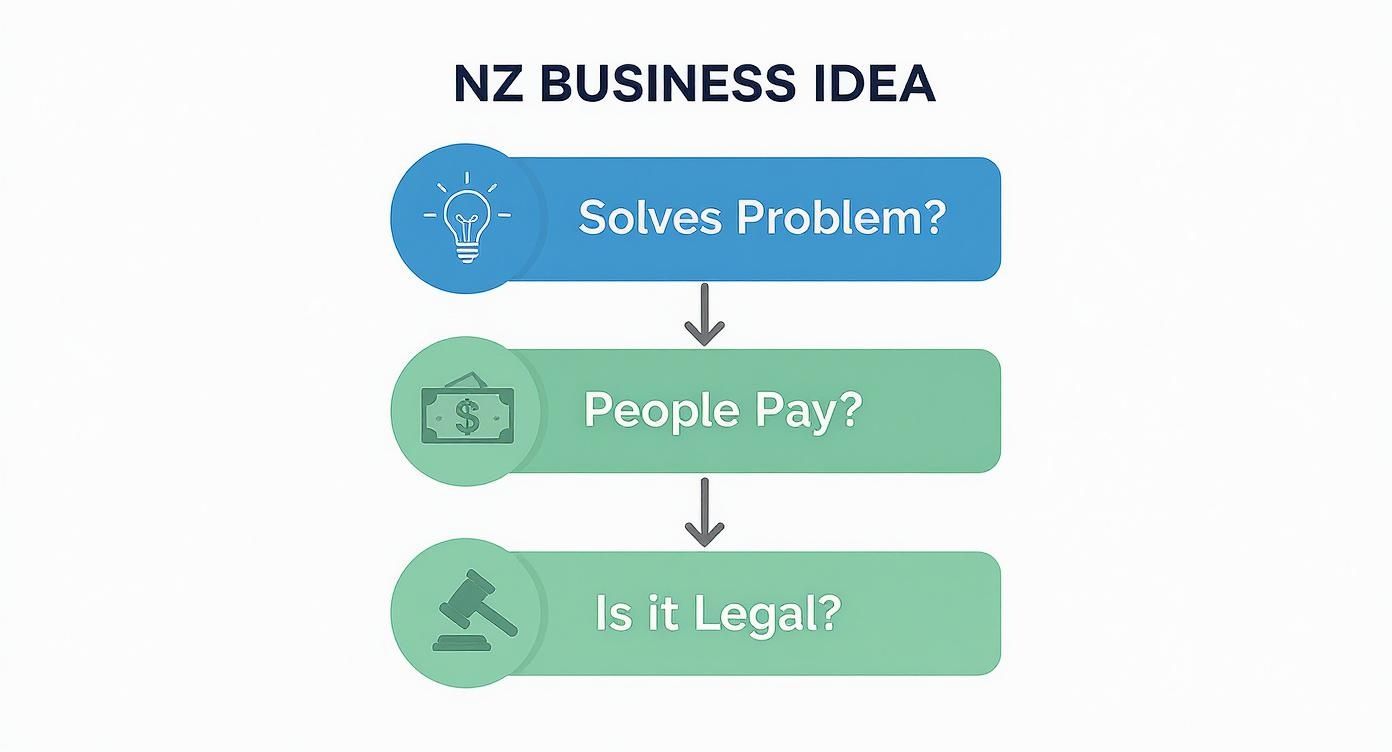
If you've ticked these boxes, you've moved past just having a cool idea and into a genuine market opportunity. Right, let's get you registered.
Getting Your Business on the Map
First up, you’ll want to get a New Zealand Business Number (NZBN). Think of it as a unique ID for your business that makes it much easier to deal with suppliers, customers, and government agencies. If you register a company, you'll get an NZBN automatically. Sole traders can apply for one for free, and it's a smart move—it just makes you look more professional from the get-go.
Next is your business name. If you're a sole trader just using your own name (like "Ben Williams, Builder"), you don't need to register it. But if you plan to use a trading name like "Summit Construction," you'll need to check it's not already taken. A quick search on the Companies Office website will tell you if the name is available.
For those setting up a limited liability company, the process is a bit more formal. You'll need to reserve your unique company name and officially register the company with the Companies Office. This structure is a popular choice because it provides limited liability, separating your personal assets from the business's debts.
Sorting Your Tax and Compliance Obligations
With your business structure in place, the next crucial piece of the puzzle is getting right with Inland Revenue (IRD). Every business needs an IRD number to handle its taxes. As a sole trader, you'll simply use your personal IRD number. If you've set up a company, it will need its own separate one.
This naturally leads to the topic of Goods and Services Tax (GST). Here's the deal:
- You must register: If you think your turnover (total sales) will be more than $60,000 in any 12-month period, you are legally required to register for GST.
- You can choose to register: If you're earning less than that, you can still register voluntarily. The main perk is being able to claim back the GST on your business purchases, but it does mean a bit more admin.
Finally, don’t forget about the Accident Compensation Corporation (ACC).
As a self-employed person or business owner, paying your own ACC levies is your responsibility. These levies cover you for injuries, ensuring you get financial support if an accident stops you from working. ACC will get in touch with you after you file your first tax return.
Ticking off these legal and financial boxes early on means you can focus your energy on what really matters: launching and growing your business. It ensures you’re not just building a business, but a compliant and resilient one. As you start to network, don't underestimate the power of a professional first impression; a good guide to printing business cards can help you get this essential marketing tool just right.
Funding Your Launch and Managing Your Money
A brilliant idea and a solid legal setup are fantastic, but they don't pay the bills. Cash flow is the lifeblood of any new venture, and honestly, it’s what separates thriving businesses from those that fizzle out in the first year. Getting a handle on your funding and finances from day one isn't just a 'nice to have'—it's absolutely non-negotiable.
This isn’t about becoming a financial wizard overnight. It’s about building simple, powerful habits that give you clarity and control, setting you up for real, sustainable growth.

Finding the Startup Capital
First things first: you need some cash to get the doors open. For most Kiwi entrepreneurs, the funding journey starts very close to home.
- Bootstrapping: This is the most common path. You use your own personal savings to get things moving. The big plus? You keep 100% ownership and control. The downside is that all the financial risk sits squarely on your shoulders.
- Friends and Family: Asking loved ones for a loan can be a great way to get started, but tread carefully. Make sure you treat it like a proper business deal with a clear loan agreement. It saves a lot of potential awkwardness down the track.
When you start looking for outside money, lenders and investors will want to see that you've done your homework. To successfully land that initial capital, knowing how to create a compelling pitch deck is often a critical first step. And if your idea has high-growth potential, our guide on how to approach angel investors in New Zealand is well worth a read.
Building Good Financial Habits From Day One
Once the money is in the bank, how you manage it is what truly counts. This is especially true right now. Recent data shows Kiwi small business owners are feeling the pressure, with only 36% reporting growth—a big drop from 48% the year before. Rising costs and a shaky economy are the main culprits, as highlighted in these insights from CPA Australia.
The very first habit to lock in? Open a separate business bank account.
Do not mix your personal and business finances. Ever. A dedicated account creates a clear financial boundary, makes bookkeeping infinitely easier, and looks far more professional to clients and the IRD.
This one simple act is the foundation of sound financial management.
Choosing Your Financial Toolkit
You don't need to be wrestling with spreadsheets. Modern accounting software is designed for business owners, not just accountants, making it incredibly easy to track income, manage expenses, and send invoices.
Popular choices here in New Zealand include Xero, MYOB, and Hnry (which is fantastic for sole traders). These tools will help you:
- Automate invoicing and payment reminders so you get paid faster.
- Track expenses easily by linking directly to your business bank account.
- Generate financial reports to see how your business is actually doing at a glance.
Finally, start with a basic budget and a cash flow forecast. Your budget maps out what you expect to earn and spend. The cash flow forecast predicts when money will actually hit your account and when it will go out. This simple foresight helps you spot potential shortfalls early and make smarter spending decisions, ensuring you always have the cash on hand to pay your bills and invest in growth.
Operations, Marketing, and Finding Customers
Alright, you’ve sorted the legal and financial paperwork. Now for the exciting part—turning your idea into a real, operating business and actually winning your first customers. This is the moment it all starts to feel tangible, where you set up your space and begin making your mark.
This phase is all about making smart, practical choices that set you up for success without blowing your startup budget. We'll cover everything from getting your workspace sorted to crafting a straightforward, effective marketing plan that really speaks to Kiwis.

Setting Up Your Base of Operations
Think of your workspace as your command centre. Whether it’s a corner of the spare room or a dedicated commercial space, getting it set up for efficiency from day one is a small investment that pays off big time in productivity.
For most new entrepreneurs, a home office is the logical and most cost-effective place to start. If this is you, make sure you carve out a dedicated area. Even a small nook can work, as long as it creates the mental separation you need to focus on business.
Don't forget, you can claim a portion of your household running costs as business expenses. This is usually calculated based on the area of your home used exclusively for your business.
Choosing Your Essential Tech Stack
Technology will be one of your best mates in business, but it's incredibly easy to get sucked into overspending on flashy software you don't really need. The key is to start lean. Pick tools that solve immediate problems and can grow with you.
Focus on these core areas first:
- Communication: A professional email address linked to your business domain (e.g.,
kiaora@yourbusiness.co.nz) is a non-negotiable. It builds instant credibility. - Productivity: Free tools like Google Workspace or the basic Microsoft 365 apps are more than capable of handling your documents, spreadsheets, and calendar when you're starting out.
- Project Management: Simple platforms like Trello or Asana have fantastic free plans. They're perfect for organising tasks and tracking progress so you don’t feel totally overwhelmed.
The best tech for a new business is whatever saves you time and costs you as little as possible. Fight the urge to sign up for every subscription service you see. Master the basics first and only add new tools when there’s a clear, pressing need for them.
Building Your Simple Marketing Plan
Marketing doesn't have to be complicated or break the bank. When you’re new, the goal is clarity and connection, not a massive ad spend. Your first marketing plan should focus on low-cost, high-impact strategies to get your name out there and attract those crucial first clients.
Your online presence is your new digital storefront. Start with a simple, professional-looking website. Platforms like Squarespace or Wix make it surprisingly easy to build a clean site that tells people who you are, what you do, and how they can get in touch.
Social media is another powerful way to connect directly with your community. You don’t need to be on every platform. Just pick the one or two where your ideal customers hang out. For a visual business like a cafe or a jeweller, Instagram is brilliant. If you’re a B2B consultant, LinkedIn is where you need to be.
A strong brand identity is what makes you memorable. If you're looking for a hand with this, check out our practical guide on naming and branding your business for some actionable tips.
The current economic climate here in New Zealand really underlines why effective marketing is so vital. Recent data shows a tough employment market, with jobs in small businesses down 1.2% year-on-year. And while sales are up by a modest 1.9%, this growth is being eaten up by inflation, making every new customer more important than ever. You can dig into these trends in the Xero Small Business Insights report.
Finally, never, ever underestimate the power of local networking and good old-fashioned word-of-mouth. Get along to local business meetups, talk to people in your community, and, most importantly, deliver an exceptional product or service. Happy customers will always be your best marketing channel—they become your advocates and help build that early momentum every new venture needs.
Planning for Growth and Overcoming Hurdles
Getting your business off the ground is a massive win, but it’s really just the starting line. The real marathon of starting a small business in NZ is learning to navigate the unpredictable road ahead—managing growth, tackling the inevitable curveballs, and building something that lasts. It’s a total mindset shift from launching to sustaining for the long haul.
This next phase is less about ticking boxes and more about building genuine resilience. You’ll be facing down common hurdles like inconsistent cash flow, figuring out how to stand out in a crowded market, and avoiding that all-too-common trap of owner burnout. Getting a forward-thinking approach locked in now is what will see you through the tough times.
Tackling Common Business Challenges Head-On
Every Kiwi entrepreneur runs into similar roadblocks. Spotting them early is half the battle. One of the biggest is getting a handle on the peaks and troughs of cash flow. One brilliant sales month can be followed by a painfully quiet one, which makes planning your finances feel like a guessing game.
Competition is another biggie. No matter how unique your idea feels, you’ll have competitors. The secret isn't just being different; it's being able to clearly communicate why you're the better choice for your ideal customer. This means you're constantly refining your message and doubling down on what makes your service or product truly special.
Burnout is probably the most personal—and sneaky—risk for new business owners. The same passion that gets you started can also trick you into working completely unsustainable hours. Looking after your own wellbeing isn't selfish; it's a core business strategy.
To build that resilience, you have to be adaptable. Markets change, customer tastes shift, and the economy does its thing. A business that can pivot and tweak its strategy without losing sight of its core purpose is a business that's built to succeed.
Adopting a Mindset of Continuous Improvement
Here’s the secret to long-term success: you don’t need to have all the answers. Not even close. What you do need is the willingness to learn and fill the gaps in your knowledge as they pop up. This is where targeted, practical learning becomes your most powerful tool for growth.
Take a hard look at your business's weak spots. Are you struggling to get noticed online? Is managing the money side of things a constant source of stress? Pinpointing these areas lets you hunt for specific, actionable skills that can make an immediate difference.
You don't need a formal, long-term qualification to solve these problems. The goal is to get practical skills, fast.
Bridging Skill Gaps with Practical Training
This is where focused, hands-on learning makes all the difference. Unlike a long university degree or a formal training programme from a registered provider, practical courses are built to give you specific, job-ready skills you can literally start using the next day.
For instance, a short course on digital marketing can teach you the basics of social media advertising or SEO, giving you the tools to attract new customers without needing a massive budget. In the same way, a course on financial literacy for business owners can take the mystery out of cash flow forecasting and help you make financial decisions with more confidence.
We offer a range of practical courses designed specifically for busy entrepreneurs just like you. They're all about real-world application, giving you the essential skills you need to solve today's problems and plan for tomorrow's growth. The aim is to empower you with the knowledge to not just survive, but to strategically steer your business towards a successful future.
Essential Skills for New Kiwi Entrepreneurs
Focusing on the right skills can make all the difference. This table outlines key practical skills for new business owners and suggests effective ways to develop them through targeted training or self-learning.
By actively seeking out the skills you need, you’re not just solving problems—you’re investing directly in your business’s long-term health and your own success as an entrepreneur.
Got Questions About Starting a Business in NZ?
Diving into the world of business for the first time? It’s completely normal to have a million questions buzzing around. To give you a bit more clarity and confidence, we've tackled some of the most common queries we hear from Kiwis just like you.
How Much Money Do I Really Need to Get Started?
Honestly, there's no single magic number. The real answer is: it depends entirely on what you’re planning to do.
A freelance copywriter starting out might only need a few hundred dollars for a good laptop, a domain name, and a subscription to some essential software. But if you’re dreaming of opening a small café on a busy Wellington street, you could be looking at tens of thousands for the fit-out, initial stock, and that hefty commercial lease bond.
The best way to get a figure that’s actually useful is to sit down and map out a startup budget. Split it into two simple lists:
- One-Off Costs: Think of things like your company registration fee, buying that essential piece of equipment, or paying a designer for your website.
- Ongoing Monthly Expenses: This is your regular stuff – rent, software subscriptions, insurance, power, and your internet bill.
A smart move is to have a cash buffer tucked away. Aim for at least 3 to 6 months’ worth of your operating expenses. This safety net isn't just nice to have; it’s what will let you breathe while you focus on getting your first customers in the door.
Do I Have to Register for GST Straight Away?
Nope, not necessarily. In New Zealand, you only have to register for GST once your annual turnover (that’s your total income before you deduct any expenses) is likely to hit NZ$60,000 within a 12-month period.
If you’re starting small and don't expect to earn that much, you can still choose to register voluntarily. The big plus here is that you can claim back the GST you pay on your business purchases, which can be a real help. The downside? It means more admin, as you'll need to file regular GST returns with the IRD. It's often worth a quick chat with an accountant to see if it makes sense for your specific situation from day one.
Can I Run a Business From My Home in New Zealand?
Absolutely! Heaps of Kiwi businesses get their start from a spare room or the kitchen table. It’s a fantastic way to keep your overheads super low when you're just kicking things off.
But before you put the sign up, there are a couple of things to check.
First, get in touch with your local council. They might have rules about things like how much customer traffic is allowed, where people can park, or signage in residential areas. And if you’re renting, you’ll definitely need to get the green light from your landlord.
It's also really important to look at your insurance. Your standard home and contents policy probably won't cover your business gear, stock, or any public liability issues. Also, remember you can claim a portion of your household running costs—like power, internet, and mortgage interest—as business expenses. This is usually worked out based on the percentage of your home's floor area that you use for work.
What’s the Difference Between a Business Name and a Company Name?
This one trips a lot of people up, but the difference is actually pretty important.
A business name is what's often called a 'trading as' name. It’s the name you operate under, and it's what sole traders and partnerships use. The key thing to know is that it offers zero legal protection. Someone else could start a business with a nearly identical name, and there's not much you can do about it.
A company name, however, is the legal name of a limited liability company that’s been officially registered with the New Zealand Companies Office. Once that name is registered, it's yours and yours alone. No one else in New Zealand can register a company with that exact name, giving you exclusive rights and proper legal protection.
Starting a business is one of the most exciting things you can do, and having the right skills from the get-go makes all the difference. At Prac Skills, we offer practical, career-focused courses designed to help busy Kiwis build businesses and succeed.
Explore our range of courses and start building the skills you need today at https://www.pracskills.co.nz.