December 13, 2025
.webp)
10 Stability Ball Exercises for a Stronger Core in 2025
Discover 10 must-try stability ball exercises, from beginner to advanced. Get step-by-step guides for a full-body workout at home. Perfect for Kiwis!
Career Development
minutes
10 Stability Ball Exercises for a Stronger Core in 2025
Welcome to your comprehensive guide to transforming your fitness routine with one of the most versatile pieces of equipment available: the stability ball. Often relegated to the corner of the gym, this simple tool is a powerhouse for building core strength, enhancing balance, and improving overall functional fitness. This article will guide you through 10 essential stability ball exercises, carefully ordered from beginner-friendly movements to more advanced challenges.
Each entry is packed with detailed, step-by-step instructions, common mistakes to avoid, and progressions to keep you improving. We'll explore exactly which muscles you're targeting and provide practical rep and set recommendations. To truly maximise the benefits outlined in this guide, having the right equipment is key; consider a quality Adidas Gym Ball to ensure proper form and durability for your workouts.
Furthermore, we've designed sample routines specifically for busy Kiwis, perfect for a quick and effective workout at home, on the farm, or wherever your day takes you. Whether you're just starting your fitness journey or looking to add a new dimension to your training, this guide provides the actionable insights you need. It’s important to note that while we provide comprehensive fitness guidance, this content is for informational purposes only. Let's get rolling and build a stronger, more stable you.
1. Foundational Core: The Stability Ball Wall Squat (Isometric Hold)
The Stability Ball Wall Squat is the perfect entry point into the world of stability ball exercises. It's a foundational movement that builds immense leg and core strength without the complexity or joint stress of a free-standing squat. By placing the ball between your lower back and a solid wall, you provide your lumbar spine with crucial support, allowing you to focus entirely on proper form and muscle engagement.
This exercise is an isometric hold, meaning you hold a static position rather than moving through repetitions. This technique is fantastic for building muscular endurance and stability, particularly in the quadriceps, glutes, and hamstrings. It’s a go-to exercise in physical therapy settings for rehabilitating knee injuries and is often recommended for individuals with lower back sensitivity, as the ball reduces spinal load.
How to Perform the Wall Squat Hold
Follow these steps for a safe and effective hold:
- Positioning: Stand with your feet shoulder-width apart, about half a metre from a sturdy wall. Place the stability ball between the wall and the curve of your lower back.
- The Descent: Lean gently into the ball and slowly walk your feet forward as you lower your hips down into a squat position. The ball will roll down the wall with you.
- The Hold: Stop when your thighs are parallel to the floor, forming a 90-degree angle at your knees. Ensure your knees are aligned directly over your ankles, not tracking past your toes. Keep your chest up and core engaged.
- Hold and Breathe: Maintain this position for your desired time. Breathe steadily and deeply throughout the hold; do not hold your breath. To finish, press through your heels to return to the starting position.
Key Insight: The primary benefit here is creating strength and stability in a supported position. This allows you to build a solid foundation before progressing to more dynamic or unsupported stability ball exercises, making it an essential first step for beginners.
Tips for Success & Progression
- Weight in Heels: Keep your weight firmly in your heels to maximise glute and hamstring activation and protect your knees.
- Time Under Tension: Start with 20-30 second holds. As you get stronger, aim to increase the duration to 60 seconds or more.
- Progression: To increase the challenge, hold a light dumbbell or kettlebell at your chest during the hold.
2. Stability Ball Push-Up (Hands on Ball)
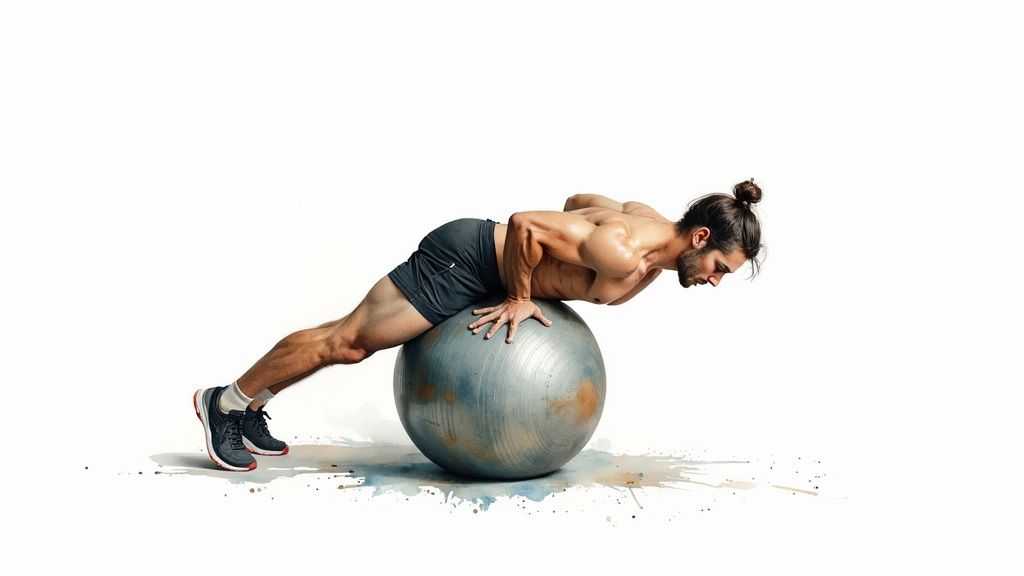
Once you've built foundational stability, the Stability Ball Push-Up is a fantastic progression that dramatically challenges your upper body and core. By placing your hands on the unstable surface of the ball, you force the smaller stabiliser muscles in your shoulders, chest, and torso to fire continuously. This transforms a standard push-up into a powerful functional movement that builds raw strength alongside balance and control.
This variation isn't just about chest and triceps; it’s an intense core exercise. To maintain a straight line from your head to your heels, your entire midsection must remain braced and engaged, preventing any sagging in the hips. It’s a common feature in advanced fitness programmes and athletic conditioning, as it directly translates to improved performance in sports requiring upper body stability and power.
How to Perform the Stability Ball Push-Up
Follow these steps for a controlled and effective movement:
- Positioning: Kneel on the floor with the stability ball in front of you. Place your hands on top of the ball, slightly wider than your shoulders, with your fingers pointing forward or slightly outward.
- Plank Setup: Engage your core and extend your legs back one at a time to form a strong plank position. Your body should create a straight, rigid line from your head to your heels.
- The Descent: Keeping your elbows tucked relatively close to your body, slowly lower your chest towards the ball. Control the movement and fight the instability.
- The Ascent: Once your chest is close to the ball, powerfully press back up through your hands, returning to the starting plank position. Focus on maintaining a tight core throughout the entire repetition.
Key Insight: The unstable surface magnifies the work your core and shoulder stabilisers must do. This exercise builds not just strength but also proprioception (your body's awareness in space), making it a highly effective tool for functional fitness and injury prevention.
Tips for Success & Progression
- Engage Your Core: The most common mistake is letting the hips sag. Squeeze your glutes and brace your abdominals as if you're about to take a punch.
- Start on Knees: If a full push-up is too challenging, perform the exercise from your knees. This reduces the load while still forcing you to control the unstable ball.
- Progression: As you get stronger, you can introduce a pause at the bottom of the movement or slow down the tempo (e.g., three seconds on the way down, one second up) to increase time under tension.
3. Stability Ball Bridge (Hip Thrust)
The Stability Ball Bridge, often called a Hip Thrust, elevates the classic floor bridge into a powerful tool for building a stronger posterior chain. By placing your feet on the unstable surface of the ball, you introduce a significant balance challenge that forces your stabiliser muscles in your core, hips, and lower back to work overtime. This exercise is renowned for its ability to isolate and activate the glutes and hamstrings more intensely than its floor-based counterpart.
This movement is a staple in glute-focused training programmes and athletic conditioning, particularly for athletes like sprinters and jumpers who rely on explosive hip power. Because the instability demands such high levels of muscle recruitment, it's an incredibly efficient way to build strength, improve hip mobility, and enhance overall functional stability, which is crucial for everything from lifting hay bales on the farm to maintaining good posture at a desk.

How to Perform the Stability Ball Bridge
Follow these steps for a controlled and effective movement:
- Positioning: Lie on your back on the floor with your arms extended out to your sides for support, palms down. Place your heels and calves on top of the stability ball with your feet hip-width apart.
- The Lift: Engage your core and press through your heels to lift your hips off the floor. Squeeze your glutes as you raise your hips until your body forms a straight line from your shoulders to your knees.
- The Squeeze: Pause at the top of the movement for a moment, focusing on a powerful glute contraction. Ensure you are not arching your lower back; the work should come from your hips.
- The Descent: Slowly lower your hips back down to the starting position with control. Avoid just dropping back to the floor. Perform 3 sets of 12-15 repetitions.
Key Insight: The instability of the ball is the "secret ingredient." It forces your brain to connect more deeply with your glutes and hamstrings to maintain balance, leading to superior muscle activation and faster strength gains compared to stable-surface exercises.
Tips for Success & Progression
- Heel Pressure: Drive through your heels on the ball to maximise glute and hamstring engagement. Pushing with your toes will shift the focus to your quads.
- Controlled Movement: Avoid using momentum. The slower and more controlled your repetitions, the more your muscles will have to work.
- Progression: Once you've mastered the two-legged bridge, progress to a single-leg bridge. Extend one leg straight up towards the ceiling while performing the hip lift with the other leg. This is a significant challenge for your stability and strength.
You can explore further health and lifestyle skills with our practical courses, which offer a great way to learn more about integrating wellness into your busy life.
4. Stability Ball Mountain Climbers
Taking the intensity up a notch, Stability Ball Mountain Climbers transform a classic cardio drill into a formidable core stability challenge. By performing the movement with your hands on an unstable ball, you force your entire core, shoulders, and chest to work overtime just to maintain balance. This variation not only elevates your heart rate but also significantly deepens the engagement of your deep abdominal muscles.
This dynamic exercise is a powerhouse for building cardiovascular endurance and core strength simultaneously. It's frequently incorporated into High-Intensity Interval Training (HIIT) circuits and conditioning programmes for its efficiency. The unstable surface demands constant micro-adjustments from your stabiliser muscles, making it a highly functional movement that improves coordination and full-body control, crucial for both athletic performance and everyday activities.
How to Perform Stability Ball Mountain Climbers
Follow these steps for a safe and effective set:
- Positioning: Place the stability ball on the floor and position your hands on top of it, slightly wider than shoulder-width apart. Extend your legs back into a high plank (push-up) position, with your body forming a straight line from head to heels.
- Core Engagement: Before starting, brace your core by pulling your belly button towards your spine. Ensure your hips are not sagging or raised too high. Your shoulders should be directly over your wrists.
- The Movement: Drive one knee towards your chest, keeping your back flat and the ball as still as possible.
- Alternating Legs: Quickly return the leg to the starting position and immediately drive the opposite knee towards your chest. Continue alternating legs at a consistent, challenging pace.
Key Insight: The primary challenge is preventing the ball from rolling. This forces your core to fire on all cylinders, turning a standard cardio exercise into one of the most effective stability ball exercises for comprehensive abdominal and shoulder stabilisation.
Tips for Success & Progression
- Neutral Spine: Avoid rounding your back or letting your hips drop. Maintaining a straight line from head to heels is crucial for safety and effectiveness.
- Controlled Pace: Start slowly to master the balance component. As you become more confident and stable, gradually increase your speed for a greater cardiovascular challenge.
- Progression: To increase the difficulty, perform the mountain climbers for longer intervals (e.g., 45-60 seconds) or incorporate them into a circuit with minimal rest between other stability ball exercises.
5. Stability Ball Hamstring Curl (Supine)
The Stability Ball Hamstring Curl is a fantastic posterior chain exercise that directly targets the hamstrings and glutes while demanding significant core stabilisation. Performed lying on your back, this movement uses the ball’s unstable surface to challenge your balance and control, forcing smaller stabilising muscles to engage. It’s an effective way to isolate the hamstrings without placing compressive loads on the spine.
This exercise is particularly valuable for building the strength needed to prevent common injuries, especially in the knees and lower back. For runners, cyclists, and athletes in sports requiring explosive power, strengthening the hamstrings is crucial for performance and injury resilience. The supine (lying on your back) position makes it accessible, yet the unstable nature of the ball ensures it remains a challenging and effective part of any lower body or core workout.
How to Perform the Hamstring Curl
Follow these steps for a safe and effective movement:
- Positioning: Lie on your back on the floor with your arms extended out to your sides, palms down for support. Place your heels and calves on the top-centre of the stability ball.
- The Lift: Squeeze your glutes and core to lift your hips off the floor, creating a straight line from your shoulders to your heels. Your body should be in a solid bridge position.
- The Curl: Exhale as you dig your heels into the ball and slowly pull it toward your glutes, bending your knees. Maintain the elevated hip position throughout the movement; do not let your hips sag.
- The Return: Inhale and slowly extend your legs back to the starting position with control. Keep your hips lifted and stable as you return the ball.
Key Insight: The main challenge is to keep your hips elevated and stable throughout the entire set. If you feel your hips dropping, you are losing core engagement, which reduces the effectiveness of the exercise and can strain your lower back.
Tips for Success & Progression
- Heel Placement: Position your heels near the centre of the ball for maximum stability. Placing them too far to the sides will make balancing more difficult.
- Slow & Controlled: Avoid using momentum. Move slowly through the curling motion to maximise hamstring activation and maintain control.
- Progression: To increase the difficulty, perform the exercise with only one leg. Place one heel on the ball and hold the other leg in the air, keeping both hips level. This single-leg variation dramatically increases the stability challenge.
6. Foundational Core: The Stability Ball Wall Squat (Isometric Hold)
The Stability Ball Wall Squat is the perfect entry point into the world of stability ball exercises. It's a foundational movement that builds immense leg and core strength without the complexity or joint stress of a free-standing squat. By placing the ball between your lower back and a solid wall, you provide your lumbar spine with crucial support, allowing you to focus entirely on proper form and muscle engagement.
This exercise is an isometric hold, meaning you hold a static position rather than moving through repetitions. This technique is fantastic for building muscular endurance and stability, particularly in the quadriceps, glutes, and hamstrings. It’s a go-to exercise in physical therapy settings for rehabilitating knee injuries and is often recommended for individuals with lower back sensitivity, as the ball reduces spinal load.
How to Perform the Wall Squat Hold
Follow these steps for a safe and effective hold:
- Positioning: Stand with your feet shoulder-width apart, about half a metre from a sturdy wall. Place the stability ball between the wall and the curve of your lower back.
- The Descent: Lean gently into the ball and slowly walk your feet forward as you lower your hips down into a squat position. The ball will roll down the wall with you.
- The Hold: Stop when your thighs are parallel to the floor, forming a 90-degree angle at your knees. Ensure your knees are aligned directly over your ankles, not tracking past your toes. Keep your chest up and core engaged.
- Hold and Breathe: Maintain this position for your desired time. Breathe steadily and deeply throughout the hold; do not hold your breath. To finish, press through your heels to return to the starting position.
Key Insight: The primary benefit here is creating strength and stability in a supported position. This allows you to build a solid foundation before progressing to more dynamic or unsupported stability ball exercises, making it an essential first step for beginners.
Tips for Success & Progression
- Weight in Heels: Keep your weight firmly in your heels to maximise glute and hamstring activation and protect your knees.
- Time Under Tension: Start with 20-30 second holds. As you get stronger, aim to increase the duration to 60 seconds or more.
- Progression: To increase the challenge, hold a light dumbbell or kettlebell at your chest during the hold.
7. Stability Ball Plank (Feet or Hands on Ball)
The Stability Ball Plank takes one of the most effective core exercises and elevates it to a new level of challenge. By placing either your hands or feet on the unstable surface of the ball, you introduce a significant balance component that forces your deep core stabilisers, including the transverse abdominis and obliques, to work overtime. This variation transforms the plank from a static hold into a dynamic stability challenge.
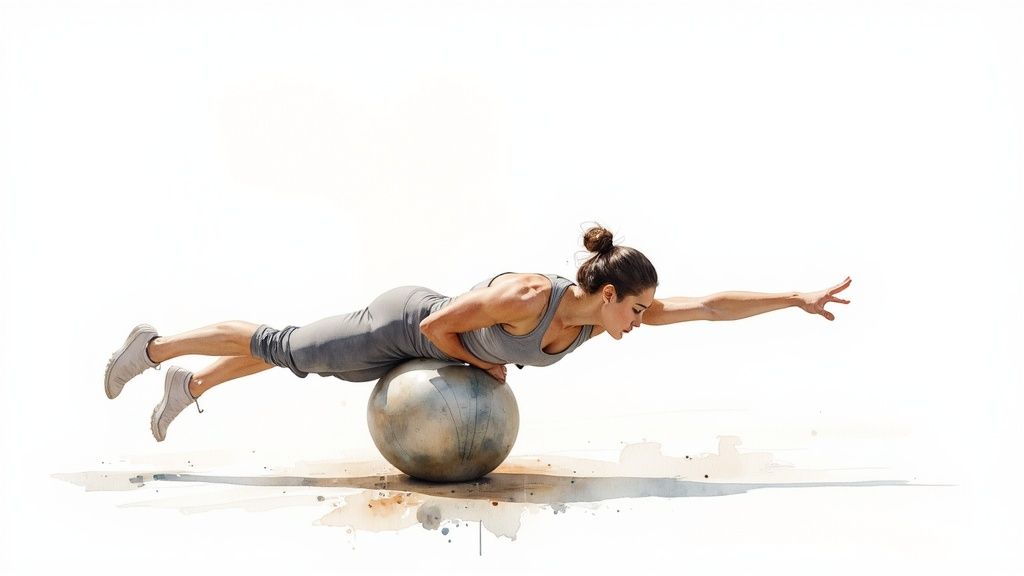
This exercise is a staple in functional fitness and strength conditioning programmes for a reason. It builds a rock-solid core that translates directly to improved performance in rotational sports like golf, tennis, and rugby, while also enhancing overall postural control and spinal health. Mastering this movement is a testament to true core strength and control.
How to Perform the Stability Ball Plank
Follow these steps for a safe and effective hold (feet on ball variation):
- Positioning: Kneel on the floor with the stability ball behind you. Place your hands on the floor directly under your shoulders and carefully walk your feet up onto the top of the ball, one at a time.
- The Plank: Extend your legs fully so your body forms a straight, rigid line from your head to your heels. Your ankles, hips, and shoulders should be aligned.
- Core Engagement: Brace your core as if you are about to be punched in the stomach. Squeeze your glutes and quads to create full-body tension and prevent your hips from sagging or rising too high.
- Hold and Breathe: Maintain this position, focusing on keeping the ball as still as possible. Breathe steadily throughout the hold. To finish, carefully walk your feet off the ball and return to a kneeling position.
Key Insight: The instability of the ball is the core challenge. Your goal is to fight the ball’s tendency to move by maximally engaging your core and glutes. This constant micro-adjustment is what builds exceptional stability and functional strength.
Tips for Success & Progression
- Start with Hands: If you're new to this exercise, begin with the hands-on-ball variation. It's more stable and allows you to build confidence before progressing.
- Neutral Spine: It is crucial to maintain a neutral spine. Avoid arching your lower back or letting your hips drop, as this places stress on the lumbar spine.
- Time Under Tension: Begin with holds of 20-30 seconds, focusing on perfect form. As your stability improves, work your way up to 45-60 second holds.
- Progression: To increase the difficulty, try performing "stir-the-pot" movements (small circles with your feet) or alternating knee tucks while maintaining the plank.
8. Stability Ball Dead Bug (Reverse Fly Position)
The Stability Ball Dead Bug takes a classic core stabilisation exercise and elevates its challenge by introducing an unstable surface. Performed while lying with your upper back and shoulders supported on the ball, this movement forces your deep core muscles, including the transverse abdominis and obliques, to work overtime to prevent you from wobbling. It's a fantastic exercise for developing coordination, balance, and true functional core strength.
This variation requires you to simultaneously control your limbs while maintaining a neutral spine on the ball, a skill that translates directly into better posture and stability during athletic movements. Unlike floor-based core exercises, the stability ball dead bug actively engages your glutes and hamstrings to hold the bridge position, making it a more comprehensive and demanding movement that improves total body control.
How to Perform the Stability Ball Dead Bug
Follow these steps for a controlled and effective movement:
- Positioning: Sit on the stability ball and slowly walk your feet forward, allowing the ball to roll up your back until it rests securely under your upper back and shoulders. Your body should form a straight line from your knees to your shoulders (a tabletop or bridge position).
- Starting Stance: Extend your arms straight up towards the ceiling, directly above your chest. Bring your knees up so your shins are parallel to the floor, forming a 90-degree angle at your hips and knees. This is your starting position.
- The Movement: Keeping your core braced and your hips level, slowly lower your right arm and left leg towards the floor simultaneously. Go only as far as you can without arching your lower back or losing balance.
- Return and Repeat: Pause briefly at the bottom, then use your core muscles to return to the starting position in a controlled manner. Repeat the movement on the opposite side, lowering your left arm and right leg. This completes one repetition.
Key Insight: The goal is not speed but precision. This exercise is about resisting rotation and extension through the torso. By keeping your hips completely still and level, you are forcing your deep core stabilisers to fire, which is the primary benefit of this advanced movement.
Tips for Success & Progression
- Slower is Better: Start with very slow and deliberate movements. The slower you go, the more time your muscles spend under tension and the greater the stability challenge.
- Neutral Spine: Do not let your lower back sag or arch. Keep your glutes squeezed and your core engaged to maintain a flat, neutral spine throughout the exercise.
- Progression: To increase the difficulty, hold a light dumbbell (1-3 kg) in each hand. This added weight will further challenge your shoulder and core stability.
9. Stability Ball Chest Fly (Prone Position)
The Stability Ball Chest Fly elevates a classic chest-building exercise by introducing a significant stability challenge. By performing the movement in a prone (face-down) position with your chest and torso supported by the ball, you force your entire core, glutes, and lower back to work overtime to maintain balance. This transforms a standard isolation exercise into a full-body stability movement.
This exercise primarily targets the pectoral muscles and anterior deltoids, but the unstable surface ensures continuous engagement from your stabiliser muscles. It is an excellent choice for advanced chest training routines, functional upper-body conditioning, and even posture-correction programmes, as it strengthens the muscles that support a neutral spine while opening up the chest.
How to Perform the Prone Chest Fly
Follow these steps for a safe and effective movement:
- Positioning: Hold a light dumbbell in each hand. Carefully roll forward onto the stability ball so that your chest and upper stomach are resting on the top curve of the ball. Your body should form a straight line from your head to your heels.
- Setup: Plant your feet wide on the floor for a stable base. Extend your arms directly below your shoulders, palms facing each other, with a slight bend in your elbows.
- The Fly: Keeping your core tight and your spine neutral, slowly open your arms out to the sides in a wide arc. Raise the dumbbells until they are level with your chest or slightly higher.
- The Return: Squeeze your pectoral muscles to reverse the motion, bringing the dumbbells back to the starting position in a controlled manner. Aim for 3 sets of 10-12 repetitions.
Key Insight: The prone position on the ball forces you to actively resist spinal extension (arching your back). This builds exceptional core strength and body awareness, making the chest fly a more functional and integrated movement than its bench-based counterpart.
Tips for Success & Progression
- Elbow Position: Maintain a slight, soft bend in your elbows throughout the entire movement to protect the joint and keep tension on the chest muscles.
- Controlled Descent: Avoid letting gravity take over. Control the lowering phase of the fly to maximise time under tension and prevent swinging.
- Progression: To increase the difficulty, bring your feet closer together. This narrows your base of support and demands even greater core stabilisation. You can also progress by slightly increasing the weight of the dumbbells.
10. Stability Ball Single-Leg Squat (Assisted)
The Stability Ball Single-Leg Squat is an advanced unilateral exercise designed to build exceptional leg strength, balance, and motor control. By performing a squat on one leg while using the ball for support, you isolate the muscles of the standing leg, exposing and correcting strength imbalances between your left and right sides. This movement directly translates to improved performance in running, jumping, and navigating uneven terrain, like you might find on a farm or hiking trail.
Using the ball as an assistive tool allows you to master the complex mechanics of a single-leg squat, often called a pistol squat, without the high risk of injury associated with the unsupported version. The ball provides a rolling support system against a wall, guiding the movement and reducing the balance demand so you can focus on building raw strength in your glutes, quadriceps, and hamstrings. It’s a crucial stepping stone for anyone serious about functional fitness and athletic development.
How to Perform the Single-Leg Squat
Follow these steps for a controlled and powerful repetition:
- Positioning: Stand sideways next to a sturdy wall, holding the stability ball with the hand closest to the wall. Place the ball against the wall at hip height.
- Setup: Shift your weight onto the leg farthest from the wall. Lift the other foot off the ground, extending it slightly in front of you. Press your hip into the ball for stability.
- The Descent: Keeping your chest up and core braced, slowly lower yourself down into a squat on your standing leg. Allow the ball to roll up your side as you descend, providing support.
- The Bottom Position: Lower yourself as far as you can control, aiming for your thigh to be parallel to the floor. Ensure your standing knee tracks in line with your foot and does not cave inwards.
- The Ascent: Drive powerfully through the heel of your standing foot to return to the starting position. Maintain control throughout the entire movement. Complete all repetitions on one side before switching.
Key Insight: This exercise is a fantastic diagnostic tool. It quickly reveals weaknesses and instability in your hips, knees, and ankles. Using the ball for assistance allows you to address these issues safely before they can lead to injury in your day-to-day activities or sport.
Tips for Success & Progression
- Controlled Descent: The lowering (eccentric) phase is where you build the most strength and control. Descend slowly over a count of three to four seconds.
- Focus on Form: Prioritise perfect form over depth. It's better to perform a shallow, controlled squat than a deep, unstable one.
- Progression: As you become stronger, rely less on the ball for support. Reduce the pressure you apply to it until you can perform the movement with minimal to no assistance, eventually progressing to an unassisted single-leg squat.
Stability Ball Exercises: 10-Point Comparison
Your Next Steps to a Stronger, More Stable Body
You’ve now explored a comprehensive toolkit of stability ball exercises designed to forge a stronger, more resilient body. We've journeyed from foundational movements like the Stability Ball Crunch and Wall Squat, which build a solid base of strength, to more dynamic challenges such as Mountain Climbers and advanced single-leg variations that test your balance and coordination to the fullest. The power of these exercises lies not just in isolating muscles, but in teaching your body to work as an integrated, stable unit.
The key takeaway is that the stability ball is more than just a piece of equipment; it's a catalyst for developing profound functional strength. Whether you're a farmer needing a strong back for a long day on the land, a busy parent chasing after the kids, or an office worker looking to counteract the effects of sitting, the benefits are universal. Mastering these movements translates directly into better posture, reduced risk of injury, and greater efficiency in everything you do.
Putting Your Knowledge into Action
To truly benefit from this guide, your next step is to integrate these exercises into your routine consistently. Remember the core principles we've discussed:
- Prioritise Form Over Everything: A well-executed repetition with perfect form is infinitely more valuable than ten sloppy ones. Focus on the mind-muscle connection and control every part of the movement.
- Progress at Your Own Pace: Start with the beginner variations and only move on when you feel confident and stable. The regressions and progressions provided for each exercise are your roadmap to continuous improvement.
- Listen to Your Body: Discomfort and muscle fatigue are normal parts of training, but sharp pain is not. Rest when you need to, and don't push through signals that something is wrong.
As you build your strength, you might become curious about tracking your progress objectively. For those wanting a deeper, more clinical understanding of their core stability, resources that detail specific core muscle strength tests can provide valuable benchmarks to measure your improvements over time.
From Unstable Surface to Unshakeable Strength
Embracing the challenge of the stability ball is an investment in your long-term health and wellbeing. The wobbly, unpredictable nature of the ball forces your deep core stabilisers to fire up in a way that traditional, stable-surface exercises simply cannot replicate. This is the essence of functional training: preparing your body for the dynamic, unpredictable demands of real life in New Zealand.
By incorporating even one of the short, Kiwi-focused routines into your week, you are taking a significant step towards building a body that is not only stronger but also smarter and more coordinated. The journey to a more stable, powerful you has begun. Keep practising, stay consistent, and enjoy the feeling of building an unshakeable foundation, one rep at a time.
Ready to turn your passion for health and wellness into a tangible skill? Explore the practical, NZ-focused online courses at Prac Skills. Our flexible, stackable certificates are designed for busy Kiwis looking to build confidence and credibility in areas they love, all on their own schedule. Find out more at Prac Skills.