
December 14, 2025
.webp)

Your Ultimate Guide to Learn Online NZ and Boost Your Career
Discover how to learn online NZ with flexible courses that fit your life. Explore funding options, career paths, and practical skills for real-world success.
Career Development
minutes
Your Ultimate Guide to Learn Online NZ and Boost Your Career
Wondering how you can learn online in NZ and get ahead without putting your entire life on hold? The secret lies in flexible, skill-focused courses built for the real world. It’s all about gaining practical abilities that directly fuel your goals, whether that means starting a business or finally climbing that career ladder.
The New Way Kiwis Learn and Grow
Feeling like you're at a career crossroads? You’re definitely not alone. Across New Zealand, from the middle of Auckland to a remote farm, people are swapping rigid timetables for flexible, hands-on learning. It's a massive shift in how we think about getting ahead professionally.
This isn't about going back to school in the traditional sense. It's about building a personal toolkit for your career, adding the exact skills you need, right when you need them. You’re in the driver’s seat.

Why Online Learning Is Really Taking Off
The surge in online education isn't just a passing phase; it’s a smart response to what modern Kiwis actually need. The freedom to study from anywhere—whether that’s a farm in the Waikato or an apartment in Wellington—is a game-changer. But while convenience is a huge plus, the real appeal runs much deeper.
Online learning gives you the power to adapt and thrive by offering a direct line to job-ready skills. Instead of committing years to a broad degree, you can master a specific, in-demand skill in a matter of weeks. This targeted approach is a perfect fit for:
- Career Changers: Get the skills you need to pivot into a new field without having to start over from square one.
- Business Owners: Learn practical management, marketing, or bookkeeping to help your venture grow.
- Ambitious Professionals: Build a strong portfolio of abilities to nail that promotion or land a better job.
And this isn't just a niche trend. Between 2019 and 2023, participation in distance learning at New Zealand schools jumped by around 25–27%, with the pandemic acting as a massive accelerator. This has helped normalise flexible education for a whole new generation. You can dig into more of the data on the growth of distance learning in Aotearoa New Zealand.
A Practical Way to Get Skilled Up
Think of this model as a modern-day apprenticeship. It puts hands-on, practical knowledge first, moving beyond pure theory.
The aim isn't just to learn about a topic, but to learn how to do something with that knowledge straight away. This focus on immediate application is what makes it so powerful for career growth.
This guide will walk you through everything you need to know to make online learning in NZ work for you. We’ll cover how to pick the right provider, make sense of different credentials, and build a study habit that slots right into your busy life. It’s about making education fit you, not the other way around.
Figuring Out Your Online Study Options
The world of online learning in New Zealand is buzzing with options, but trying to pick the right one can feel a bit overwhelming. Let's clear up the confusion. Think of this as your guide to understanding the real differences between a traditional uni degree, a formal qualification, and a practical, skills-first certificate.
First things first: not all online courses are built the same. They’re designed with completely different goals in mind. Matching what you want to achieve with the right kind of study is the secret sauce to making your investment of time and money really pay off.
The Big Picture: University Degrees vs Practical Skills
For a long time, a university degree was seen as the main ticket to a professional career. And for some jobs, like being a doctor or a lawyer, it still is. These programmes dive deep into academic theory and are essential for certain professions, but they’re also a huge commitment, often taking several years to complete.
On the flip side, you've got a new wave of courses focused on targeted, industry-ready skills you can put to use straight away. These are built for people who want to upskill for a specific job, kick off a side hustle, or switch careers without having to go back to square one.
The real difference is the goal. One path is about building a broad, theoretical foundation over many years. The other is about giving you specific, job-ready skills you can use tomorrow.
This is a massive deal for anyone looking to learn online in NZ. We're seeing a huge demand for flexible, on-demand learning. More and more Kiwis are grabbing micro-credentials and short professional certificates they can knock out while still working. This isn't just a hunch; market analysis shows that user numbers for all types of online education are on the rise. You can check out more data on New Zealand's online education market to see the trend for yourself.
Understanding Qualifications and Credentials
As you start digging into courses, you'll come across a bunch of different terms. It’s important to know what they actually mean for your career.
- NZQA Qualifications: The New Zealand Qualifications Authority (NZQA) oversees formal qualifications from registered providers. These fit into the New Zealand Qualifications Framework (NZQF) and are often a non-negotiable for specific, regulated industries.
- Practical Certificates: Many online providers, including Prac Skills, offer certificates that are all about practical, hands-on ability. While they are not NZQA qualifications, they are often accredited by respected international bodies like ICOES and CPD, which shows a real commitment to high standards. They’re a clear signal to employers that you’ve mastered a specific, practical skill.
For a lot of jobs—especially in small businesses, creative industries, and on the farm—what you can do matters more than a piece of paper. A certificate that proves you can manage farm finances or run a digital marketing campaign can often open more doors than a general business degree. Our guide on distance learning courses in NZ dives into this a bit more if you're curious.
It's also worth knowing about different learning formats. For example, some people thrive in cohort-based courses, where you learn alongside a group of peers on a set schedule, which adds a great layer of collaboration and support.
Choosing Your Online Learning Pathway
To make things a little easier, we've put together a table comparing the most common online learning pathways here in New Zealand. Have a look and see which one feels like the best fit for your goals.
Ultimately, the right path depends entirely on where you want to go. A uni degree is perfect for some, while a practical certificate is exactly what someone else needs to get ahead. The key is to be honest about your goals and choose the tool that’s best for the job.
Matching Your Ambition to the Right Course
Right, let's get practical. Understanding the difference between a degree and a certificate is one thing, but how do you pinpoint the one course that clicks perfectly with your career goals?
The secret is to work backwards. Figure out where you want to end up, then find the learning path that will get you there. This isn’t about endlessly scrolling through course catalogues; it’s about making a strategic choice so that every hour and dollar you invest moves you closer to your goal.
Whether you want to learn online in NZ to kick off a side hustle, climb the ladder in your current job, or make a complete career switch, there’s a smart way to find the right fit.
Finding Your 'Why' Before Your 'What'
Before you even glance at a course outline, take a moment. What’s the real outcome you’re aiming for? A fuzzy goal like “get a better job” is tough to plan for. But a specific one like “master bookkeeping so I can manage my own plumbing business” gives you a clear target to aim at.
Think of it like planning a road trip. You wouldn't just jump in the car and hope for the best. You'd pick a destination first. Your learning journey is exactly the same. Once you know where you're headed, you can map out the most direct route.
This simple decision tree can help you visualise which path might be right for your specific goal.
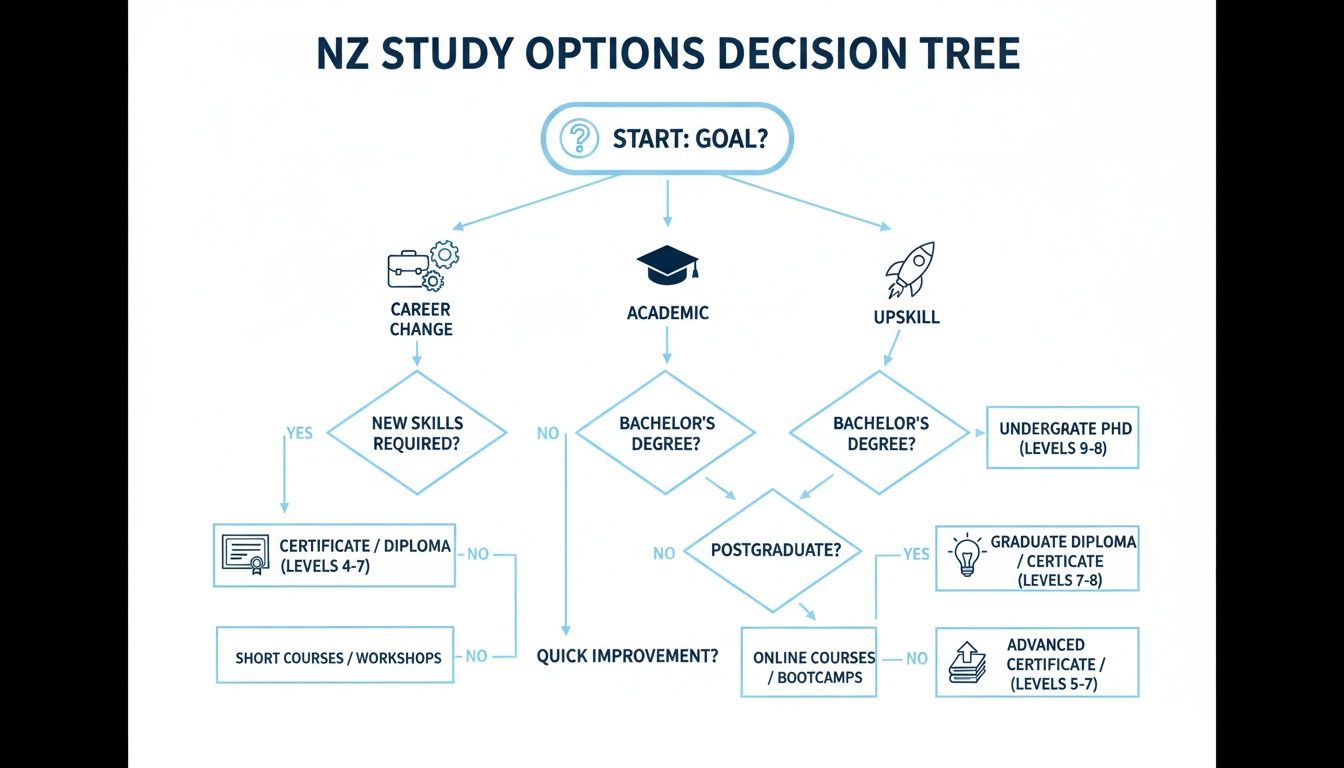
As you can see, your end goal—whether it's a new career, an academic path, or a quick skills boost—is what should really drive your choice of education.
Real-World Scenarios Unpacked
Let's ground this in a few real-world examples you might recognise. By breaking down what they want to achieve, we can see how to find the perfect course for the job.
First, meet Sarah, 'The Side-Hustler'. She loves crafting handmade jewellery and wants to turn her hobby into a proper online store that makes money.
- Her Goal: Launch an e-commerce business and generate consistent sales.
- Skills Needed: The basics of digital marketing, social media ads, simple website management, and product photography.
- What to Look For: Sarah definitely doesn't need a three-year marketing degree. She needs a practical course with hands-on projects, like setting up ad campaigns on Instagram and Facebook, learning to take great product photos with her phone, and getting templates for a simple marketing plan.
Next up is Dave, 'The Tradie'. He's a talented builder who’s recently gone out on his own. He’s a pro with the tools but finds himself drowning in paperwork every weekend.
- His Goal: Get a solid handle on his business finances and stop losing his weekends to admin.
- Skills Needed: Practical bookkeeping, the basics of GST and tax for small NZ businesses, and how to invoice properly.
- What to Look For: A university accounting course would be total overkill. Dave needs something focused on software like Xero or MYOB, with modules that specifically cover compliance for sole traders in New Zealand. The best assessments would be real-world tasks, like creating an invoice or reconciling a bank statement.
By zeroing in on practical, targeted skills, both Sarah and Dave can get exactly what they need to succeed—without the time and cost of a broad, theoretical programme. This is the power of matching your ambition to the right course.
The Power of Stacking Certificates
This targeted approach unlocks another brilliant strategy: stacking certificates. Instead of locking yourself into one long programme, you can earn a series of smaller, focused certificates over time. Each one bolts a new, practical skill onto your professional toolkit.
For instance, a farm manager might start with a certificate in Advanced Livestock Management. Next, they could add one in Pasture Management, and finish with another in Agricultural Business Management. Each certificate is valuable on its own, but together, they create a seriously powerful and relevant skillset.
This method gives you incredible flexibility, letting you build a custom learning path that evolves as your career does. You can learn more about finding the right fit by exploring the different types of online courses available in NZ and seeing how they map to different career paths.
Ultimately, choosing to learn online in NZ is about putting yourself in the driver's seat. It’s about taking control of your professional growth and building the exact future you want, one practical skill at a time.
Funding Your Future and Getting Employer Buy-In
Investing in your skills is one of the smartest career moves you can possibly make, but let's be real—the practical questions of cost and value are always front of mind. How do you pay for a course, and just as importantly, how do you convince your current (or future) boss that it's worth every cent?
Let's tackle the bottom line. Figuring out how to fund your studies and getting buy-in from your employer are essential first steps. It’s all about building a solid case for the value of practical, hands-on learning and knowing exactly how to show it off.
Tapping Into Your Professional Development Budget
A lot of New Zealand businesses set aside funds specifically for employee training and development. This isn't just a nice little perk; it's a savvy investment on their part. When you learn new skills, you bring fresh ideas and beefed-up capabilities back to the team, which can directly boost productivity and improve the company’s results.
The trick is to frame your request not as a personal favour, but as a strategic move for the business. You need to connect the dots for them, showing a clear line between the course content and the company's own goals.
Think like your manager for a moment: they need to see a return on investment (ROI). Your job is to paint a clear picture of what that return will look like, whether it’s saving time on tasks, improving clunky processes, or even opening up new ways to make money.
This simple shift in perspective turns your request from a line-item expense into a powerful business proposal.
Building a Winning Business Case for Your Boss
To get your employer on board, you can't just fire off a quick email with a link to the course. You need to present a clear, compelling case that makes it incredibly easy for them to say "yes." Preparing a short, professional proposal is the way to go.
A strong business case gets straight to the point: what's in it for the company? Think about the specific headaches or challenges your team is dealing with right now. Is a gap in digital marketing knowledge holding back sales? Are inefficient admin processes eating up valuable time and money?
Use this simple checklist to structure your pitch:
- Define the Problem: Start by pinpointing a specific business challenge. For example, "Our current social media efforts are falling flat and aren't bringing in any leads."
- Present the Solution: Explain how this particular course is the answer. "This course in social media marketing teaches practical, hands-on strategies for lead generation that we can use immediately."
- Outline the Benefits: List the tangible outcomes you expect. This could be anything from increased efficiency and higher quality work to bringing a new skill in-house instead of paying an external contractor.
- Detail the Costs: Be completely upfront about the course fee and the time commitment needed from you.
- Show the ROI: Wrap it up by summarising the return on investment. For instance, "By investing $500 in this training, I can roll out a new lead-generation strategy that could realistically increase our sales enquiries by 15%."
Taking this structured approach shows you've seriously thought about the business's needs, making your request far more likely to get the green light.
Showcasing Your Skills on Your CV
Once you've earned that certificate, the next job is to make sure it gets noticed. When you learn online in NZ through practical, hands-on courses, the focus is always on what you can actually do. This is a massive advantage, especially for certificates that are not part of the formal NZQA framework.
Hiring managers are looking for tangible proof of your abilities, not just a list of credentials. Instead of just burying the course title in your education section, create a dedicated "Professional Development" or "Skills & Certifications" section on your CV.
Here’s how you can make your practical certificates really stand out:
- Lead with the Skill: List the name of the certificate clearly.
- Name the Provider: Mention the organisation you studied with.
- Highlight Key Projects: This is the most crucial part. Use bullet points to describe the real projects you completed. Did you build a marketing plan from scratch? Create a farm budget in Xero? Design a website for a small business? Be specific.
- List Tangible Skills: Explicitly spell out the key skills you gained, like "Xero Bookkeeping," "Facebook Ad Campaign Management," or "Pasture Rotation Planning."
By zeroing in on projects and real-world capabilities, you completely change the conversation from qualifications to competence. You’re not just telling them you’ve learned something; you’re showing them exactly what you can now do for their business. In a competitive job market, that’s what truly sets you apart.
How Kiwis Actually Succeed with Online Study
Let's bust a common myth right now: you don't need to find huge, uninterrupted blocks of time to get ahead with online study. For most of us Kiwis, that’s just not realistic. Real progress doesn't happen in marathon library sessions; it's made in the small, stolen moments you can carve out of a busy day.
It's about grabbing 15 minutes on your lunch break, listening to a module on the commute, or logging on after the kids are finally asleep. Success isn’t about putting your life on hold. It’s about smartly weaving learning into your life. That’s the secret to actually finishing what you start and getting the skills you’re after.

Small Bursts Lead to Big Wins
The idea of studying in short, focused bursts isn't just a nice theory—it's exactly how New Zealanders are getting it done. Real-world data from local vocational providers shows that most online learning happens in quick sessions, with the average lasting just over nine minutes.
This proves you don't need to clear your calendar for hours at a time. A huge amount of study also happens well outside the typical 9-to-5. Thousands of sessions are logged between midday and midnight, and believe it or not, over 3,600 sessions have been recorded between the hours of midnight and 6 am. Now that’s dedication, and it highlights the need for true flexibility.
The takeaway is simple: consistency beats intensity, every time. Ten minutes of focused effort each day will get you much further than a stressful four-hour cram session once a month.
This "micro-learning" approach is what makes it possible to learn online in NZ, even when life feels completely maxed out.
Create Your Simple Study Space
You don’t need a fancy, dedicated home office to be a successful online learner. Honestly, all you need is a simple, organised spot where you can focus without a million distractions. This could be a corner of the kitchen table, a comfy chair in the lounge, or even a quiet spot in the workshop.
Here’s how to set up an effective little study nook:
- Keep Essentials Handy: Have your laptop, a notebook, and headphones all in one place. When you have a spare moment, you can dive right in.
- Minimise Clutter: A tidy space helps clear your mind. Take two minutes to clear the area before you start—it makes a huge difference.
- Signal 'Study Time': A small ritual, like making a fresh cuppa or putting on a specific playlist, can instantly switch your brain into learning mode.
The whole point is to make it easy to get started. By removing the little barriers, you're far more likely to actually use those small pockets of time. For more ideas on setting up a productive home base, check out our guide on thriving while working and studying remotely.
Master Your Time and Assessments
When you're short on time, your ability to focus is your superpower. Simple techniques like the Pomodoro Method are perfect for this. You just set a timer and work in a focused 25-minute burst, then take a five-minute break. It’s a brilliant way to prevent burnout and keep your brain sharp.
And when it comes to assessments, the key is to chip away at them over time to avoid that last-minute panic. Many modern courses are moving away from high-pressure exams and toward practical, project-based assessments. This lets you apply what you’ve learned in a real-world context, building your skills and confidence as you go. For anyone wanting to stand out, mastering video editing for beginners is a fantastic skill to have, helping you create polished presentations and assignments.
Ultimately, successful online study is all about working smarter, not harder.
It's Time to Start Your Online Learning Journey
You've seen just how much flexible online learning can shake things up for your career, and you know the secret is picking a course that’s practical and laser-focused on your goals. Now, it's your turn to put that insight into practice. This isn't about taking a leap into the dark; it's about making a smart, deliberate choice to build a better future for yourself, starting right now.
The main takeaway is simple: the right course is the one that actually fits your life and gets you closer to where you want to be. It’s not about finding just any course; it’s about finding your course.
Putting What You’ve Learned into Action
Think back to the people we talked about—the budding entrepreneur who needs to get savvy with digital marketing, or the tradie who wants to get a handle on their own bookkeeping. Your first step is to get crystal clear on your own goal. Are you chasing a promotion, kicking off a new business venture, or finally turning that long-held passion into a proper income stream?
Once you know your destination, you can start plotting your course. Let these principles be your guide:
- Look for Practical Outcomes: Search for courses that teach real, tangible skills you can put to use straight away.
- Check for Real-World Projects: The best way to learn something is by doing it. If a course is built around practical assessments, that's a massive green flag.
- Demand Flexibility: Find a provider that lets you learn on your own terms, slotting study into the pockets of time you actually have.
Using these filters, you can cut through the noise and confidently find a learning pathway that genuinely lines up with your ambitions.
The point isn't just to collect knowledge; it's to build real capabilities. Choosing the right online learning experience in NZ means investing in a direct route to the skills that employers and clients are actually looking for.
Your Next Step Is Simple
Getting started is often the hardest part, but we’ve made it easy. At Prac Skills, we've designed our courses to remove all the usual friction. You can explore practical skills in everything from farm management to digital photography, all created with the realities of Kiwi life and business front of mind.
We reckon learning should empower you, not bury you in theory. That’s why we offer fast, stackable certificates that prove what you can do and build your confidence along the way. You can start with a free lesson, see how it feels, and begin building a stronger professional future in the next few minutes. Your journey to learn online in NZ and smash your goals is just a click away.
Common Questions About Learning Online in NZ
Diving into the world of online study can bring up a few questions. Getting clear, straightforward answers is key to moving forward with confidence. Here, we tackle some of the most common queries Kiwis have when they decide to learn online in NZ.
This section is all about giving you simple answers to help you understand the practical side of upskilling, from what you need to get started to how employers will see your new credentials.
Do I Need University Entrance to Study Online?
For most practical and vocational courses, the answer is a simple no. While universities have pretty rigid academic requirements for getting into degree programmes, many modern providers are far more interested in your passion and goals than your old school report card.
This approach really opens up learning to everyone. It’s perfect if you're changing careers after years in the workforce, if you've just left school and are exploring your options, or if you simply want to add a new skill without needing a prior degree. The focus is on your future, not your past.
Are Online Certificates Valued by NZ Employers?
Absolutely. More and more, New Zealand employers are focused on what a candidate can do, not just the piece of paper they hold. A demonstrated skill and a proactive attitude toward learning often speak louder than a traditional degree.
While formal NZQA qualifications are vital for certain regulated industries, certificates that prove you’ve mastered in-demand skills are highly respected. Think of specific, practical abilities like project management, social media marketing, or even pasture management.
The key is to prove your capability. A certificate from a reputable provider, backed by a portfolio of real-world projects, is powerful evidence that you have the skills to deliver results from day one. It shows initiative and a genuine commitment to growing professionally.
How Much Time Will an Online Course Take Each Week?
The beauty of modern online learning is that you are in the driver's seat. Most courses are self-paced, specifically designed to fit into your life—not the other way around. Forget trying to juggle rigid timetables and deadlines that just don't work with your schedule.
As we’ve seen, many Kiwis find success by studying in short, focused blocks of 10-20 minutes whenever they can grab the time. This could be during a lunch break, on the bus, or after the kids are in bed. The whole model is built for consistency over intensity, which makes it achievable for even the busiest people.
Can I Get Help with Funding for My Course?
Yes, there are definitely a few avenues to explore for funding your studies. A great place to start is with your current employer, as many businesses have professional development budgets set aside for upskilling their team.
The trick is to build a solid business case showing how your new skills will directly benefit the company. If you can connect your training to improved efficiency, cost savings, or better results for the business, your manager will be far more likely to get behind your request. It's also worth checking if any industry bodies offer grants or support for specific types of training.
Ready to find a course that fits your life and career goals? At Prac Skills, we offer practical, hands-on courses designed for the realities of Kiwi business and life. Explore our courses and start building your future today.