
February 2, 2026
.webp)
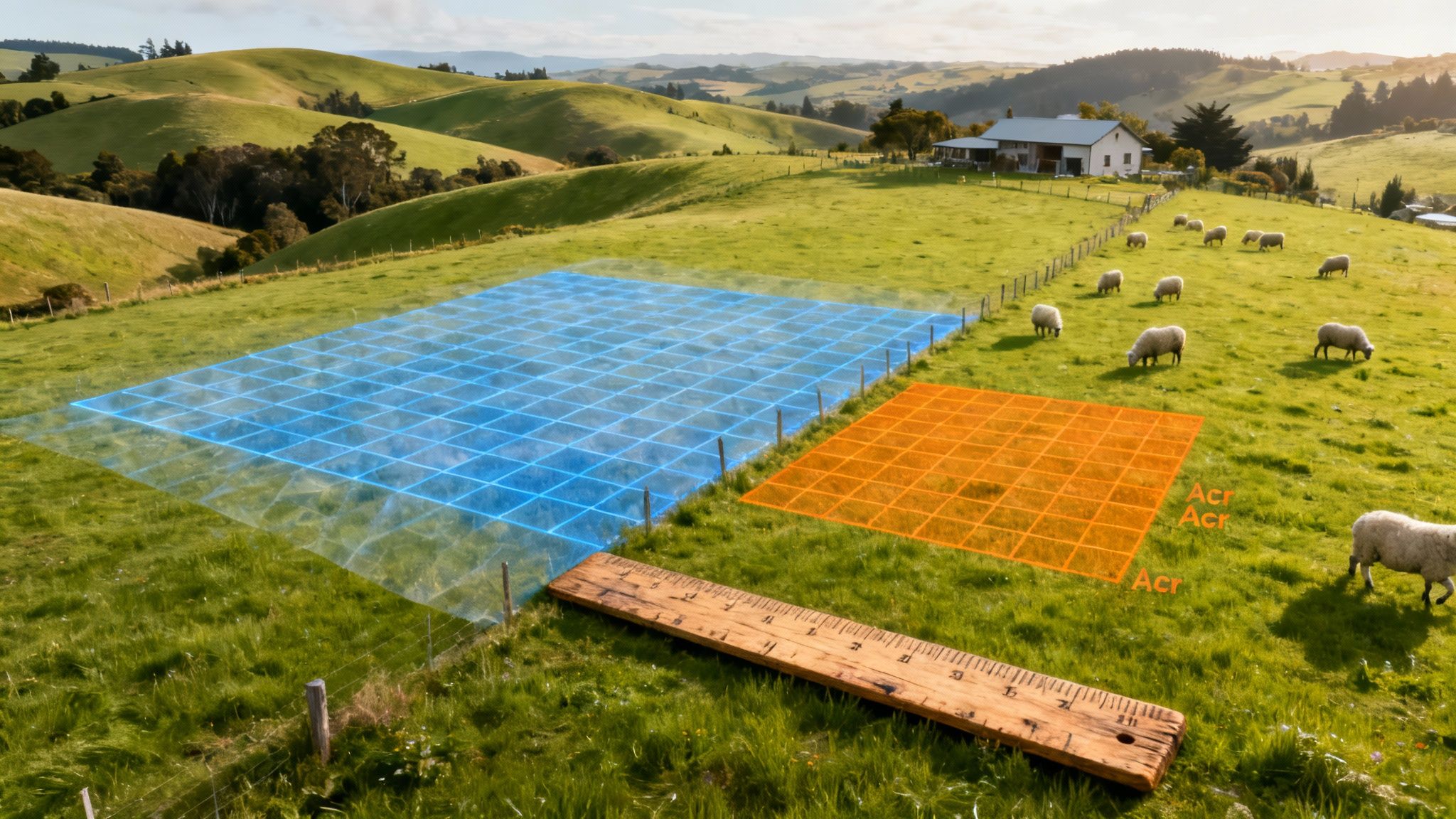
Hectare vs Acre A Practical Guide for New Zealand Land Buyers
Struggling with hectare vs acre? This guide simplifies land measurement for NZ with clear conversions, practical examples, and tips for buyers and farmers.
Practical Skills
minutes
When you're looking at a piece of land in New Zealand, you'll quickly run into two key terms: hectare and acre. The main thing to remember is that a hectare is roughly 2.5 times larger than an acre.
While all our official land documents use the metric system (hectares), you'll find the imperial acre is still a common part of everyday Kiwi chat, especially out in the country.
Hectare vs Acre: The Essential NZ Breakdown
Trying to sort out land measurements in New Zealand can feel like you're translating between two languages. On one side, you have every official paper—from council plans to property titles—strictly using hectares (ha). But on the other, you'll hear farmers, real estate agents, and old-timers talking about land in acres.
So, which one should you be using? Honestly, both.
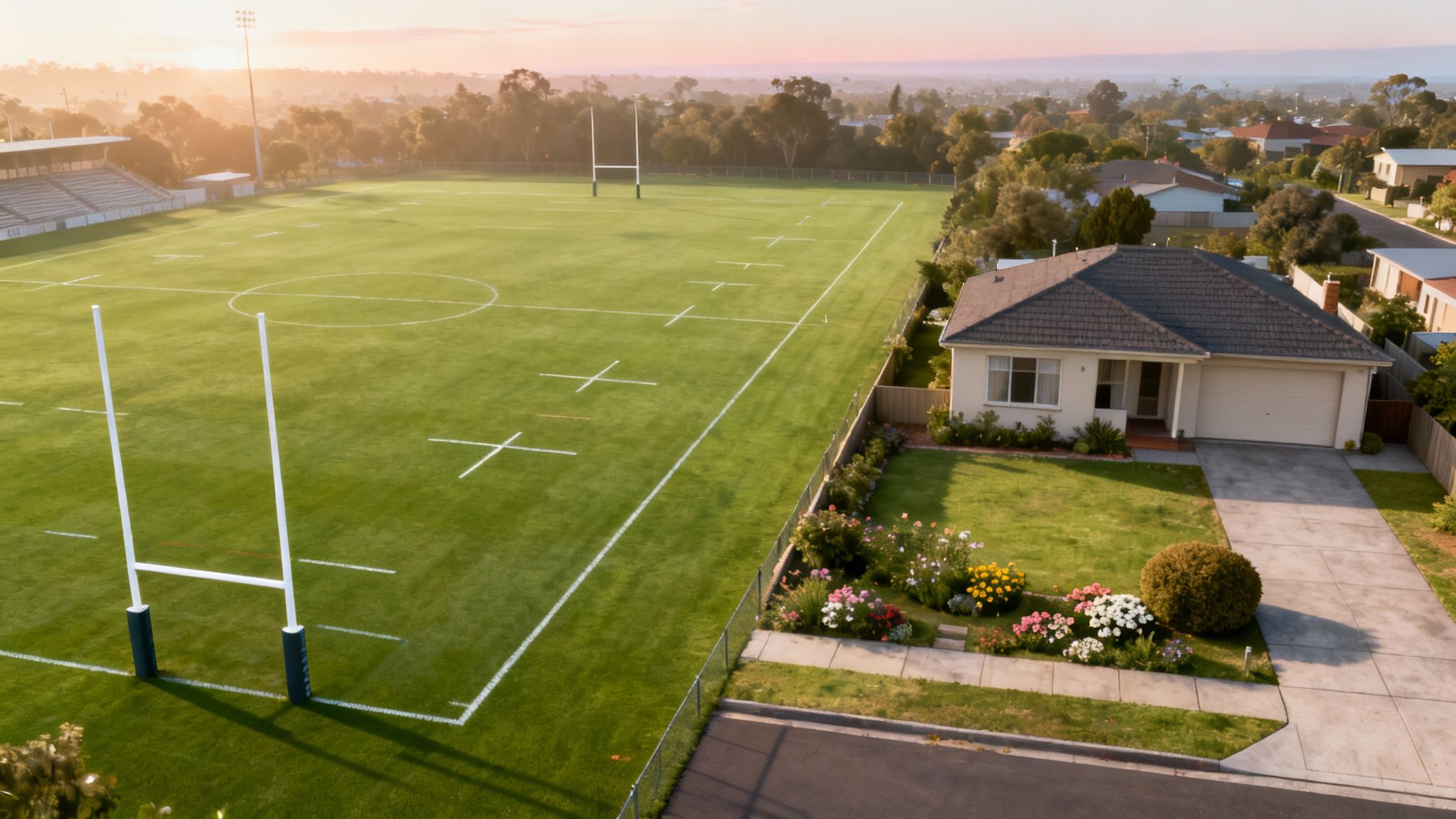
A hectare (ha) is the official metric unit, representing an area of 10,000 square metres. The easiest way for a Kiwi to picture it is to think of a standard rugby field. That's almost exactly one hectare. Because it's the legal standard, you absolutely have to know what it means for any formal transaction.
Then there's the acre (ac), an older imperial measurement that works out to about 4,047 square metres. For a classic Kiwi reference point, just think of the iconic "quarter-acre pavlova paradise." A full acre is simply four of those traditional suburban sections put together. It might not be an official unit anymore, but its cultural roots run deep, so you still need to get it.
Getting a handle on both measurements is crucial. If you only think in acres, you're bound to make mistakes with official paperwork. But if you ignore the term completely, you'll find yourself lost in conversations about land size, especially in rural areas.
Quick Land Measurement Conversion Guide
To keep things simple, here’s a straightforward table to help you switch between units on the fly. This comes in handy whether you're laying out a new garden or sizing up a farm paddock. And if you're keen to manage your land like a pro, learning more about practical skills through horticulture is a great next step.
Keep this chart handy, and you'll find it much easier to visualise and calculate land sizes, no matter which unit is being used.
To really get your head around the hectare vs acre debate, it helps to know where they came from. These units weren't just plucked out of thin air; they stem from completely different ways of thinking about land, which is exactly why both are still kicking around in New Zealand today. One is a throwback to ancient farming, while the other was born from a revolution in logical thinking.
The acre has wonderfully practical, if slightly muddy, roots. It goes way back to medieval England, where it was defined by a straightforward, real-world task.
An acre was basically the amount of land one bloke and his ox could plough in a single day. It was an organic measurement, tied directly to the sweat and effort of farming, which made it perfectly intuitive for landowners for centuries. Of course, this also made it a bit vague—the size of your "acre" could easily depend on how motivated your ox was feeling that morning.
The Logic of the Metric System
The hectare, on the other hand, is a much more modern invention. It arrived with the metric system during the French Revolution, and its creation was all about logic, not labour. The whole point was to create a standardised, universal system of measurement that anyone, anywhere, could easily understand and use.
A hectare is defined as 10,000 square metres—a tidy 100 metres by 100 metres square. This clean, base-ten structure makes scaling it up or down incredibly simple, whether you're measuring a small lifestyle block or a massive Canterbury high-country station.
This historical split is the key to understanding the whole thing. The acre is rooted in farming tradition and human scale, which is why it still feels so natural when you're leaning on a gate talking about a paddock. The hectare, however, is a product of scientific precision and global standards, making it the only logical choice for official documents and modern land management.
This backstory explains the situation here in New Zealand perfectly. We officially went metric back in the 1970s, making the hectare the legal standard for all land titles, council plans, and resource consents. Yet, the acre's long history means it remains firmly planted in our rural vocabulary, passed down through generations of Kiwi farmers and landowners who still think in terms of the land they can work.
How to Visualize Land Size in New Zealand
To really get your head around the difference between a hectare and an acre, you need to move past the numbers. The best way to get a feel for land size is to link it to familiar Kiwi benchmarks you already know. It helps build an instinct for scale when you’re scanning property listings or sketching out farm plans.
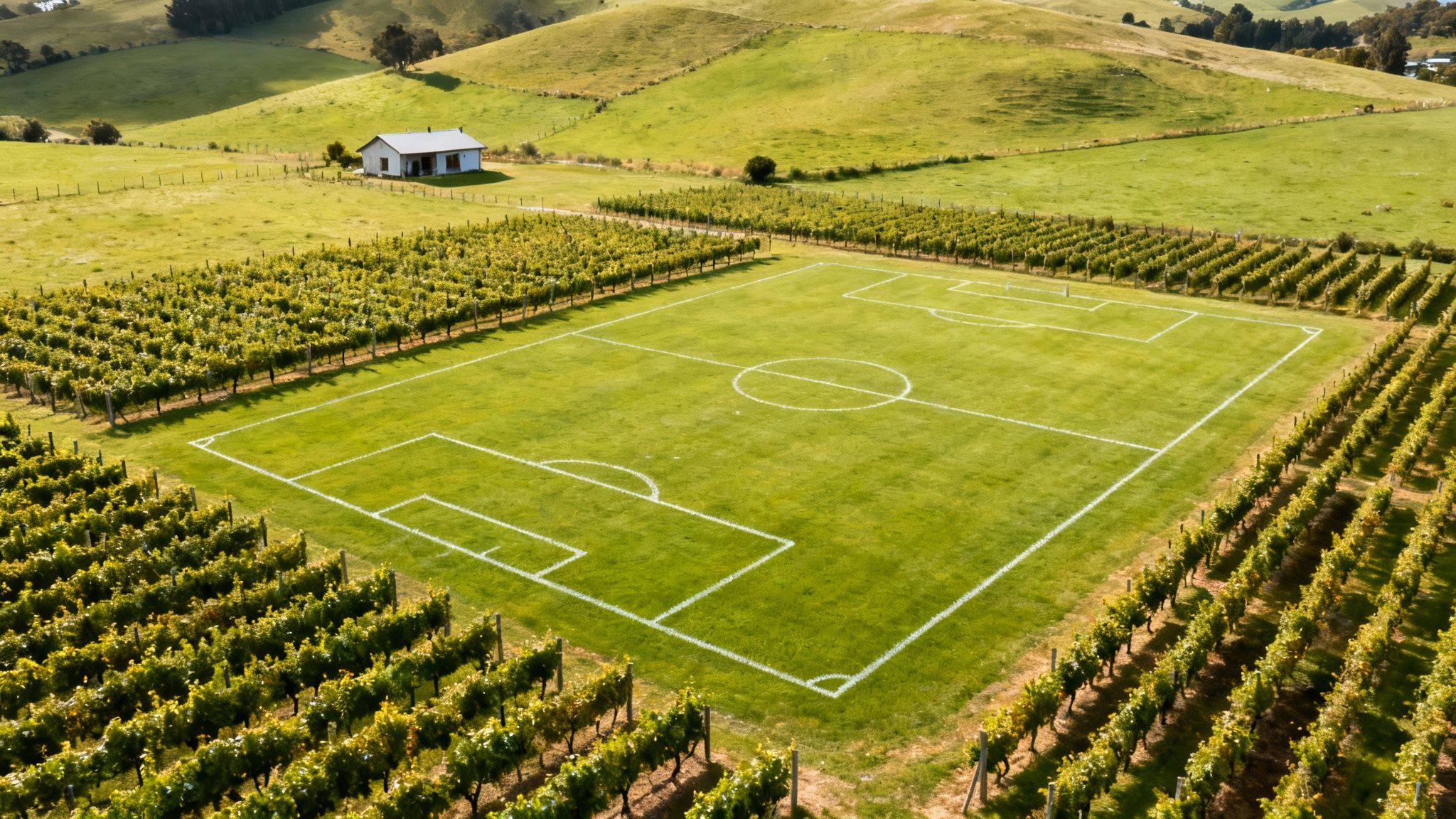
For a hectare, the easiest comparison is a standard rugby field. Picture it from goal line to goal line—that’s one hectare. So, when you see a property listed as 10 hectares, you’re looking at ten rugby fields stitched together. Suddenly, the size feels a lot more real.
From Pavlova Paradise to Paddock Size
When it comes to the acre, nothing beats the classic "quarter-acre pavlova paradise." It’s the iconic Kiwi dream of a generous suburban section. While many modern sections are a bit smaller, a true quarter-acre is 1,012 square metres. A full acre is simply four of these traditional sections side-by-side.
That works well for town sections, but what about bigger blocks out in the country? To develop a sense of scale for farming, it helps to look at real-world examples from around New Zealand.
A Waikato Dairy Paddock: A typical dairy farm often rotates its herd through 2-hectare paddocks. Just imagine two rugby fields next to each other; that's the sort of space the cows get for grazing before being moved on.
A Marlborough Vineyard: In prime wine country, every metre counts. A small, manageable block of Sauvignon Blanc vines might be planted on a 5-hectare plot, which is roughly the same size as five rugby fields.
A Canterbury Lifestyle Block: A common size for a lifestyle block in Canterbury is 4 hectares. That’s about 10 acres—plenty of room for a house, a big garden, a couple of paddocks for sheep or a horse, and some sheds. For anyone managing a block with trees, understanding the basics of forestry work in New Zealand can be a huge help.
By connecting hectares and acres to these real-world examples—from the rugby field to the vineyard—you move beyond abstract numbers. This allows you to accurately interpret property listings and make informed decisions based on a true sense of the land's scale and potential.
This kind of practical visualisation is crucial, whether you're a first-time lifestyler or a seasoned farmer. It helps you figure out if a property is right for your needs, plan your stock or crop management, and talk about land size with confidence.
Why Both Units Matter for NZ Farmers and Growers
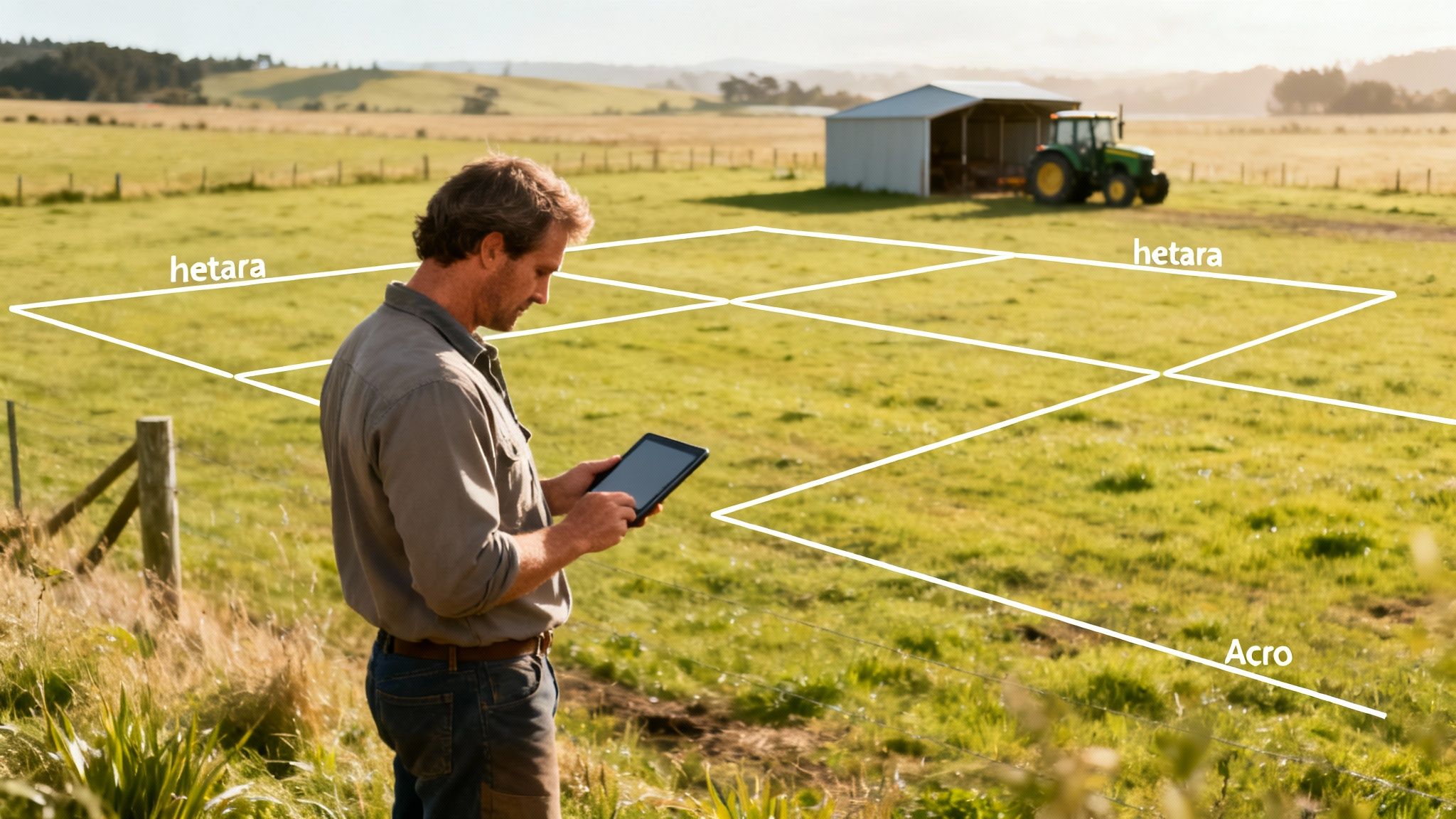
Here in New Zealand, being able to think in both hectares and acres isn't just a handy skill for those on the land—it's absolutely essential. You’ll find that the entire official side of things, from council regulations to resource consents and legal documents, is built on the metric system. For anything formal, hectares are the law of the land.
But step out of the office and onto the farm, and the conversation often switches. A lot of the day-to-day chat, historical property titles, and informal agreements still lean heavily on acres. This dual-unit world means that a simple misunderstanding isn't just awkward; it can be a costly mistake waiting to happen.
Navigating the Two Worlds of Measurement
The ability to flick between hectares and acres is a core part of daily farm operations. A farmer will plan their fertiliser application in kilograms per hectare to meet industry standards and compliance, then turn around and discuss that same paddock’s grazing potential with a neighbour in terms of acres. It’s a constant back-and-forth.
Think about these common scenarios where you'll be juggling both:
- Calculating Fertiliser Rates: Your supplier recommendations and environmental compliance documents are almost always calculated in kilograms or tonnes per hectare. Getting this right is critical for your yields and for staying within regulatory limits.
- Planning Crop Yields: When you're forecasting a harvest, you might be working off historical data recorded in bushels per acre, while your new seed density plans are laid out in seeds per hectare.
- Managing Livestock Density: You might think about your farm's overall carrying capacity in stock units per hectare, but manage daily rotations based on the familiar size of a "20-acre" paddock.
For many, managing land effectively also involves budgeting for specific tasks. For instance, understanding the forestry mulching cost per acre is a practical area where knowing your imperial units is vital for accurate quoting and planning.
The Importance of Precision in High-Value Agriculture
Nowhere is measurement accuracy more critical than in our high-value horticulture sector. When you’re dealing with premium crops like kiwifruit, wine grapes, or avocados, even a tiny miscalculation in land size can have a massive financial knock-on effect.
The scale of our horticultural industry highlights this perfectly. New Zealand manages around 125,200 hectares of horticultural land—that's roughly 309,000 acres. This land underpins a huge export market, valued at $6.2 billion NZD back in 2019, making it a cornerstone of our economy.
A minor error converting between hectares and acres could lead a grower to order the wrong amount of expensive rootstock, miscalculate irrigation needs, or apply an incorrect spray rate. In an industry of tight margins, precision is everything.
In a practical sense, it’s about knowing which language to speak and when. Formal, legal, and scientific applications demand hectares. At the same time, the acre is deeply embedded in the hands-on, practical language of farming life. Mastering both isn't just a 'nice to have'; it's a fundamental skill for anyone working the land in Aotearoa, and it's a key part of the practical training covered in many agriculture courses available in NZ.
Common Land Conversion Mistakes to Avoid
When you're dealing with land in New Zealand, even a tiny miscalculation can snowball into a massive, expensive headache. Getting your head around hectare and acre conversions means being careful, as a few common slip-ups can catch out even the most seasoned land buyers and managers. Knowing what these pitfalls are is the first step to making sure every transaction is spot on.
One of the most frequent mistakes is using a rounded or “close enough” conversion factor. Saying a hectare is "about 2.5 acres" is fine for a chat over the fence, but it’s nowhere near precise enough for any formal paperwork. You absolutely have to use the exact factor of 2.471 for accurate calculations, especially with large or high-value blocks where those small rounding errors can quickly add up to a big problem.
Another issue often pops up when you're looking at older property documents. A lot of historical titles and old farm records only talk in acres. If you misread these or just apply a rough conversion, you could end up with a boundary dispute or a complete misunderstanding of a property's real productive capacity.
Land Use Capability and Forestry Conversions
This is another area where it’s easy to get tripped up. New Zealand’s Land Use Capability (LUC) system, which is all about assessing the long-term, sustainable use of land, is based entirely on hectares. A simple misunderstanding here can have major consequences, particularly with the big trend of converting sheep and beef country into forestry.
And that trend is moving fast. Recently, around 40,000 hectares of sheep and beef farmland were sold to be planted in trees—that's a whopping 98,840 acres. If you want to dig deeper into this shift, you can explore the details of recent farm sales for forestry.
Failing to correctly interpret LUC classifications in hectares can lead to poor land management decisions. An area suitable for grazing might be incorrectly assessed for forestry if the measurements are not understood properly, affecting both profitability and environmental outcomes.
Finally, paddocks that aren't perfect rectangles are a classic trap. Simple length-times-width sums just don't cut it for paddocks with curved boundaries or awkward corners. Relying on guesswork for these areas almost always leads to the wrong number. The only way to be certain is to use digital mapping tools or call in a professional surveyor. That way, you know you’re paying for exactly what you’re getting.
Simple Tools And Formulas For Accurate Conversions
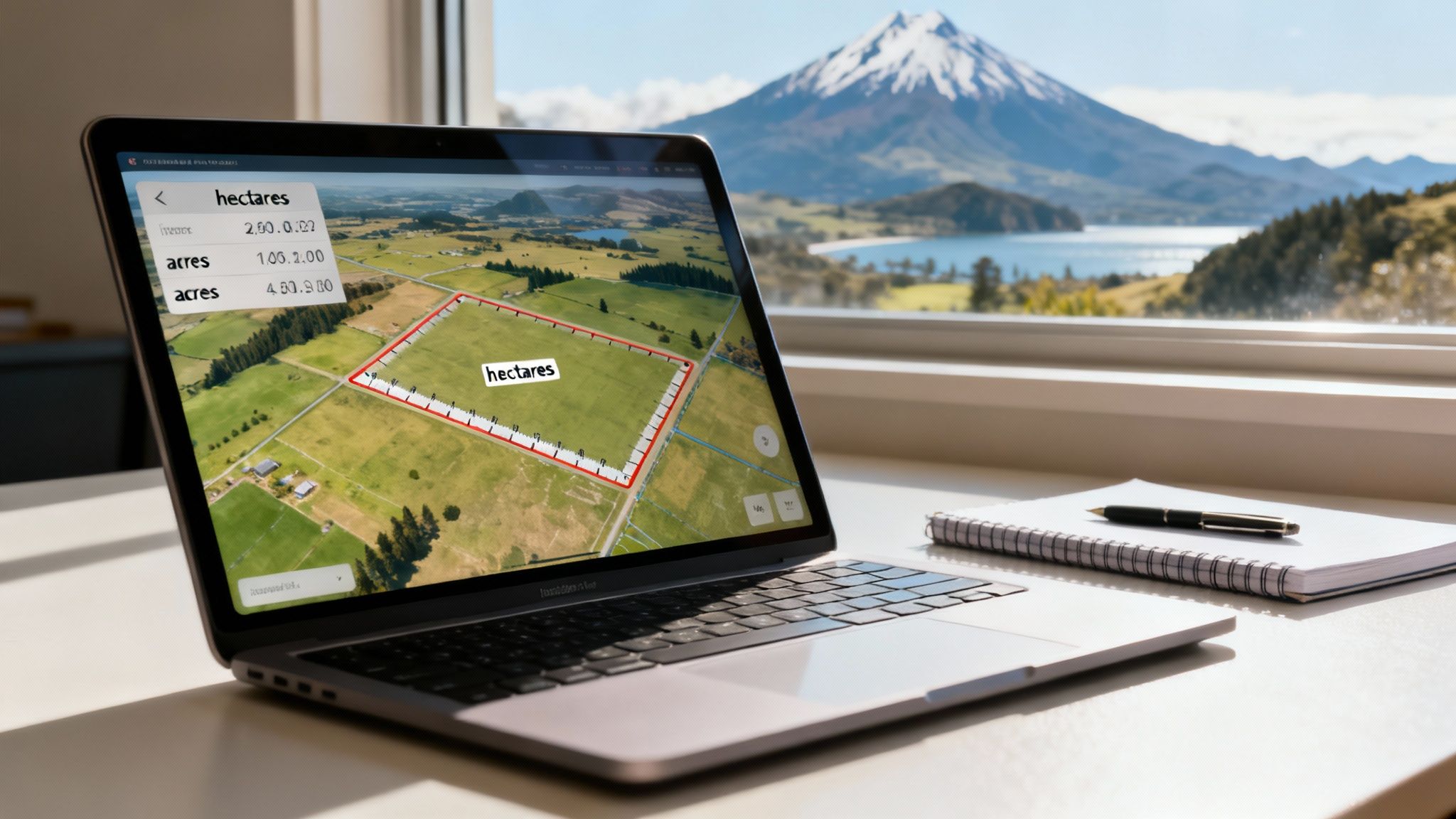
Whether you’re out in the paddock or back at your desk, having a quick way to convert land measurements is essential. Thankfully, you don't need fancy software to confidently switch between hectares and acres—the basic formulas are simple enough for any calculator.
Just keep these two numbers handy:
- Hectares to Acres: Multiply the hectare figure by 2.471.
- Acres to Hectares: Multiply the acre figure by 0.4047.
So, if you're looking at a 50-hectare farm for sale, the maths is just 50 ha x 2.471 = 123.55 acres. Knowing this simple conversion means you always have a clear picture of a property's scale, no matter which unit is being used.
Beyond Manual Calculations
While the formulas are solid, digital tools can give you even more speed and precision. There are countless free online conversion calculators that provide instant, accurate results. They're perfect for double-checking your own calculations or when you just need a quick answer on the go.
You can also use free mapping services to measure land directly. Tools like Google Maps or your regional council’s GIS (Geographic Information System) viewer often have features that let you draw a boundary around a property and get an automatic area calculation.
Precise measurement is more important than ever. Between 2002 and 2022, New Zealand’s total farmland area actually shrank by 2.4 million hectares—a drop of about 15%—which puts a bigger premium on exact land management.
Of course, before you convert anything, you need an accurate starting measurement. For a detailed walkthrough on getting that right, check out this comprehensive guide to yard area calculation. By combining these simple formulas with easy-to-use digital tools, you’ll be set to handle any hectare vs acre conversion with confidence.
Your Top Questions About NZ Land Measurements, Answered
Alright, let's wrap this up by tackling some of the most common questions that pop up when Kiwis are dealing with land. Getting your head around these details can save a lot of headaches, whether you’re eyeing up a lifestyle block or just trying to get a true sense of your farm’s layout.
Getting it Right in Real Estate
What unit should I be using with a real estate agent in New Zealand?
When it comes to the crunch, official property listings and all legal documents will always use hectares (ha). That’s the law. However, don't be surprised if many rural agents still chat in acres – it’s a language many of their clients grew up with and feel comfortable using. The best approach? Be fluent in both, but always, always double-check the official size in hectares from a LIM report or the property title. That’s your source of truth.
Is a quarter-acre section really a quarter of an acre anymore?
Historically, it was! But these days, the "quarter-acre" is more of a nostalgic nod to the classic Kiwi dream of a big backyard. A true quarter-acre is exactly 1,012 square metres, but you'll find most modern suburban sections are quite a bit smaller, often falling between 400 and 800 square metres. Think of the term now as suggesting a generous, family-sized section, not a precise measurement.
Practical Measurement Questions
How can I measure my paddock without calling in a surveyor?
For a surprisingly good estimate, you can lean on free online mapping tools. Google Maps is perfect for this. Just right-click on your property, select the "Measure distance" feature, and trace the perimeter of your paddock. It will calculate the total area for you, often in both square metres and acres. It won’t be survey-accurate, of course, but for initial planning or just satisfying your curiosity, it's a brilliant tool.
The key takeaway is simple: hectares are the logical, metric unit used for all official business. Acres are the traditional, imperial unit that’s stuck around in everyday Kiwi chat. Knowing which one to use and when is the name of the game.
So why does New Zealand use hectares instead of acres anyway?
It all goes back to the 1970s when New Zealand officially went metric, aligning us with most of the world for consistency. The hectare is a cornerstone of this system – it’s a neat 10,000 square metres (a perfect 100m x 100m square), which makes every calculation straightforward. Acres are a much older imperial unit with deep historical roots, and their legacy lives on in our informal conversations today.
Ready to turn your understanding of the land into practical, real-world skills? Whether you're managing a farm, starting a horticulture venture, or getting your lifestyle block sorted, Prac Skills NZ offers online courses designed for Kiwis. Build your confidence and capabilities with practical knowledge you can use straight away. Explore our range of agriculture and horticulture courses.