
February 2, 2026
.webp)
Your Complete Guide to Forestry Work in New Zealand
Discover what forestry work in New Zealand is really like. This guide breaks down the roles, pay, career paths, and how to get your start in the industry.
Practical Skills
minutes
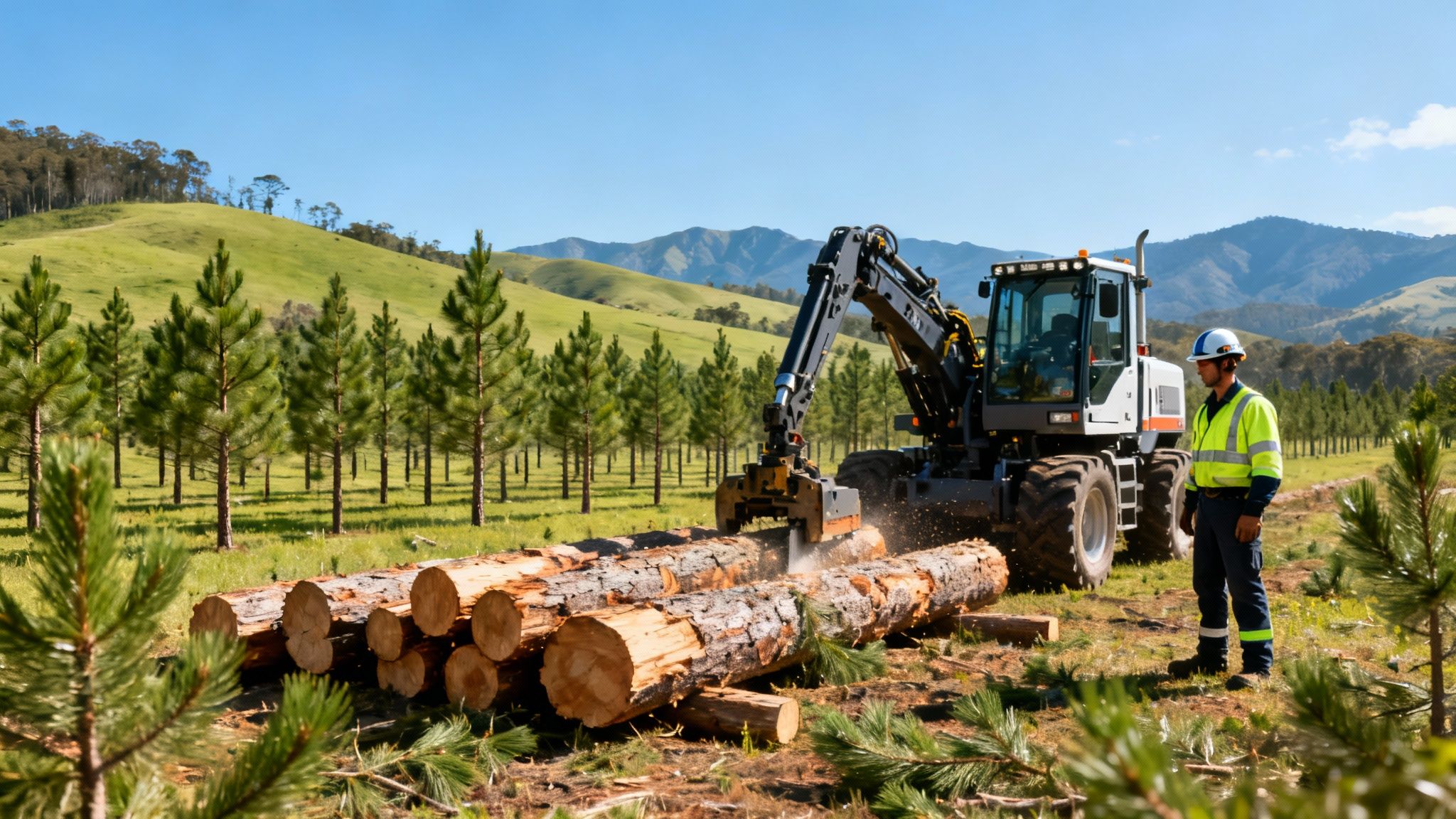
If you've got an old picture in your head of a classic Kiwi lumberjack with a flannel shirt and an axe, it's time for an update. Today's forestry industry is a high-tech, powerhouse sector that drives regional economies all over New Zealand. It's about combining hands-on, outdoor work with the skill to operate some seriously impressive machinery. For anyone leaving school or just looking for a solid career change, it offers a real, tangible path forward.
What a Career in New Zealand Forestry Really Looks Like
Forget the stereotypes. Modern forestry is a sophisticated operation that's absolutely critical to our economy. It's a blend of skilled physical work and operating multi-million dollar gear, offering genuine progression and the chance to build a proper career from the ground up.
The best way to think about a commercial forest is as a massive, slow-growing farm for trees. The work cycle covers everything from planting tiny saplings to managing the forest as it matures (a practice called silviculture), and finally, the highly skilled process of harvesting. This cycle is the lifeblood for entire communities in many parts of the country.
The Scale of the Industry
The sheer size of this sector is hard to wrap your head around. New Zealand's planted forests cover a massive 1.79 million hectares—a huge chunk of our landscape and a cornerstone of the economy.
This vast area, mostly radiata pine, holds a staggering standing volume of 561 million cubic metres of timber. A huge portion of that is now mature and ready for harvest, which means there's a constant demand for skilled workers. It's an industry that's not just about logging; it's about managing a massive, sustainable resource.
A career in forestry is so much more than just a job; it's your chance to be part of the powerful economic engine that keeps regional New Zealand running. It’s where practical skills meet technology, all in an environment where looking out for your mates is the top priority.
A Modern and Demanding Workplace
A modern forestry site is a complex, fast-moving environment. The work is physically demanding, no doubt about it, and you've got to have a rock-solid commitment to health and safety. Crews rely on constant, clear communication and some pretty advanced tech to get the job done safely and efficiently.
Working in remote locations comes with its own set of challenges and responsibilities.
Teamwork is Everything: A crew operates like a well-oiled machine. Everyone has a critical role to play in keeping the operation safe and productive.
Technology is Key: From GPS-guided harvesting machines to drones used for mapping and planning, technology is at the heart of modern forestry.
Safety is Non-Negotiable: A deep-rooted safety culture underpins every single operation. It’s all about looking after yourself and your mates.
Keeping people safe, especially when they're working alone in remote spots, is critical. It’s worth checking out guides on lone worker safety devices for New Zealand forestry to see the kind of protective measures used in the industry. And if you're seriously considering this path, have a look at our resources on career development for more insights on building a successful, long-term future in forestry.
The Core Roles That Power a Forestry Crew
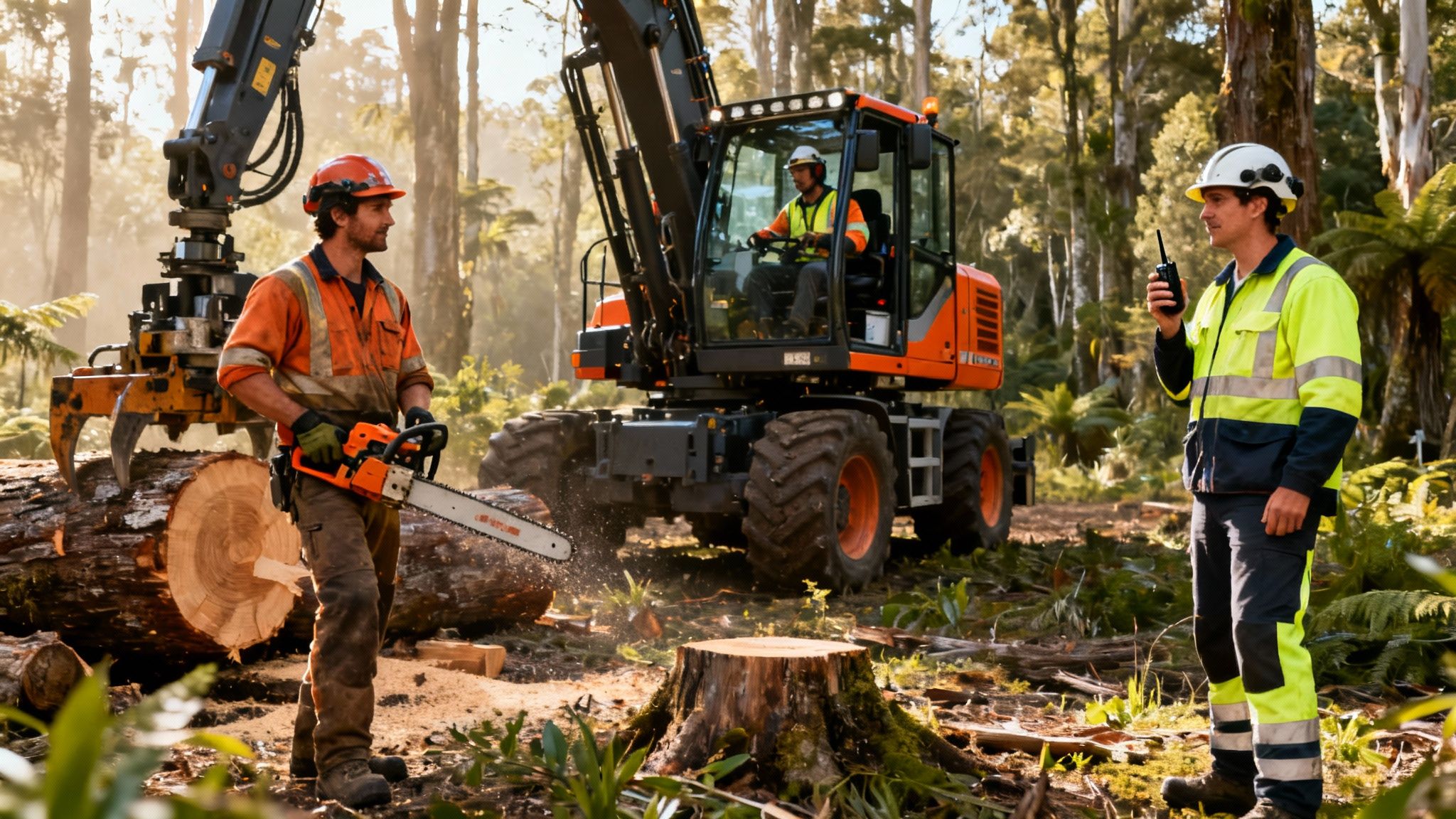
A professional forestry crew is a bit like a well-drilled rugby team. Everyone has a specific job, and the entire operation’s success—and more importantly, its safety—comes down to slick communication and everyone knowing their part.
Think of the Foreman as the captain, setting the strategy for the day and making sure everyone sticks to the safety plan. The Machine Operators are the powerful forward pack, doing the heavy lifting and controlling the flow of work. Then you have the Tree Fellers and Breaker Outs, the agile backs who work in the toughest, most dynamic parts of the site.
Let’s take a closer look at who does what on a typical Kiwi harvesting operation.
On-Site Forestry Roles and Responsibilities
Every job on a forestry site is essential. The table below breaks down some of the most common roles you'll find, what they involve, and the skills needed to do them well. From the high-tech cab of a harvester to the steep slopes of a cable logging site, each position plays a vital part in the crew's success.
These roles aren't just jobs; they are highly skilled positions that demand professionalism and a constant focus on the task at hand. Teamwork is the glue that holds it all together.
The Skilled Machine Operator
The days of every tree coming down with a chainsaw are long gone. Today, the engine room of a modern logging operation is its machinery, and the operators are the highly skilled pros behind the controls. This is worlds away from just driving a digger; these operators are technicians running incredibly complex, expensive gear.
The star of the show is often the harvester. This is a tracked machine with a specialised head that can grab a standing tree, cut it, strip the branches, and slice it into specific log lengths—all in a matter of seconds. The operator uses joysticks and onboard computers to get the most value out of every single tree, which takes immense concentration and technical skill.
Once the logs are ready, a forwarder or hauler moves in. These machines are designed to collect the processed logs and transport them to a central ‘landing’ area where they’re sorted and loaded onto trucks. Doing this safely on steep, rough terrain requires incredible judgement and a deep respect for what the machine can handle.
The Hands-On Tree Feller
While machines do most of the heavy lifting these days, the manual Tree Feller is still absolutely essential. These are the specialists brought in when a tree is too big, growing in an awkward spot, or on ground too gnarly for a harvester to reach. A good feller is a true master of their craft.
Their work is about so much more than just pulling the cord on a chainsaw. They have to read the tree’s lean, factor in the wind, spot any hazards, and plan the perfect directional fell. The goal is to land that tree exactly where it needs to go, avoiding damage to other timber and keeping everyone on site safe. It’s a physically demanding job that requires skill, focus, and a huge amount of respect for the forces at play.
In forestry, teamwork isn't just about getting the job done faster; it's a lifeline. The machine operator's precision keeps the breaker out safe on the ground. The feller’s careful cut prevents a disaster. Every single action has a ripple effect, making safety a shared responsibility.
The Essential Breaker Out
In a cable logging operation, where a big hauler winch uses steel ropes to drag logs up a steep hillside, the Breaker Out is the vital link on the ground. Often called a ‘skiddy’, this is frequently an entry-level job, but it’s one of the most physically demanding and high-stakes roles in the entire crew.
The Breaker Out works down on the steepest, toughest part of the site, attaching heavy-duty cables, or ‘strops’, to the felled logs. They’re in constant radio contact with the hauler operator up on the landing, giving the all-clear before a log is pulled up the hill.
This job requires serious physical fitness, an unwavering awareness of your surroundings, and nerves of steel. A Breaker Out must always know what’s happening around them, plan escape routes, and listen carefully to instructions. It's tough, gritty work, but there’s no better way to learn the fundamentals of a harvesting operation from the ground up.
Finding Your Entry Point into the Forestry Industry
So, how do you get your foot in the door of the forestry industry? The great news is you don’t need a university degree to start building a brilliant career. Forestry work in New Zealand is built on practical skills and on-the-job training, which opens up pathways for anyone with the right attitude and work ethic.
Think of it less like enrolling in a formal course and more like an old-school apprenticeship. Contractors are always on the lookout for reliable, hard-working people who are keen to learn the ropes. In this game, your character and willingness to show up every day ready for a physical challenge are your most valuable assets.
This hands-on approach means your career starts on-site, not in a classroom. The real learning happens out in the bush, where experienced crew members will show you the fundamental skills needed to stay safe and be productive.
Building Your Skills with Practical Qualifications
While a degree isn't necessary, specific, practical qualifications are completely non-negotiable for safety and moving up the ladder. The industry runs on a system of NZQA unit standards – think of them as official stamps of approval confirming you’ve mastered a particular skill to a national standard.
Imagine these unit standards as individual building blocks. You start with the basics, like first aid and chainsaw use, then gradually add more specialised blocks as you gain experience and move into different roles. Each new qualification you earn opens up more opportunities for responsibility and, of course, better pay.
These qualifications aren’t about theory; they're about proving you can perform a critical task safely and competently in a real-world environment. From operating a complex harvester to safely handling a chainsaw on steep terrain, these standards are the industry's language of trust.
This system ensures everyone on a worksite has a verified level of skill, which is absolutely essential in such a high-stakes environment.
Where to Get Your Forestry Certifications
To get these crucial NZQA unit standards, you'll need to complete assessments with registered industry training providers. These are specialist outfits approved to deliver and assess forestry-related skills. It's important to know that we do not offer these specific NZQA forestry units.
You can get started on your own by looking up local providers that offer foundational courses. Better yet, many forestry contractors will arrange and pay for your training once you’re hired, building your skills as part of your employment. This on-the-job training is a common and highly effective way to get qualified.
For those exploring a broad range of practical career options in New Zealand's primary industries, you can discover more about building foundational knowledge in our courses for the agriculture and farming sector.
Your Pre-Employment Checklist
Before you even think about qualifications, there are a few absolute must-haves that every employer will expect. Getting these sorted before you start applying shows you’re serious and ready for the demands of forestry work in New Zealand.
A Full Driver's Licence: Forestry sites are often remote. You’ll need to get yourself there reliably, often very early in the morning. A restricted licence might fly to start, but a full licence is usually required.
Passing a Drug Test: There is a zero-tolerance policy for drugs and alcohol in forestry. You must be able to pass a pre-employment drug test and be prepared for random testing throughout your career.
Physical Fitness: This work is physically demanding. You don’t need to be a CrossFit champion, but a good level of fitness is essential to handle the long days and challenging terrain safely.
A Great Attitude: Above all, employers want people who are reliable, ready to listen and learn, and committed to being a safe and productive member of the crew.
Getting these basics in order is your first step. It proves you have the personal responsibility and maturity needed to succeed in an industry where safety and reliability are everything.
What to Expect from Forestry Pay and Work Conditions
Let's get right into the nuts and bolts: the money you can make and what the day-to-day reality of the job looks like. Forestry in New Zealand can be seriously lucrative, but it’s not a walk in the park. It demands a rock-solid work ethic and the grit to handle some pretty tough conditions.
First up, you need to get your head around how crews get paid. The industry typically uses two main systems, and the one your crew is on will directly shape your weekly paycheque.
One common setup is a straight hourly wage. Simple and reliable. You get paid for every hour you’re on the clock, which gives you a predictable income. This is pretty standard for entry-level roles or for crews where the work is steady and consistent.
The other system is a tonnage rate. This is a performance-based model where the crew’s pay is tied directly to how much wood you harvest. For a slick, experienced crew that works like a well-oiled machine, this can be where the big money is. High production means high earnings. The flip side? Things outside your control, like rough weather or a machine breakdown, can hit your wallet directly.
Realistic Earning Potential
As you rack up skills and time on the job, your pay packet will grow—a lot. Forestry is an industry that absolutely rewards expertise. Making the jump from a general hand to a skilled machine operator is where you’ll see a major leap in your earnings.
Here’s a rough guide to what you can expect:
Entry-Level Roles: If you’re just starting out, maybe as a ‘skiddy’ or a general labourer, you’ll be on a solid starting wage. Think somewhere in the $23-$28 per hour range. This is your time to learn the ropes from the ground up.
Skilled Operators: Once you’re confidently operating a harvester or forwarder, your value to a crew skyrockets. Good operators are always in demand and can pull in anywhere from $35 to over $50 per hour. The top-tier operators are comfortably earning six-figure salaries.
This earning potential is a direct result of the industry's economic clout. In recent years, New Zealand's forestry and logging sector generated a massive $7.6 billion in revenue. That number alone shows just how vital this industry is for regional jobs and the national economy.
The Realities of the Work Environment
This is no office job. The environment is probably the biggest thing you need to be prepared for, as it demands both physical and mental toughness.
Your day will start early. And I mean really early. Most crews are on site before the sun is up, ready for the daily ‘toolbox talk’ to run through the plan and safety checks for the day. You’ll be working outdoors in whatever the weather decides to throw at you, from freezing winter mornings to scorching summer afternoons.
The work is physically demanding, so a decent level of fitness and stamina is a must. You’ll also be around heavy machinery and vibrating tools a lot, which is why understanding hand-arm vibration assessment is so important for looking after your long-term health in this game.
At the heart of every single forestry site is the principle of ‘tāngata ora’—making sure everyone is safe and well. This isn’t just some poster on a wall; it’s a deeply ingrained culture of looking out for yourself and your mates.
This safety-first mentality is completely non-negotiable. You’ll see it in everything, from the daily pre-start checks on all gear and clear communication over the radio, to the mandatory high-quality Personal Protective Equipment (PPE). Your steel-capped boots, high-vis gear, and helmet are your first line of defence. It’s this culture that ensures that while the job is tough, it’s done with the highest possible respect for everyone’s wellbeing.
Mapping Your Career Growth in the Forest Industry
Starting out in forestry isn't just about getting a job; it’s about stepping onto a clear career ladder with plenty of rungs to climb. If you're driven, dead-set on safety, and keen to learn, your career can grow just as tall and strong as the trees you work with.
The path is pretty well-trodden. Most people start at ground level, get a feel for the fundamentals, and then find their specialty. With a bit of experience and the right attitude, leadership roles and even opportunities 'off-the-hill' will open up for you.
This isn’t an industry where you get stuck in one place. It’s an environment that genuinely rewards ambition and skill, offering a solid future for those who are willing to put in the hard yards.
From Newcomer to Skilled Operator
The classic entry point into forestry in New Zealand is as a general hand or a 'skiddy' (breaker out) in a harvesting crew. This is where you learn the rhythm of the worksite, the critical importance of safety, and the basics of the whole operation from the ground up. It’s tough work, but it’s the best education you can get.
Your first big promotion is often a game-changer: moving into the cab of a machine. Making the jump from a manual role to a skilled machine operator is a major step up in both responsibility and pay.
But to make this move, you need more than just time on the job. You’ll have to prove you’ve got:
Rock-solid reliability and a safety record that speaks for itself.
A good dose of mechanical aptitude and a real understanding of how the gear works.
The ability to maintain intense focus and concentration for hours on end.
A willingness to get qualified with the right NZQA unit standards for the machine you want to operate.
Once you’re a competent operator, you become a seriously valuable asset to any crew.
Climbing the Ladder to Leadership
After you've mastered the technical side of things as a machine operator, the next step is about leading people. An experienced, safety-first operator is the perfect candidate to move into a Foreman or Crew Supervisor role.
This promotion is less about how well you can handle a machine and more about how you manage a team and the entire site. It’s a completely different skillset, but it’s built on the foundation of your hands-on experience.
The journey from operator to foreman is about shifting your focus from controlling one machine to coordinating an entire worksite. It's about developing leadership, planning, and communication skills to ensure the whole crew works safely and productively.
Supervisors are the ones responsible for daily planning, running toolbox safety talks, managing logistics, and making sure production targets are hit. It’s a challenging but hugely rewarding position that’s really the peak of on-site operational roles.
Exploring Off-the-Hill Career Pathways
Your experience on the ground also opens up a surprising number of 'off-the-hill' careers. The practical knowledge you gain working in a harvesting crew is gold in other parts of the industry, giving you a pathway away from the physical slog of frontline work if you want it.
Many seasoned pros transition into roles where their hard-won expertise is essential. Some of these pathways include:
Logistics and Transport Planning: You’ll be coordinating the fleet of logging trucks that get the timber from the forest to the port or mill.
Forest Management: This involves working for a large forestry company in a planning or operational oversight role, managing harvest plans and keeping an eye on contractor performance.
Health and Safety Auditing: Becoming a certified auditor who inspects worksites to make sure they’re meeting the industry's tough safety standards.
Industry Training and Assessment: Using your years of experience to train the next generation of forestry workers, a vital role supported by various accreditations and partnerships that keep industry standards high.
These roles prove that a career that starts in the bush doesn't have to end there. Forestry work in New Zealand provides a solid foundation for a diverse and long-lasting professional journey.
Your Questions Answered: Getting Started in Forestry
Jumping into a new industry always kicks up a lot of questions. Forestry is a rewarding but demanding career path here in New Zealand, so it's smart to get a clear picture of what's really involved before you dive in.
We've pulled together the most common questions we hear from people thinking about a future in the bush. Here are the straight-up answers you need to figure out if this is the right move for you.
Do I Need Previous Experience to Get a Forestry Job?
For most entry-level spots, the answer is a definite no. You don't need to have worked in forestry before to get a start as a general hand on a harvesting crew or as a planter in a silviculture team. What contractors are really looking for is a great attitude, a solid work ethic, and a genuine commitment to safety.
Being reliable and keen to learn is worth far more than anything else when you’re starting out. The whole industry is built on training you on the job, so that first role is where you’ll learn the ropes from seasoned pros. You will, however, have to tick a few non-negotiable boxes, like passing a pre-employment drug test and having at least a restricted driver’s licence.
What Is the Single Most Important Skill in Forestry?
While knowing your way around a chainsaw or a piece of machinery is vital, the most important 'skill' across the entire industry is an unshakable commitment to health and safety. The forest can be a high-risk environment, and a safety-first mindset is absolutely non-negotiable.
This means always knowing what's going on around you, communicating clearly with your crew, and using your Personal Protective Equipment (PPE) correctly every single time. It also means having the guts to speak up if something doesn’t feel right and refusing to take shortcuts that could put you or your mates in harm's way.
Crew managers value people who actively contribute to a safe site and look out for their teammates above all else. Beyond that, just being a reliable and collaborative team player is the foundation for building a long and successful career in this industry.
Where Are the Main Forestry Hubs in New Zealand?
Forestry is a major employer in many regions, but the work is naturally concentrated where the biggest commercial forests are. If you're serious about finding a job, focusing your search on these key areas will massively boost your chances.
The major forestry hubs are:
Central North Island: This is the big one, covering the Bay of Plenty, Waikato, Gisborne, and Hawke's Bay.
Nelson-Tasman and Marlborough: These regions in the upper South Island have huge harvesting and processing operations.
The West Coast: Known for its rugged country, the Coast has a long and proud history in the forestry game.
Otago and Southland: These southern regions also have massive forest estates and a steady demand for good workers.
These are the places with the processing mills, ports, and support businesses that keep the industry humming, making them the best places to start your job hunt.
How Has Technology Changed Modern Forestry Work?
Technology has completely flipped the industry on its head, making it far safer and more efficient than ever before. A modern worksite is a world away from the old-school logging camps you might imagine.
Today’s operations are all about advanced harvesters and forwarders guided by GPS, packed with powerful onboard computers that optimise every single log for maximum value. This tech-heavy approach has massively improved safety by getting people out of high-risk felling zones and into the protection of reinforced machine cabs.
On top of that, drones are now used for everything from mapping forest blocks and planning harvests to monitoring tree health and checking for fire risks. This shift means a lot of modern forestry roles now need a good head for tech and the ability to operate complex, expensive machinery with precision and confidence. It’s a career that now blends practical outdoor skills with a real handle on modern technology.
At Prac Skills, we're all about giving Kiwis the practical knowledge to get ahead in their chosen fields. While we don't offer NZQA-registered forestry training, our courses are designed to build your foundational skills and confidence across a range of primary industries and business ventures. See how you can grow your capabilities at https://www.pracskills.co.nz.