
December 12, 2025
.webp)
Finding the Right Cyber Security Course in NZ
Discover how to choose the right cyber security course in NZ. Our guide covers costs, skills, and how to find a provider that matches your career goals.
Career Development
minutes
Finding the Right Cyber Security Course in NZ
So, what exactly is a cyber security course? Think of it as a structured programme that gives you the knowledge and, more importantly, the hands-on skills to protect computer systems, networks, and data from all sorts of digital nasties.
A solid programme goes way beyond the textbook stuff. It's designed to make you job-ready, covering everything from the foundational principles of digital defence to the advanced tactics used on the front lines today.
Is a Career in Cyber Security Right for You?

Before you even start comparing course options, it's worth asking a more fundamental question: is this career path actually a good fit for your personality? Being successful in cyber security is about so much more than just being good with computers. It demands a very specific mindset.
The need for skilled professionals here in New Zealand is absolutely undeniable. As more Kiwi businesses and government agencies go digital, their vulnerability skyrockets. This isn't some abstract threat—it has real, painful consequences.
Just look at the numbers. In the first quarter of 2025 alone, New Zealand’s National Cyber Security Centre (NCSC) dealt with 1,369 cyber incidents. A staggering 77 of those were classified as having national significance. The financial damage from these attacks hit $7.8 million, a sharp 14.7% jump from the previous quarter. This shows just how sophisticated and damaging cybercrime has become. You can dig into the details yourself in the NCSC's quarterly insights report.
This rising tide of threats creates huge demand, but what kind of person actually thrives in this high-stakes world?
Traits of a Successful Cyber Pro
Technical skills can be taught, but certain personality traits are strong indicators of someone who will excel in this field. It’s less of a job and more of a calling for a unique type of problem-solver.
The best cyber experts tend to be:
- Insatiably Curious: They have a genuine need to understand how systems work—and more importantly, how they can be broken. This curiosity is what drives them to constantly learn and adapt.
- Detail-Oriented: Missing a single line of code or a tiny anomaly in network traffic could be the difference between security and a catastrophic breach. Meticulous attention to detail is non-negotiable.
- Cool Under Pressure: When an incident hits, things get stressful. Fast. The ability to stay calm, think logically, and execute a plan is what separates the pros from the amateurs.
- Ethical and Principled: You'll be trusted with the keys to the kingdom—access to incredibly sensitive data and systems. A rock-solid ethical compass is the foundation of a trustworthy professional.
A career in cyber security is perfect for those who see a complex puzzle where others see chaos. It’s for the person who enjoys the challenge of out-thinking an adversary and finds deep satisfaction in protecting people and organisations.
A Glimpse into the Daily Reality
Let’s paint a picture. An e-commerce business in Auckland notices its website is crawling. Then, a customer calls in to report a weird pop-up appearing at checkout. Is it just a server glitch, or is it the first sign of a coordinated attack?
As a cyber security analyst, your first instinct wouldn't be to just restart the server. Your day would quickly turn into a digital investigation. You'd be piecing together clues—digging through server logs, analysing network traffic patterns for anything unusual, and hunting for suspicious file modifications. You'd become a digital detective, following a trail of breadcrumbs to find the root cause and shut down the threat before real damage is done.
This blend of deep analytical thinking and decisive, immediate action is what the job is all about. If that sounds more exciting than terrifying, then a cyber security course is likely your next best move.
For more guidance on charting your professional path, check out our articles on career development.
What You Will Actually Learn in a Cyber Security Course
Jumping into a cyber security course can feel a bit like learning a new language. You’ll hear jargon like "firewalls," "cryptography," and "penetration testing" thrown around, but what does it all mean in the real world? Let's pull back the curtain on the core modules of a typical programme and show you the practical skills you'll actually be building.
Think of it this way: a great course doesn’t just drone on about theory. It puts you in the driver’s seat as a digital defender. You won’t just learn what the tools are, but how and when to use them when the pressure is on. This hands-on, practical approach is exactly what New Zealand employers are crying out for.
The curriculum is usually structured to build your knowledge from the ground up, starting with the essentials before moving into the complex defensive and offensive strategies you’ll use on the job.
The Foundations of Digital Defence
Every strong fortress needs a solid foundation, and in cyber security, that means understanding the battlefield. You simply can't protect a network if you don't know how it works. This is where you'll get to grips with the absolute must-haves.
You’ll typically cover:
- Network Security: This is all about securing the digital "building." Firewalls are your locked doors and access controls, while intrusion detection systems are the security cameras and sensors alerting you to dodgy activity. You’ll learn how data moves and, more importantly, where its weakest points are.
- Operating System Security: Whether it’s Windows, Linux, or macOS, you’ll dive deep into how to "harden" these systems against attack. Think of it as reinforcing the windows and walls of your building to make them much tougher to break through.
- Cryptography: It sounds complicated, but at its heart, it’s the art of secret codes. You’ll learn how encryption protects data—both when it's sitting on a server and when it's flying across the internet—making it gibberish to anyone without the key.
This foundational knowledge is non-negotiable. Without a solid grasp of these basics, the more advanced stuff will feel like trying to run before you can walk.
Stepping into the Mind of an Attacker
To properly defend a system, you have to learn to think like the person trying to break in. This is where the exciting world of ethical hacking comes into play. A quality cyber security course will teach you offensive techniques—not to cause harm, but to find and patch weaknesses before the bad guys can exploit them.
This practical training usually involves:
- Penetration Testing: You’ll actively try to hack into systems within a safe, controlled lab. It’s this hands-on experience that shows you exactly how vulnerabilities are found and exploited in the wild.
- Vulnerability Assessment: This involves using specialised tools to scan networks and apps for known security holes, then figuring out which ones need fixing first based on how critical they are.
A solid cyber security course will also get into the nitty-gritty of specific attack methods and how to stop them, such as preventing Man-in-the-Middle (MITM) attacks, to give you critical skills for the real world.
The goal of learning ethical hacking isn't just to find flaws; it's to develop a proactive security mindset. You learn to anticipate an attacker's next move and build defences that can withstand real-world threats.
Responding When Things Go Wrong
Let's be realistic: no defence is ever 100% perfect. An incident will happen sooner or later, and how you respond can mean the difference between a minor blip and a full-blown catastrophe. This part of your training is all about crisis management in the digital world.
You'll master incident response procedures, which is essentially a playbook for handling a security breach. It covers identifying the attack, containing the damage to stop it from spreading, kicking the threat out for good, and getting your systems back online. It’s all about keeping a cool head and executing a clear, effective plan under pressure.
Good courses prepare you for the future of cyber defence, not just the challenges of today. The skills you pick up here are immediately useful in the workplace and are a core part of any cyber professional's toolkit. If you’re keen to broaden your technical expertise even further, you can explore other programmes in our digital skills course category.
How to Evaluate Cyber Security Course Providers in NZ
Choosing the right place to study cyber security is probably the biggest decision you'll make on this journey. New Zealand has a growing list of options, from universities to specialised training outfits, and it's easy to get lost in the noise. The trick is to look past the slick marketing and figure out what they actually deliver.
A modern cyber security course shouldn't feel like a stuffy academic lecture. It's about building practical, job-ready skills. Your goal isn't just a certificate; it's to develop the kind of hands-on competence that makes you useful to an employer from day one. That means your checklist for a good provider should have "practical application" right at the top.
Practical Labs and Real-World Scenarios
The single biggest thing that separates a great provider from an average one is a relentless focus on hands-on learning. You can't learn to fend off a cyber attack by reading a textbook, any more than you can learn to drive a car by looking at the manual. It’s a skill that has to be practised.
When you're comparing providers, get straight to the point and ask them about their practical training:
- Do they use virtual labs? These are crucial. They're safe, sandboxed environments where you can test out offensive and defensive tactics without any risk of breaking a real system.
- What scenarios will you work on? Are they based on real-world breaches and current threats, or are they just generic, cookie-cutter exercises?
- How much of the course is hands-on? Look for a programme where the majority of your time is spent actively doing things, not just passively listening.
This practical focus is non-negotiable. The sophistication of cybercrime in New Zealand is a serious problem, and businesses need people who can actually respond. In early 2025, direct financial losses from cyber incidents here climbed to $7.8 million in a single quarter—a 14.7% jump—with 28% of reported incidents involving a financial hit. These aren't just abstract numbers; they show why employers need graduates who can walk in and make an immediate impact.
Instructors with Current Industry Experience
Who teaches the course is just as important as what's in it. The cyber security world moves incredibly fast; what was relevant two years ago could be completely obsolete today. The best instructors are the ones still working in the field.
They bring up-to-the-minute insights from the front lines that you just can't get from a textbook. They know what tools attackers are using right now, and they understand exactly what Kiwi businesses are looking for when they hire. An instructor with a purely academic background simply can't offer that level of real-world relevance.
An instructor with current industry experience turns a course from a simple info-dump into a proper mentorship. They share war stories, give career advice, and can connect you with the local industry in a way no textbook ever could.
Formal Qualifications vs Practical Skills
This is where a lot of people get tripped up: the role of formal qualifications, like those from universities or polytechnics. While a university degree or a formal diploma has its place, it's not the only way to get a great job in cyber—and often, it's not the most direct route.
Many of the most effective, industry-aligned training providers are not part of the NZQA framework, and that’s often a deliberate choice. Their goal isn't to tick boxes for a rigid academic framework. It's to build the specific, in-demand skills that get you hired. These programmes put practical ability, industry certifications, and job-readiness first.
So, when you're looking at a provider, don't just use NZQA registration as your only yardstick. Focus on the outcomes. Ask for success stories from past graduates, check out their industry connections, and see what kind of career support they provide. A provider's partnerships with industry bodies and tech companies are often a much better signal of quality and relevance. You can learn more about how accreditations and partnerships show a provider's commitment to real-world standards.
To help you navigate the options, here's a quick comparison of the different types of cyber security training available.
Comparing Cyber Security Training Options
Ultimately, the best training provider for you will be the one that gives you a clear, practical path toward a specific career, whether that's in defence, offence, or analysis.
A great cyber security course sets you up for a specific career path. This decision tree can help you visualise where your interests might take you.
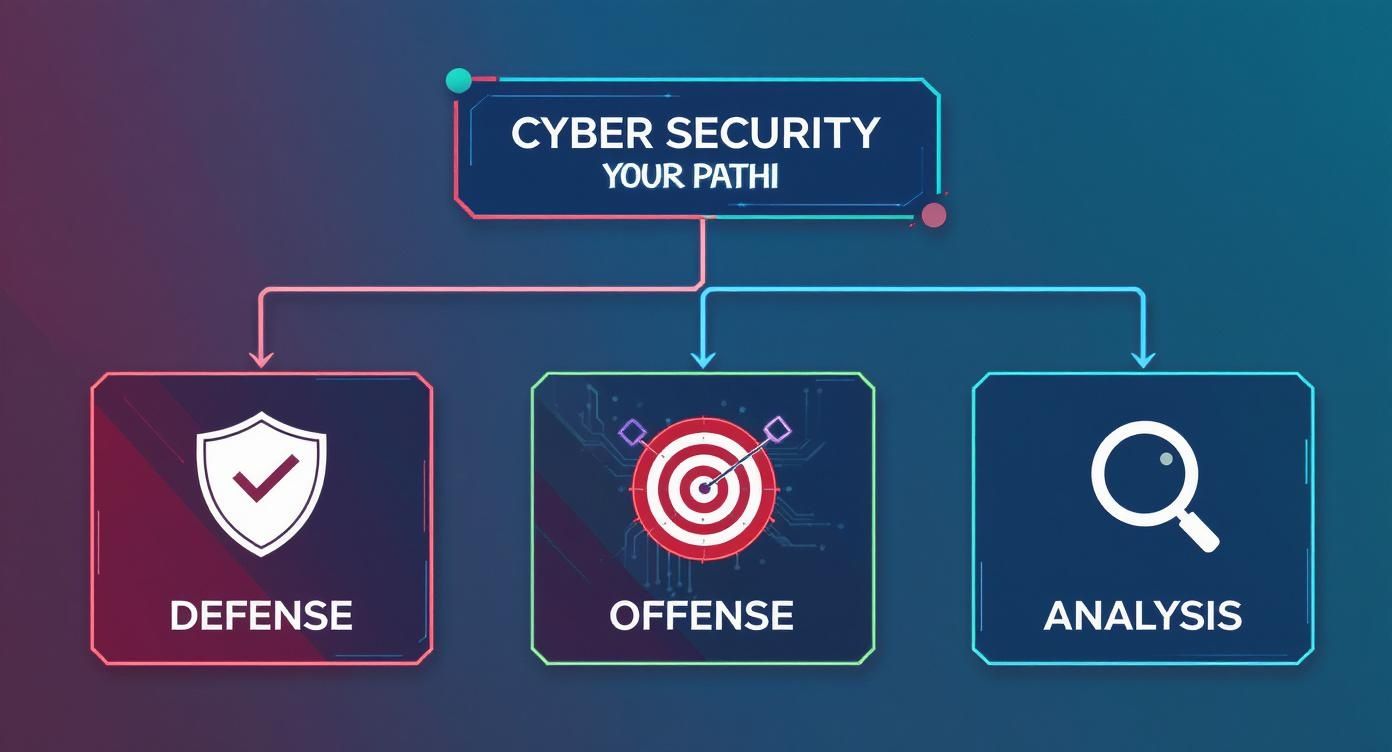
At the end of the day, choose the provider whose curriculum and teaching style align directly with your career goals, focusing on the tangible skills that will actually get you hired.
Understanding Course Costs and Time Commitments
Alright, let's get down to the brass tacks: what's a cyber security course actually going to cost you in time and money? Deciding to upskill is a huge step, and you need a clear picture of the investment before you dive in. And 'investment' really is the right word—while there’s an upfront cost, the payoff is a secure and rewarding career.
The price tag on a course can vary wildly. You’ll find everything from intensive, skills-focused programmes costing a few thousand dollars to multi-year university degrees with much higher fees. When you’re looking at the cost, don't just stop at the headline number. Dig a little deeper. Does that fee cover your learning materials, access to virtual labs for hands-on practice, or vouchers for those all-important industry certification exams? These things add up.
Breaking Down the Time You Will Need
Just as important as the financial cost is the time you'll need to set aside. Your study schedule will obviously depend on whether you go for a full-time or part-time programme, so it’s crucial to find a rhythm that actually works with your life.
A typical week might look something like this:
- Part-Time Study: This is the go-to for most people juggling a job or family. You're generally looking at around 10-15 hours per week for lectures, getting your hands dirty in labs, and hitting the books.
- Full-Time Study: Ready to go all in? A full-time course is basically a full-time job, requiring a commitment of 30-40 hours per week.
Whichever path you choose, consistency is everything. Block out specific times in your calendar each week and treat your study sessions like you would a work meeting. That discipline is what will keep you on track and make sure you get real value out of the experience.
Seeing Your Course as a Smart Investment
It’s easy to get a bit of sticker shock when looking at course fees, but you have to frame it as an investment in your future earning power. The demand for cyber security skills here in New Zealand isn’t just growing; it's exploding. Projections show the job market expanding by around 18% by 2025, all driven by a desperate need for professionals who can defend Kiwi organisations from ever-smarter threats.
New Zealand is currently facing a skills shortage of about 3,500 cyber security specialists. Finishing a quality training programme puts you in an incredibly strong position in the job market. The return on investment isn't just a bigger paycheck; it's rock-solid job security in a field that's only getting more critical.
This massive skills gap is what’s pushing salaries up and creating so many opportunities. You can get a better sense of these NZ market trends and growth areas. Good training providers also get that paying the whole fee upfront isn't always possible. Most will offer flexible payment plans or financing options to help you manage the cost. Always ask what’s available—investing in your skills should feel empowering, not like a financial burden.
From Student to Professional After Your Course

Finishing your cyber security course isn’t the finish line—it’s the starting block. The knowledge you've packed in is powerful, but now it’s time to strategise. The next phase is all about turning that classroom learning into real-world opportunities by being proactive, showcasing your skills, and making the right connections to land that first role.
This transition from theory to practice takes focused effort. The skills that got you through your studies are your foundation, but now you need to build on them with tangible proof of your abilities and a solid professional network.
Mastering the Material Beyond the Classroom
Just passing assessments isn't going to cut it; you need to truly own the skills you've been taught. The best way to do that is to continue the hands-on learning that was central to your course.
One of the most valuable habits you can build is spending consistent time in virtual labs. Think of these sandboxed environments as your personal training ground where you can experiment, break things, and fix them without any real-world consequences. This is where concepts like penetration testing and incident response shift from being theoretical ideas to becoming pure muscle memory.
At the same time, get involved in the wider cyber security community. Jump into online forums, join Discord servers, or contribute to open-source projects. You'll be amazed at the new ideas and challenges you're exposed to. This peer support network is invaluable for troubleshooting problems and keeping yourself motivated.
Building Your Professional Portfolio
A CV can list your skills, but a project portfolio shows them in action. This is your chance to give potential employers concrete evidence of what you’re capable of. It doesn’t have to be massively complex, but it must clearly demonstrate your practical abilities.
Here are a few ideas to get you started:
- Home Lab Projects: Document the entire process of setting up a secure home network. You could detail how you configured a firewall, set up an intrusion detection system (IDS), or created a secure guest network.
- Capture the Flag (CTF) Write-ups: Take part in online CTF competitions and write detailed reports on how you solved the challenges. This is a brilliant way to showcase your problem-solving process and technical chops.
- Vulnerability Analysis: Pick an open-source application, conduct a vulnerability assessment (ethically and responsibly, of course!), and document your findings and recommended fixes.
Your portfolio is your single most powerful marketing tool as a new professional. It proves you can apply your knowledge to solve real problems, which is exactly what hiring managers in New Zealand are looking for.
This portfolio becomes a key talking point in interviews, giving you a chance to walk an employer through your work step-by-step.
Networking and Preparing for Technical Interviews
Making connections within the NZ tech scene is crucial. Start attending local industry meetups, connect with professionals on LinkedIn, and don't be afraid to ask for informational interviews. You’ll find that most people in the industry are happy to share advice with newcomers who show genuine passion.
Technical interviews can feel daunting, but preparation makes all the difference. Expect to be tested on both theory and practical skills. You might be asked to analyse a packet capture, identify some malicious code, or walk through an incident response plan. Practice these scenarios in your home lab so you’re ready to perform when the pressure is on.
As you move from student to professional, learning how to stand out in competitive job applications is essential to landing the cyber security role you want. Your portfolio and networking efforts are what will set you apart.
The Power of Industry Certifications
While your course provides a strong, practical foundation, industry certifications act as a respected, third-party stamp of approval on your skills. They are a standardised benchmark that employers right across New Zealand recognise and trust.
For anyone starting out, certifications like the CompTIA Security+ are an excellent first step. It proves you have a solid grasp of core concepts and is often a prerequisite for entry-level roles. Pursuing a certification after your course does two things: it forces you to revise and deepen your knowledge, and it gives your CV an immediate boost.
Ultimately, your journey from student to pro is a continuous cycle of learning, doing, and connecting. By applying smart study habits, building a tangible portfolio, networking effectively, and validating your skills with certifications, you create a clear and compelling path from the classroom directly into your first cyber security role.
Got Questions About Cyber Security Courses? We've Got Answers.
Stepping into the world of cyber security training can feel like navigating a minefield of jargon and options. It's totally normal to have a bunch of questions. To help clear things up, we’ve tackled some of the most common queries we hear from people thinking about a cyber security course here in New Zealand.
Do I Really Need a University Degree to Get a Cyber Security Job?
Short answer: absolutely not. While a university degree can build a solid theoretical base, it’s far from the only way into the industry. Honestly, many Kiwi employers are now looking for practical, hands-on skills and recognised certifications over a traditional degree.
This is where skills-focused training programmes, often called bootcamps, really shine. They're built to make you job-ready in a fraction of the time, zeroing in on the actual tools and techniques you'll use from day one. That’s what hiring managers want to see.
Do I Have to Be a Coding Whiz to Make It?
This is a huge misconception that stops a lot of people. While knowing a scripting language like Python is a brilliant asset—especially as you climb the ladder—it's not a deal-breaker for every entry-level role. Many foundational jobs in cyber security are more about analysis, configuration, and incident response than they are about writing code from scratch.
Any decent cyber security course will cover the scripting basics you need to get started. What's far more important is your ability to solve problems and a natural curiosity to figure out how things work.
The skills that truly matter are analytical thinking, an eye for detail, and the ability to keep a cool head when things get messy. You can always learn a new tool, but it's that proactive security mindset that really sets a professional apart.
What’s the Difference Between a Training Provider and a Formal College?
This is a really important one to get your head around, especially in the NZ context. A formal college, polytechnic, or university usually offers degrees and diplomas that are on the New Zealand Qualifications Authority (NZQA) framework. These programmes tend to be longer and take a wider, more academic view.
On the other hand, specialised training providers are all about practical, vocational skills that get you a job. They might not be NZQA-registered because their courses are designed to be nimble, changing quickly to meet industry needs and line you up for specific certifications like those from CompTIA. The whole point is to build real-world competence, not to tick boxes in a rigid academic system.
How Much Could I Earn After Finishing a Course?
Okay, let's talk money. Your starting salary will hinge on a few things, like where you are in New Zealand, the exact role you land, and whether you have any IT experience already.
But the good news is, cyber security is known for its strong salaries and fantastic growth potential. An entry-level gig, like a Junior Security Analyst, often starts in the $60,000 to $75,000 bracket. Stick with it, grab a few years of experience and specialise a bit, and it’s very common to see those salaries push well into six figures.
Can I Study a Cyber Security Course Part-Time?
Yes, you certainly can. Many providers get that people have lives, so they offer part-time options for those already working or juggling other commitments. This flexibility means you can build career-changing skills without having to hit pause on everything else.
A part-time course will obviously take a bit longer, but it’s a smart, manageable way to pivot into a new career. It’s an incredibly popular path for career changers who need to keep the bills paid while they upskill.
Ready to build the practical skills you need for a career in cyber defence? At Prac Skills, our cyber security course is designed for the realities of the New Zealand market, focusing on the skills that get you hired. Explore our course and start your journey today.