
February 2, 2026
.webp)
Your Ultimate Guide to Working From Home in New Zealand
Discover how to succeed at working from home in NZ. This guide covers your rights, tax obligations, home office setup, and tips for staying productive.
Practical Skills
minutes
Working from home is no longer just a temporary fix in New Zealand—it’s become a permanent and popular way of life for thousands of Kiwis. It’s a massive shift, driven by a real demand for more flexibility, a better balance between work and life, and more control over our careers. This guide is here to walk you through everything you need to know to make it work for you.
The New Normal: Working From Home in New Zealand

The move to remote work is much more than a fleeting trend; it’s now a solid part of how we do business in Aotearoa. For so many of us, the morning commute has been swapped for a quick stroll to the home office, completely changing our daily rhythm and what we expect from our jobs.
This guide will give you a clear roadmap, covering all the practical, legal, and lifestyle changes that come with making the switch. Our goal is to give you the confidence to thrive, whether you're a full-time employee, a contractor, or even launching a side hustle from your kitchen table.
A Nationwide Shift Towards Flexibility
Across the country, the desire for more adaptable work setups is reshaping the job market. The preferences that emerged during the pandemic are here to stay, with research showing that over 75% of Kiwi employees now want jobs that offer flexible hours and the option to work remotely.
While only about 32% of the workforce actually worked from home during that time, the experience fundamentally changed everyone's expectations. New Zealand’s own legal framework even allows employees to formally request flexible work arrangements, which speaks volumes about this cultural and professional evolution.
This isn't just about convenience. It’s a structural change in how we view the integration of our work and personal lives. The ability to juggle family commitments and professional duties is now a massive factor in job satisfaction and keeping great staff.
What This Guide Covers
Think of this as your go-to manual for mastering the art of working from home in New Zealand. We're going to break down the essentials so you’re completely prepared for what’s ahead:
- Your Rights and Responsibilities: A clear look at what’s expected, whether you’re an employee or a contractor.
- The Tax Side of Things: How to handle your taxes and what you can claim for home office expenses.
- Essential Practical Skills: Tips for staying productive and looking after your wellbeing.
- Setting Up Your Workspace: How to create a space that helps you focus and stay healthy.
Getting a handle on these key areas is crucial if you want to build a sustainable and rewarding remote career. By understanding the ins and outs, you can confidently steer your professional life from the comfort of home. For more on staying ahead of the curve, check out our articles on current industry trends.
Is Remote Work Right for You?
The dream of working from home often conjures up images of perfect work-life balance—professional focus blended with personal freedom. While that can absolutely be the reality, it's worth having an honest chat about what the lifestyle really involves.
Working remotely offers some incredible perks, but it also brings its own unique set of challenges. Getting it right often comes down to your personality, your home situation, and your ability to manage yourself.
For many Kiwis, the biggest win is getting time back. Imagine swapping the daily grind of Auckland traffic for an extra hour to spend with the kids, hit the gym, or just ease into the morning with a proper coffee. That change alone can be a massive boost to your quality of life.
Plus, the savings on petrol, public transport, and those tempting city-centre lunches really start to stack up. It's a tangible benefit that can give you a bit more financial breathing room each month.
Benefits vs Challenges Of Working From Home
Before you ditch the office for good, it’s crucial to weigh up both sides of the coin. What one person sees as a dream come true can be a real struggle for someone else.
Here’s a quick breakdown of what you can expect:
Ultimately, succeeding at remote work is all about maximising the benefits while having solid strategies in place to tackle the challenges head-on.
The Other Side Of The Coin
Of course, it’s not all sunshine and pyjamas. One of the biggest hurdles can be social isolation. When your colleagues are brainstorming and building rapport in the office, it’s easy to feel a bit disconnected from your kitchen table.
Another common struggle is creating that mental boundary between your work life and your home life. When your living room is also your office, the workday can easily bleed into your evening, making it tough to properly switch off and relax. Without clear separation, you risk heading towards burnout.
The very autonomy that makes working from home so appealing also demands a huge amount of self-discipline. With no manager just down the hall, the drive to stay focused and hit your deadlines rests squarely on your shoulders.
Finding What Works For You
To thrive in a remote role, you need to be honest with yourself about what kind of environment you do your best work in. Are you a self-starter who can happily structure your own day, or do you feed off the collaborative energy of an office?
There's no right or wrong answer—it’s about self-awareness.
Consider these key questions:
- Motivation: Can you stay on task and meet your deadlines without someone looking over your shoulder?
- Social Needs: Do you need regular, face-to-face interaction to feel connected and part of the team?
- Home Environment: Have you got a dedicated space where you can work without constant interruptions from family or flatmates?
Deciding if working from home is the right move is a trade-off. It’s about balancing the desire for more freedom and a better lifestyle against the need for structure, social connection, and self-motivation. For those exploring different ways to work, understanding the landscape of New Zealand part-time jobs can also open your eyes to other flexible arrangements that might be the perfect fit.
Understanding Your Rights and Responsibilities
Figuring out the legal side of working from home in New Zealand can feel a bit like untangling a knot, but it’s actually pretty straightforward once you get the hang of it. Whether you’re an employee enjoying some new-found flexibility or an independent contractor running your own show, knowing where you stand legally is the key to a secure and successful remote career.
Just because your office is now the kitchen table doesn't mean your employment agreement goes out the window. That contract still stands, and both you and your employer have obligations to meet. For contractors, the game is different but the rules are just as important—it’s all about locking in clear, professional agreements from day one.
Your Rights as a Remote Employee
In New Zealand, the law gives you the power to ask for flexible working arrangements, and that absolutely includes working from home. This isn’t just a casual chat with your boss; it's a formal process backed by legislation.
You have the right to put a request in writing to your employer at any time. They are legally required to give it serious thought and must get back to you within one month. They can't just say "no" without a solid business reason.
So, what counts as a valid reason to refuse? It usually comes down to things like:
- Significant Impact: If your absence would genuinely hurt business performance or quality.
- Can't Reorganise: If the company truly can't shuffle work around among the existing team to make it work.
- Not Enough Work: If there simply isn't enough work available for you to do from home.
If your employer does turn down your request, they have to explain why in writing, pointing to one of the specific reasons laid out in the Employment Relations Act. It keeps the whole process fair and transparent.
Employer Duty of Care in a Home Office
Just because you’re not in the office doesn’t mean your employer’s health and safety duties vanish. Under the Health and Safety at Work Act 2015, their duty of care extends right into your home office. This is a big one that a lot of people miss.
Think of it this way: your employer is still responsible for giving you a safe place to work, even if they don't own the building. They need to take all reasonable steps to make sure your home setup won’t cause you any harm.
This usually means working together. Your employer might give you a checklist to help you spot potential hazards in your own space, covering everything from your desk and chair ergonomics to electrical safety and even mental wellbeing support. In return, it's on you to report any risks you find.
The World of Contractors and Side-Hustlers
If you're self-employed, the whole dynamic changes. You’re not an employee; you're a business providing services to a client. This distinction is absolutely critical and shapes your entire working relationship. Your rights aren't covered by employment law but by the contract you sign.
This is exactly why a rock-solid contract is non-negotiable for anyone freelancing or contracting from home. It's your single most important tool for protecting yourself and setting crystal-clear expectations. Without one, you’re leaving yourself wide open to misunderstandings, payment dramas, and a lot of professional headaches.
Crafting a Bulletproof Contract
Think of your contract as your professional rulebook. It should be clear, concise, and cover all the essentials of your working relationship. This isn't about being difficult; it's about being a professional and making sure both you and your client are on the same page.
A strong contract should always lay out:
- Scope of Work: A precise description of what you'll do and what the client will get at the end. Be specific!
- Payment Terms: Your agreed rate, how and when you'll send invoices, and the deadline for payment (e.g., within 7 or 14 days of the invoice).
- Timelines and Deadlines: Clear start and end dates for the project, including key milestones for bigger jobs.
- Communication Protocols: How you'll stay in touch (email, calls) and what the expected response times are.
- Revisions and Feedback: The number of revisions included in your fee. This helps avoid "scope creep"—those endless little changes that can derail a project.
By setting these boundaries upfront, you build a foundation of trust and professionalism. It's a simple document that prevents future conflicts and lets you focus on what you do best: delivering fantastic work from your home base.
Making Sense of Your Tax Obligations

Let's be honest, tackling taxes can feel like a bit of a chore. But when you’re working from home, getting your head around your obligations to the IRD is one of the most important things you can do. It's not just about staying on the right side of the law; it's about making sure you aren't paying a dollar more in tax than you need to.
The rules are worlds apart depending on whether you're a salaried employee or a self-employed contractor. Getting this distinction right from day one is absolutely crucial, as it dictates what you can claim and how you need to manage your finances.
Tax Rules for Employees
For most employees working from home, the ability to claim expenses is pretty limited. Generally, your employer is on the hook for providing the gear you need to do your job, like a laptop, monitor, or keyboard.
If your employer gives you an allowance to help cover costs like your internet or power bill, this is often tax-free up to a certain point. The key thing to remember is that you can't usually claim these expenses yourself on your tax return. For employees, the opportunities to directly claim home office costs are few and far between.
What Self-Employed Kiwis Can Claim
Now, if you're a contractor, freelancer, or running a side hustle, it's a completely different story. You're operating a business, which means the legitimate costs of running that business are usually claimable as expenses. This is where you can find some real financial upside to working from home.
Some of the most common things you can claim a portion of include:
- Rent or mortgage interest: You can claim a percentage based on how much of your home is used for work.
- Power and heating: A fair portion of your utility bills can be claimed back.
- Home and contents insurance: The business-use percentage is a valid expense.
- Internet and phone bills: Claim the percentage that's for business purposes.
Keeping meticulous records is non-negotiable here. To make tracking all those little expenses easier and simplify things come tax time, exploring some dedicated receipt management tools can be a game-changer.
Calculating Your Home Office Percentage
So, how do you figure out exactly what percentage of your household costs you can claim? The IRD simply asks for a "fair and reasonable" calculation, which is usually based on the area of your home you use for work.
Think of your home as a pie and your office as one slice. If your dedicated workspace takes up 10% of your home's total floor area, you can generally claim 10% of your shared household running costs—like rent, rates, and power.
It's a simple but powerful formula. Just measure your office space and the total area of your home to get your percentage. Once you have that number, you can apply it consistently across all your relevant household expenses to work out what you can claim.
A Note for Digital Nomads
New Zealand's approach to tax is also evolving to keep up with the global workforce. The rise of 'digital nomads'—international workers who choose Aotearoa as their temporary base—has brought some important tax considerations to the forefront.
Recently, immigration laws were updated to allow visitor visa holders to work remotely for their overseas employers while in NZ. To add more clarity, a proposed Taxation Bill, set to take effect from 1 April 2026, addresses their tax status directly. These new rules are designed to switch off the standard 183-day tax residency test for these qualifying visitors, which stops them from being unexpectedly classed as NZ tax residents. It's a welcome change providing much-needed certainty for the international remote workforce.
Designing a Productive Home Office
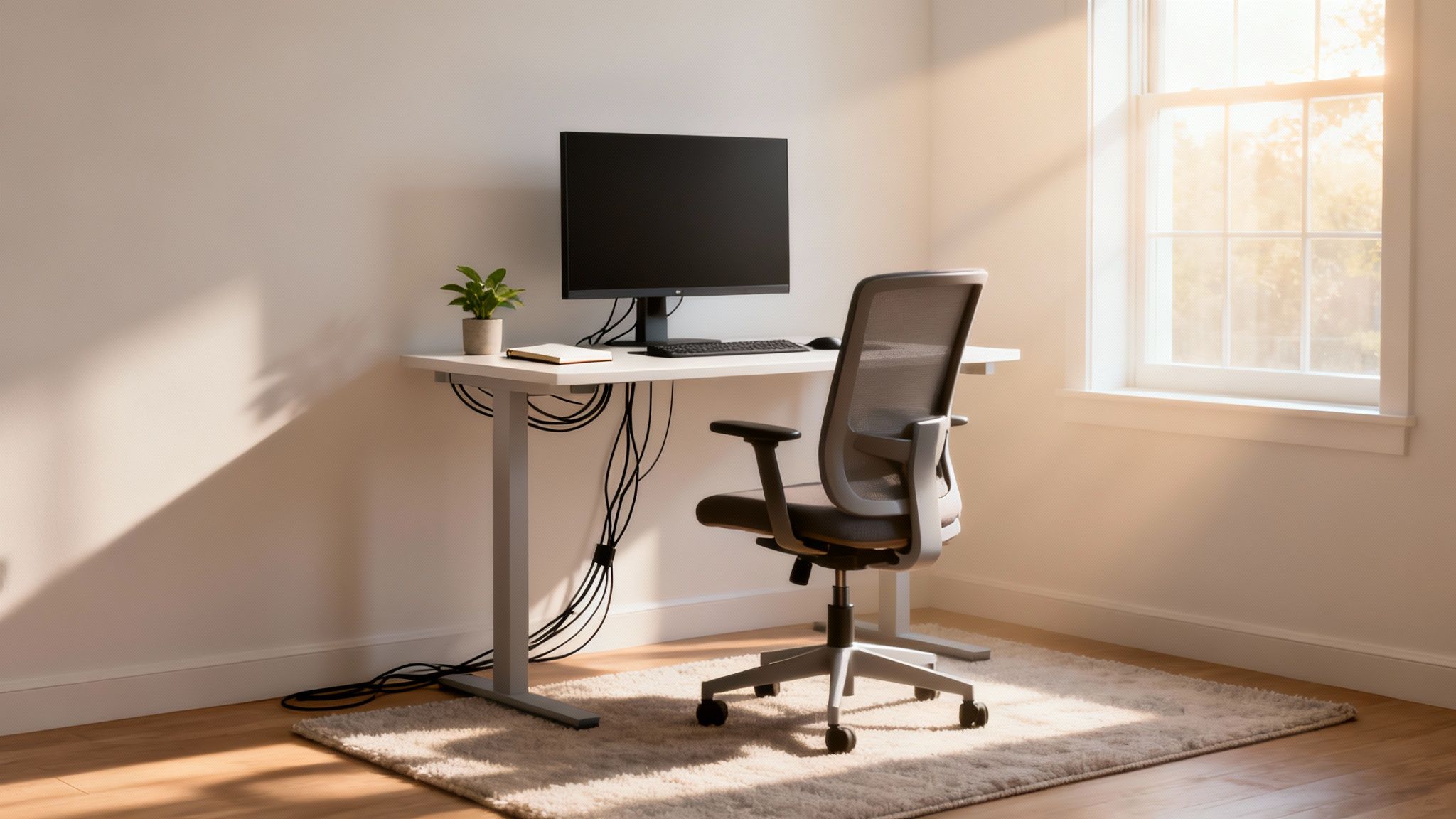
A great home workspace is so much more than just a desk and a chair. Think of it as your personal command centre, engineered for focus, productivity, and your physical wellbeing. Setting up a space that actually supports your work isn't an indulgence; it's a fundamental part of a successful career from home.
The right setup helps you create a clean mental break between your job and your personal life, even when they're under the same roof. It sends a clear signal to your brain: when you're here, it's time to concentrate. This simple shift helps you be more effective during work hours and, just as importantly, lets you properly switch off afterwards.
Creating an Ergonomic Workspace
Ergonomics might sound technical, but it’s really just about making your workspace fit you, not forcing yourself to fit your workspace. A proper setup is your best defence against the nagging back pain, neck strain, and sore wrists that can easily creep in after hours of sitting.
The goal is to hold a neutral posture. This means your feet are flat on the floor, your knees are bent at a roughly 90-degree angle, your back is properly supported, and your wrists are straight when you type. Simple.
A classic mistake is to focus only on the chair. An ergonomic setup is a whole system where your chair, desk, and monitor all work together to support a healthy posture all day long.
To get this right, you'll want to pay attention to a few key pieces:
- The Right Chair: Look for one with adjustable height, backrest, and armrests. Good lumbar support that follows the natural curve of your lower back is absolutely non-negotiable.
- Monitor Height: The top of your screen should be at or just slightly below your eye level. You shouldn't have to crane your neck up or tilt your head down to see it clearly. If you’re on a laptop, an external monitor or a laptop stand is a must-have.
- Desk Depth: Make sure you have enough room to place your keyboard and mouse comfortably, which allows your forearms to rest without any strain.
Carving Out a Distraction-Free Zone
Let's be real—not everyone has a spare room to convert into a dedicated office. True Kiwi ingenuity shines when you have to create a professional, distraction-free zone, no matter how much space you're working with.
The secret is establishing clear physical and mental boundaries. If you’re set up in the corner of the living room or kitchen, use visual cues to define your "work territory." This could be a small rug under your desk, a portable screen, or even a specific lamp that you only switch on during work hours. These simple signals help you and others in your household respect the space as a place for work.
For more inspiration on keeping things tidy and functional, check out these brilliant home office organizing ideas.
Choosing Your Tech Essentials
Your technology is the true backbone of your remote work setup. Reliable gear isn't a luxury; it’s what prevents those frustrating interruptions and keeps you connected and productive.
Start with your internet. For most city dwellers, Fibre is going to be your best bet, offering fast speeds and stable performance. If you're out in a rural area, it's worth investigating Rural Broadband options or even satellite internet to make sure you have enough bandwidth for video calls and shifting large files.
Next, get your hardware sorted:
- A Reliable Computer: Choose a machine that can handle your daily grind without lagging or freezing up.
- An External Monitor: A second screen can be a game-changer for productivity, giving you much more digital real estate to work with.
- A Quality Headset: A good pair of noise-cancelling headphones is crucial for blocking out household noise during important meetings.
- An External Keyboard and Mouse: These allow for a much more ergonomic setup than wrestling with a laptop's built-in trackpad and keyboard.
Investing in these core components will give you a professional foundation that lets you perform at your best, no matter where your "office" happens to be.
Thriving Personally and Professionally
Let’s be honest: the hardest part of working from home often isn't the work itself. It’s figuring out how to manage your own time and wellbeing when your home is also your office. Real, long-term success in a remote role isn’t about just getting the job done; it's about building sustainable habits that keep you productive without letting burnout sneak in.
The first domino to fall is usually your schedule. When the daily commute and rigid office hours vanish, your day can quickly feel like one long, shapeless blob of time. This is where you need to get deliberate. A bit of planning will be your best friend for both focus and sanity.
Mastering Your Day with Time Blocking
One of the most powerful ways to bring structure back into your day is a simple technique called time blocking. Forget your basic to-do list. Instead, you'll assign every single task a specific slot in your calendar, essentially making appointments with yourself to get things done.
This isn’t just about organising your list; it forces you to be realistic about what you can actually accomplish. By carving out dedicated blocks for your most important work, you fence off your focus and make it much harder for distractions and notifications to pull you away. It's a game-changing shift from being reactive to proactively owning your day.
Time blocking isn’t about being rigid for the sake of it—it’s about being intentional. When you decide in advance what you’ll work on and when, you free up so much mental energy to just do the work, instead of constantly asking yourself, "what's next?"
Creating Firm Boundaries
When your living room doubles as your office, the line between your work life and personal life can get incredibly blurry. If you want to stay sane long-term, setting firm boundaries is absolutely non-negotiable. Without them, your workday will bleed into your evenings, then your weekends, and before you know it, you're always on the clock.
Here are a few practical ways to build that healthy separation:
- Define Your Work Hours: Stick to a consistent schedule as much as you can. When your day is done, it’s done. Shut the laptop and physically step away from your desk.
- Create a "Shutdown" Ritual: A simple routine can signal to your brain that the workday is officially over. This might be tidying your desk, planning tomorrow's to-do list, or just heading out for a quick walk around the block.
- Communicate Your Availability: Make sure your colleagues and clients know when you’re online and when you're not. Critically, turn off work notifications on your phone outside of these hours to reclaim your personal time.
Staying Connected and Combating Isolation
While the peace and quiet of a home office can be great for deep focus, it can also get pretty lonely. You have to be proactive about staying connected, not just for your mental health, but for your career too. Don't just wait for project meetings; schedule regular video calls with your team just to chat and catch up. It’s the closest thing to those spontaneous "water cooler" moments.
And this deliberate effort to connect and stay productive is really paying off here in New Zealand. Recent data from the public service, for instance, showed that for 49% of managers, having staff work from home either boosted productivity or had no negative impact at all. With 65% of public servants now using flexible work arrangements, it's clear Kiwi organisations are embracing this new way of working. You can read more about these findings on remote work productivity in NZ.
Getting these habits right is a continuous process. To dig deeper into building a successful remote career, check out our guide on how to start thriving remotely and turbocharge your career from home.
Your Top Questions About Remote Work in NZ
Diving into the world of working from home can definitely bring up a few questions. To help clear things up, here’s a quick rundown of the most common queries we see from Kiwis, reinforcing some of the key takeaways from this guide.
What Are My Rights if I Ask to Work From Home?
In New Zealand, you have a legal right to request flexible working arrangements, and that absolutely includes working from home. Once you put in a request, your employer has to take it seriously and give you a written answer within one month.
They can’t just say no for the sake of it. An employer can only decline your request for specific, recognised business reasons—like if it would genuinely hurt performance or if it’s impossible to shuffle work around the team. They need a valid justification.
Is My Employer Responsible for My Home Office Safety?
Yes, they absolutely are. Your employer's duty of care, as laid out in the Health and Safety at Work Act 2015, doesn't stop at the office door. It extends right into your home office. They need to take reasonable steps to make sure your workspace is safe and won't put your health at risk.
This is usually a team effort. You’ll likely be asked to fill out a self-assessment checklist to spot any potential hazards, from a dodgy ergonomic setup to trip hazards, making sure your home is a safe and sound place to work.
How Do I Claim Expenses for My Home Office?
This one really comes down to your employment status.
- For Employees: Generally, you can't claim home office expenses yourself. Your employer is on the hook for providing the gear you need to do your job. If they give you an allowance for things like internet or power, it's typically tax-free up to a certain point.
- For Contractors: It's a different story here. As a self-employed person, you can claim a portion of your household running costs as business expenses. This includes a percentage of your rent, power, internet, and insurance, all based on how much of your home you use for work.
How Can I Avoid Feeling Isolated When Working Remotely?
Feeling a bit disconnected is one of the most common hurdles of working from home, but it’s something you can manage with a bit of effort. Make a point of scheduling regular, informal video calls with your colleagues that aren't just about ticking off work tasks.
Staying connected requires intention. Replicating those spontaneous office chats helps maintain team bonds and a sense of belonging, which are vital for both your wellbeing and career progression.
It also pays to get out of the house. A short walk after you clock off for the day doesn't just create a mental break; it gives you a change of scenery and a chance for a bit of social interaction outside your work bubble.
Ready to build the practical skills you need for your career or side hustle? Prac Skills offers a range of online courses designed for busy Kiwis. Gain market-ready skills with flexible, self-paced learning. Start a free lesson today and see where Prac Skills can take you.