
February 2, 2026
.webp)

Your Ultimate Guide to Finding the Right Project Management Course
Discover the different types of project management course options, from Agile to PMP, and learn how to choose the right training to advance your career.
Practical Skills
minutes
Diving into project management can feel like a massive career change, but a great project management course is your most direct route to getting it right. Don't think of it as just a string of lessons; see it as a roadmap for mastering the tools, methods, and people skills you need to take a project from a rough idea to a successful reality. And trust me, those skills are in hot demand all over New Zealand.
Starting Your Journey in Project Management
Embarking on a journey into project management is a real investment in your future. It opens doors to leadership roles in pretty much every industry you can think of. Whether you're coordinating a tech rollout in Auckland's bustling CBD or overseeing a construction project down in Christchurch, the ability to juggle resources, time, and teams is an incredibly powerful asset.
This guide is here to help you get your head around the training landscape in NZ, from hands-on workshops to formal certifications. We'll show you how to navigate all the options and give you a clear, friendly starting point for what can be a really dynamic and rewarding field.
Understanding the Modern Demand
Let's be clear: the need for skilled project managers has never been greater. Projects are what drive businesses forward, and they need confident leaders calling the shots. Taking a course gives you a proven framework for tackling complex problems, making sure you can deliver results on time and on budget. This is about more than just learning buzzwords; it's about building genuine, practical confidence.
The learning options here in New Zealand have really expanded to meet this demand. Between 2019 and 2024, the country saw a big jump in project management study options, with universities and other institutions launching specialised courses. We’ve also seen a huge rise in online and short courses designed for working professionals who need to upskill without putting their careers on hold.
Why a Practical Course Is Key
While a formal qualification definitely has its place, many Kiwi employers are now looking for candidates with hands-on, job-ready skills. This is exactly where a practical project management course shines. It cuts to the chase, focusing on how to actually use proven methods and tools so you can walk into a new role and make an immediate impact.
A practical course bridges the gap between theory and action. It's about learning how to draft a project charter, manage a budget, and lead a team meeting—not just reading about it in a textbook.
These courses are built to be accessible and efficient. They give you a direct path to valuable skills without the long-term, high-cost commitment of a university degree. By exploring our range of practical courses, you can find a pathway that actually fits your career goals and your life.
Exploring Different Project Management Methodologies
The term 'project management' isn't a single, rigid discipline. It’s more like a builder’s van, packed with different toolkits for all sorts of jobs. Picking the right one is the first step to a successful project, and a good course will show you exactly how to choose and use each one.
The best methodology really depends on the project's goals, its industry, and how much change you can expect along the way. You wouldn’t use a sledgehammer to hang a picture frame, right? In the same way, you wouldn’t apply a strict, long-term plan to a fast-moving software update that needs to adapt on the fly.
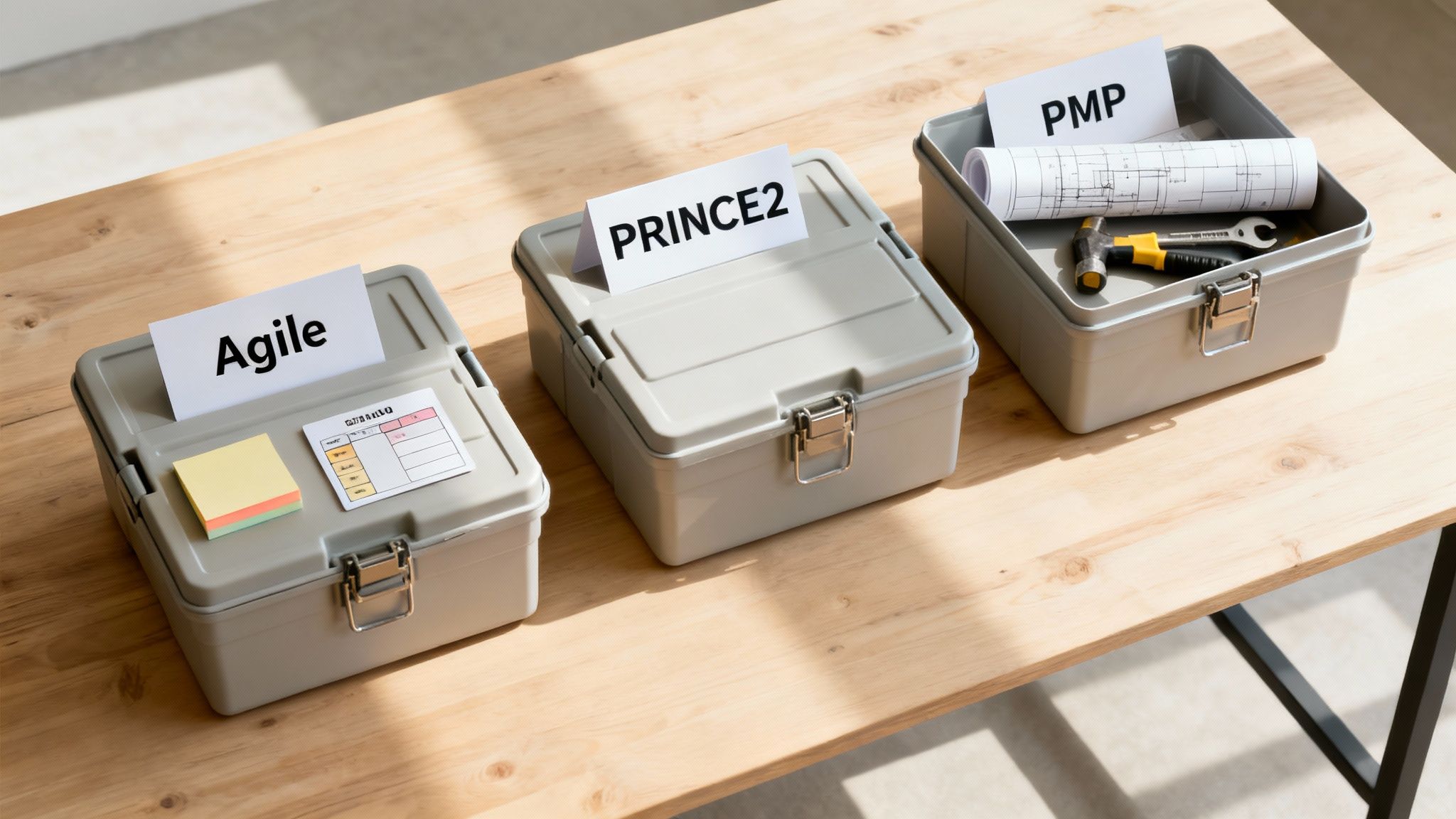
Getting to grips with these core approaches is crucial, especially since different industries across New Zealand tend to favour certain styles. Let's open up a few of these toolkits and have a look inside.
The Adaptable Toolkit: Agile
Think of Agile as the modern, versatile toolkit that’s perfect for projects where the final outcome might need to evolve. It’s hugely popular in New Zealand's booming tech and creative sectors for this very reason. Instead of mapping out one massive plan from the start, Agile breaks work down into small, manageable cycles called “sprints.”
This approach lets teams adapt quickly to feedback and shifting requirements. It’s all about collaboration, customer input, and being flexible rather than getting bogged down in rigid documentation.
Key features of Agile include:
Iterative Progress: Projects are built piece by piece, allowing for regular testing and tweaks.
Customer Collaboration: Stakeholders are part of the journey, ensuring the final product is what they actually need.
Flexibility: Changes are welcomed, even late in the game, to deliver the best possible result.
The Architect's Blueprint: PRINCE2
If Agile is the flexible toolkit, then PRINCE2 (Projects IN Controlled Environments) is the detailed architect's blueprint. It's a highly structured, process-driven method that gives you a clear, step-by-step framework for every single stage of a project.
You’ll see this approach widely used in government, construction, and large corporate projects across New Zealand—places where predictability and tight control are non-negotiable. PRINCE2 defines clear roles, responsibilities, and processes, making sure nothing is left to chance.
The Global Standard: PMP Concepts
The Project Management Professional (PMP) isn't a methodology like Agile or PRINCE2. Instead, it’s a globally recognised standard of excellence. Courses aligned with PMP principles teach a broad set of knowledge areas based on the official Project Management Body of Knowledge (PMBOK® Guide).
This framework covers the entire project lifecycle, from kicking things off and planning to execution, monitoring, and finally, closing the project. It provides a common language and a set of best practices that can be applied to almost any project, in any industry. Gaining skills based on these principles signals a deep, well-rounded understanding of the profession.
Every project brings its own unique challenges, so it's handy to see how these methodologies stack up against each other.
Comparing Popular Project Management Methodologies
Ultimately, a project manager's real skill isn't just mastering one methodology but knowing which one to pull out of the van for a specific challenge.
The best training gives you more than just the tools; it equips you with the judgment to know when and how to use them effectively.
The Rise of Practical Skills Training
Beyond these big-name frameworks, there’s a growing demand for practical, skills-based training. While methodologies tell you the 'what' and 'why', this type of training drills down into the 'how'. It focuses on getting you job-ready with competencies like using specific software, running an effective team meeting, or putting together a proper risk assessment.
This approach is perfect for people who need to get valuable skills on their CV quickly, without committing to a long and expensive certification. Many employers in New Zealand value this hands-on ability because it means you can start adding value from day one. These courses aren’t about deep academic theory; they're about building the confidence and competence to get the job done right.
How to Choose the Right Project Management Course for You
Picking the perfect project management course can feel like you're staring at a departure board with a dozen different destinations. It’s overwhelming. To cut through the noise, it helps to have a simple framework for making your decision, focusing on the factors that actually matter for your career.
Let's break down how to compare the different programmes out there, from intensive bootcamps to more flexible online options, so you can find a path that genuinely fits your life and your goals.
Balancing Time Commitment and Cost
Your two most valuable resources are your time and your money, so finding a course that respects both is non-negotiable. The options across New Zealand vary wildly, from multi-year university degrees to shorter, punchier training courses.
Formal academic qualifications are a serious investment. In New Zealand, a postgraduate project management qualification can set you back anywhere from NZ$16,000 to over NZ$50,000 per year. The time commitment is just as significant, ranging from a one-year master's degree to part-time options that stretch out over two or three years.
On the other hand, skills-focused bootcamps and online courses offer a much more direct—and affordable—route. They’re built for professionals who need to get job-ready skills fast, without the massive financial and time commitments of a traditional degree.
Finding Your Ideal Learning Format
How you actually learn best is a huge piece of the puzzle. The right format can be the difference between thriving and just surviving a course. It pays to be honest with yourself about what works for you. You can dig into this a bit more by exploring the differences between active vs passive learning methods.
Here’s a quick rundown of the most common formats you'll see:
Immersive In-Person Workshops: These are brilliant for hands-on, collaborative learning. You get to network with your peers and get instant feedback from instructors.
Self-Paced Online Modules: The go-to for busy professionals. This format gives you total flexibility to study whenever and wherever you can squeeze it in around your existing commitments.
Blended Learning: This hybrid model gives you the best of both worlds—the flexibility of online study combined with the occasional in-person or live virtual session for that crucial human interaction and support.
The best learning format isn't about which one is "better" in general. It's about which one is better for you. A frank look at your schedule and how you prefer to learn will point you straight to the right answer.
Academic Qualifications vs Industry-Focused Training
It's really important to get your head around the difference between a formal academic qualification and practical, industry-focused training. A university degree gives you a deep theoretical grounding and is recognised within the academic world.
But let’s be real: many employers today are looking for people who can hit the ground running with practical, applicable skills from day one. This is where industry-focused training providers like Prac Skills come in. To be clear: we are not an NZQA registered college. Our mission is different.
We specialise in teaching the specific, hands-on skills that Kiwi employers are crying out for. Our courses are designed to be practical, efficient, and immediately relevant to the workplace, helping you build a portfolio that proves you can do the job. To get a better feel for what the industry values, it's worth checking out a list of the best project management certification programs to see how they align with what employers are looking for.
Evaluating Assessment Styles
Finally, think about how you want your learning to be measured. This can have a huge impact on your experience and what you ultimately walk away with.
Exam-Based Certifications: These are standard for formal methodologies like PMP or PRINCE2. They test your knowledge of a specific framework and give you a recognised credential at the end.
Portfolio-Based Assessments: This style is all about applying what you've learned to projects that mimic the real world. You might be asked to create a project charter, build a risk management plan, or put together a complete project proposal.
This portfolio approach is fantastic because it gives you tangible proof of your abilities—something you can actually show to potential employers. It proves you don't just know the theory; you know how to put it into practice. Choosing a course with an assessment style that lines up with your career goals is one of the smartest moves you can make.
Translating Training Into Career Outcomes
Finishing a project management course is about so much more than getting a certificate to hang on the wall. It’s about turning that fresh knowledge into real-world career momentum. The true value is in how your training arms you with the high-demand skills Kiwi employers are actively looking for, opening doors to better jobs and bigger paycheques.
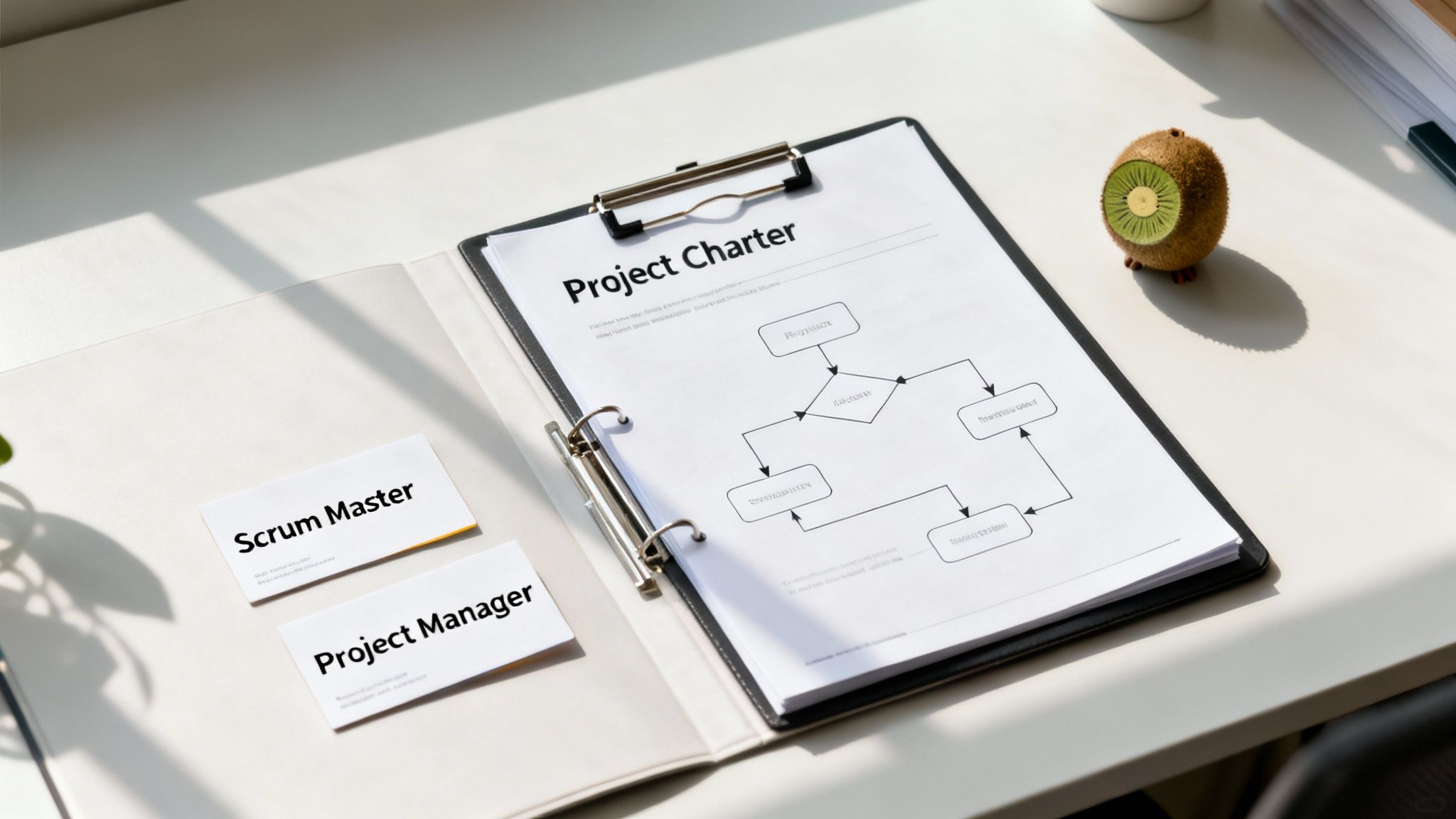
This is where the theory you’ve learned gets its hands dirty and meets the practical demands of the job market. You’re not just learning concepts; you’re building a professional toolkit you can use from day one.
From High-Value Skills to High-Value Roles
A quality, practical-focused course builds skills that are immediately useful. Instead of just memorising definitions, you learn how to actually do the core tasks of a project leader.
These skills are the bridge between your training and your next job title:
Strategic Risk Management: You’ll learn to spot potential roadblocks long before they can derail a project—a critical skill for keeping things on track and on budget.
Stakeholder Communication: This is all about mastering the art of keeping everyone, from the CEO down to the delivery team, informed, aligned, and engaged.
Budget Forecasting: You’ll get good at creating realistic budgets, tracking every dollar, and making sure projects deliver value without blowing the bank.
Agile Resource Allocation: This teaches you how to assign tasks and manage your team’s capacity effectively, especially in fast-moving environments where priorities can change in a heartbeat.
These practical skills map directly to sought-after roles right here in New Zealand. A solid foundational course can set you up for a Project Coordinator role, where salaries typically sit between $65,000 to $85,000. If you specialise in Agile, you could step into a Scrum Master position, often earning between $110,000 and $140,000.
As you build up experience, a full Project Manager role can command a salary of $120,000 to $170,000 or even more, depending on the industry and how complex the projects are.
What a Practical Curriculum Looks Like
To get a better idea of how training builds these skills, let’s peek inside a typical curriculum that’s focused on practical results. It’s usually structured to follow the real lifecycle of a project, making sure you learn in a logical, step-by-step way.
A course might be broken down into these core modules:
Project Initiation: This is where you learn to define a project’s purpose, goals, and stakeholders to create a rock-solid foundation.
Project Planning: Here, you’ll build a detailed roadmap, covering scope, timelines, budget, and who’s doing what.
Project Execution: This module is about managing the day-to-day work, leading the team, and keeping communication flowing smoothly.
Monitoring and Closure: Finally, you'll learn to track progress against the plan, handle changes, and formally wrap up the project once it’s done.
This structure ensures you’re not just memorising facts but are actually internalising a repeatable process for success. To really turn your training into career wins, think about how a structured employee training plan template can help guide your ongoing professional development.
A Hands-On Assessment Example
The best way to make learning stick is by doing. A great practical assessment goes way beyond multiple-choice questions and asks you to apply your skills to a realistic scenario. This is how you build a portfolio that proves what you can do.
Assessment Scenario: The Kiwi Startup Launch
Imagine you’re asked to create a complete project charter for a new eco-friendly packaging startup based in Wellington. Your assessment would require you to define the project’s objectives, identify key stakeholders (like investors, suppliers, and the marketing team), outline the scope, create an initial budget, and map out potential risks.
This kind of hands-on task proves you can think like a project manager and deliver real value from your very first day on the job. It’s this focus on practical application that truly makes a difference.
And the proof is in the numbers. Vocational project management courses in New Zealand have great job placement rates. For instance, the New Zealand Certificate in Project Management reports an employment rate of 67% two years after study, targeting key skills for sectors like construction, IT, and business. This shows a clear link between targeted training and getting a great job.
Why Practical Training Is Your Career Accelerator
In a competitive job market, what you can do often speaks louder than what you know in theory. While a solid academic foundation is great, employers across New Zealand are crying out for people who can hit the ground running and deliver results from day one.
This is where practical, industry-focused training becomes your secret weapon.
Think of it like learning to be a chef. You can read every cookbook on the shelf, memorise every recipe, and watch every cooking show. But until you actually step into a kitchen, feel the heat, chop the vegetables, and learn to time everything perfectly, you're not a chef. A practical project management course puts you right in that kitchen. It's about doing, not just knowing.
Bridging the Gap Between Knowing and Doing
Traditional education is brilliant at explaining the 'what' and 'why' of project management. Practical training, on the other hand, is obsessed with the 'how'. It’s built to close that crucial gap between understanding a concept, like risk management, and actually sitting down to build a risk register for a real-world project.
This hands-on approach means you can make an immediate impact. Employers love candidates with this kind of experience because it means less hand-holding and a faster return on their investment. They're looking for team members who can confidently step in to manage a budget, communicate with stakeholders, and steer a project toward the finish line.
We’re not a traditional academic institution. Our focus is on targeted, practical training designed to give you job-ready skills that move your career forward—without the huge investment of time and money.
Learning from People Who've Been There
One of the biggest differences with practical training is who you're learning from. Our courses are run by industry veterans—people who have spent years in the trenches managing real projects right here in New Zealand. They don't just teach from a textbook; they share firsthand stories, hard-won lessons, and invaluable local insights.
This means you’re not just learning generic theory. You’re working through case studies that reflect the reality of launching a tech product in Auckland or managing an agricultural project in Canterbury. That local context makes everything you learn instantly more relevant and applicable.
Building a Portfolio That Proves What You Can Do
A certificate looks good on your CV, but a portfolio of your actual work is undeniable proof of your skills. Practical training is designed around assessments that help you build exactly that. Instead of cramming for an exam, you’ll complete tasks that mirror what you’d be doing in a real job.
For example, you might be asked to:
Develop a complete Project Charter for a hypothetical Kiwi startup, forcing you to define the scope, objectives, and stakeholders from scratch.
Create a Stakeholder Communication Plan to manage the expectations of everyone involved in a community project.
Build a detailed Project Budget for a small business expansion and justify every single line item.
When you finish these tasks, you walk away with tangible evidence of your abilities to show potential employers. It completely changes the conversation in a job interview from, "I know about project charters," to, "Here’s a project charter I developed..." That shift is incredibly powerful and is often what makes a hiring manager choose you over someone else.
The success of this approach shines through in our students' experiences. You can see how this practical focus has helped others fast-track their careers by reading our student testimonials.
Ultimately, a practical project management course is an investment in your ability to perform. It makes you a more confident, capable, and valuable professional in the New Zealand job market.
Got Questions About Project Management Courses? We've Got Answers
Stepping into the world of project management is a big move, and it's completely normal to have a few questions before you commit to a course. To help you feel confident in your decision, we've rounded up some of the most common queries we hear from aspiring project managers across New Zealand.
Think of this as the final piece of the puzzle. We’re here to clear up any lingering doubts so you can move forward with certainty. Let’s dive in.
Do I Need a Degree to Become a Project Manager in New Zealand?
Not necessarily. While some senior or highly specialised roles might list a university degree as a preference, it's far from a hard-and-fast rule in the New Zealand job market. In fact, many of the most successful project managers build their careers on a solid foundation of practical experience, topped off with targeted, industry-recognised training.
Skills-based courses that focus on specific methodologies like Agile or PRINCE2 are incredibly well-respected by employers. Why? Because they prove you have job-ready skills that you can put to use from day one. They show you know how to do the work, not just talk about it in theory.
For most people, especially those looking to switch careers or upskill quickly, a practical project management course is a much faster and more cost-effective way into the profession. At the end of the day, it's all about demonstrating your competence, and focused training is one of the best ways to do just that.
What Is the Real Difference Between Agile and PRINCE2?
It's helpful to think of them as two different toolkits for two very different jobs. Neither one is "better" than the other; it all comes down to the nature of the project and the industry you're in.
Imagine you're building a new software application. The requirements will almost certainly change as you get user feedback. For this, you’d reach for Agile. It's an adaptable, flexible framework that works in short cycles called 'sprints'. This approach allows for constant feedback and adjustments, making it perfect for dynamic environments like software development or creative marketing campaigns.
Now, picture building a new bridge. You need a highly detailed, predictable plan with very little room for error or change. That’s where PRINCE2 shines. It’s like a comprehensive architect's blueprint—incredibly structured, with clearly defined stages, roles, and documentation. It provides the control and predictability essential for large-scale projects in sectors like construction or government infrastructure.
Of course, many Kiwi companies now use a hybrid approach, blending the rock-solid structure of PRINCE2 with the flexibility of Agile to get the best of both worlds.
How Long Does It Take to Complete a Project Management Course?
The timeline can vary dramatically depending on the path you choose. A formal university degree is a significant commitment, often taking one to two years of full-time study.
On the other hand, practical, skills-focused training is designed to be much more direct and efficient. An intensive course focusing on a specific methodology can often be wrapped up in just a few days or weeks, giving you valuable credentials in a fraction of the time.
Online micro-credentials and skills-based courses offer even more flexibility, allowing you to learn at your own pace over several months while juggling your job and personal life.
The right choice really depends on your immediate goal. If you need a formal academic qualification for a specific career path, then you're in for a longer journey. But if you want to gain job-ready skills quickly to land a new role or a promotion, a short, intensive course is almost always the fastest route.
Are Online Project Management Courses as Effective as In-Person Ones?
Absolutely. In fact, for many working professionals in New Zealand, a high-quality online course isn't just as effective—it's often a much better fit for their lifestyle. Modern online learning has evolved far beyond passively watching pre-recorded lectures.
Today’s best online programmes are highly interactive and feature:
Live Virtual Classrooms: Engaging, real-time sessions where you can interact directly with instructors and your classmates.
Interactive Workshops: Hands-on activities that help you apply what you're learning straight away.
Collaborative Group Projects: Opportunities to work with other students, just like you would in a real-world project team.
Direct Access to Experts: Channels to ask questions and get personalised feedback from industry veterans who have been there and done that.
The key benefit, of course, is flexibility. You can fit your studies around your existing work and family commitments without a daily commute. The secret is to choose a provider that fosters an engaging and supportive online community. Look for courses with practical assessments and plenty of opportunities for interaction to ensure you get a learning experience that is every bit as valuable as an in-person one.
Ready to turn your ambition into action? At Prac Skills, we offer practical, career-focused courses designed specifically for New Zealanders. Our training is built to give you the job-ready skills you need to succeed, with flexible online learning that fits your life.
Explore our courses and start your project management journey today!